QUESTION IMAGE
Question
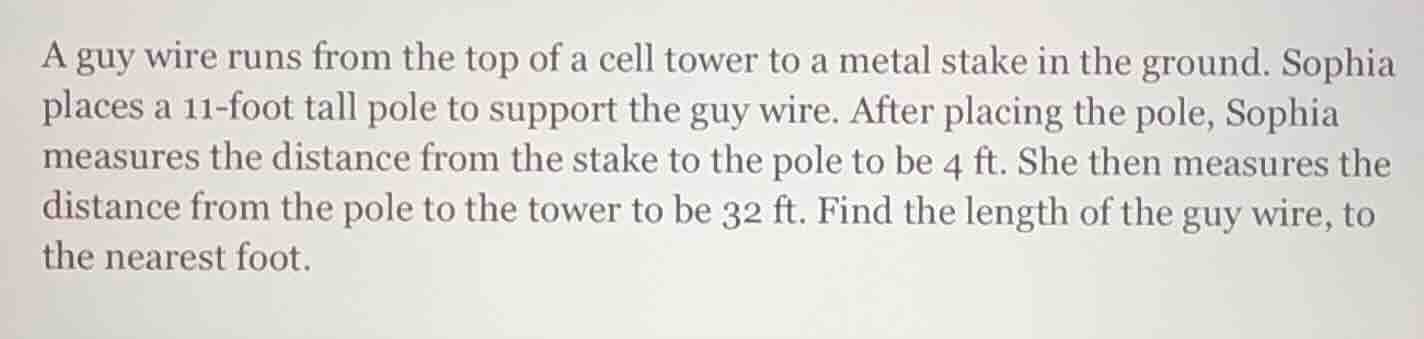
a guy wire runs from the top of a cell tower to a metal stake in the ground. sophia places a 11-foot tall pole to support the guy wire. after placing the pole, sophia measures the distance from the stake to the pole to be 4 ft. she then measures the distance from the pole to the tower to be 32 ft. find the length of the guy wire, to the nearest foot.
Step1: Determine horizontal distance from stake to tower
The distance from the stake to the pole is 4 ft, and from the pole to the tower is 32 ft. So the total horizontal distance from the stake to the tower is \(4 + 32=36\) ft.
Step2: Determine vertical height of the tower (with the pole's help)
The pole is 11 - foot tall, and we can consider the similar triangles or the right - triangle formed by the guy wire, the ground, and the tower. The vertical height of the tower above the pole's top? Wait, actually, we can think of the right triangle where the horizontal leg is 36 ft (from stake to tower) and the vertical leg is the height of the tower. But since the pole is 11 - foot tall and we can assume that the triangle formed by the guy wire, the ground from stake to tower, and the tower is a right triangle, and also the small triangle formed by the part of the guy wire above the pole, the pole, and the distance from pole to tower is similar. But an easier way: The horizontal distance from stake to tower is \(x = 4+32 = 36\) ft. Let the height of the tower be \(h\). We can use similar triangles. The ratio of the height of the pole to the distance from stake to pole should be equal to the ratio of the height of the tower to the distance from stake to tower. So \(\frac{11}{4}=\frac{h}{36}\), then \(h=\frac{11\times36}{4}=99\) ft.
Step3: Use Pythagorean theorem to find the length of the guy wire
The guy wire forms the hypotenuse of a right triangle with legs \(h = 99\) ft (height of tower) and \(x = 36\) ft (horizontal distance from stake to tower). By the Pythagorean theorem, \(l=\sqrt{h^{2}+x^{2}}\), where \(l\) is the length of the guy wire. So \(l=\sqrt{99^{2}+36^{2}}=\sqrt{9801 + 1296}=\sqrt{11097}\approx105\) ft. Wait, maybe a better way: Wait, actually, the pole is used to support the guy wire, so we can think of two right triangles. The small right triangle has legs 4 ft (stake to pole) and 11 ft (pole height). The large right triangle has legs \((4 + 32)=36\) ft (stake to tower) and \(H\) (tower height). Since the triangles are similar, \(\frac{11}{4}=\frac{H}{36}\), so \(H = 99\) as before. Then the length of the guy wire \(L=\sqrt{99^{2}+36^{2}}=\sqrt{(9\times11)^{2}+(9\times4)^{2}}=9\sqrt{11^{2}+4^{2}}=9\sqrt{121 + 16}=9\sqrt{137}\approx9\times11.7047\approx105\) ft. Alternatively, we can also consider that the guy wire is the hypotenuse of a right triangle with horizontal component 36 and vertical component 99.

Snap & solve any problem in the app
Get step-by-step solutions on Sovi AI
Photo-based solutions with guided steps
Explore more problems and detailed explanations
105