QUESTION IMAGE
Question
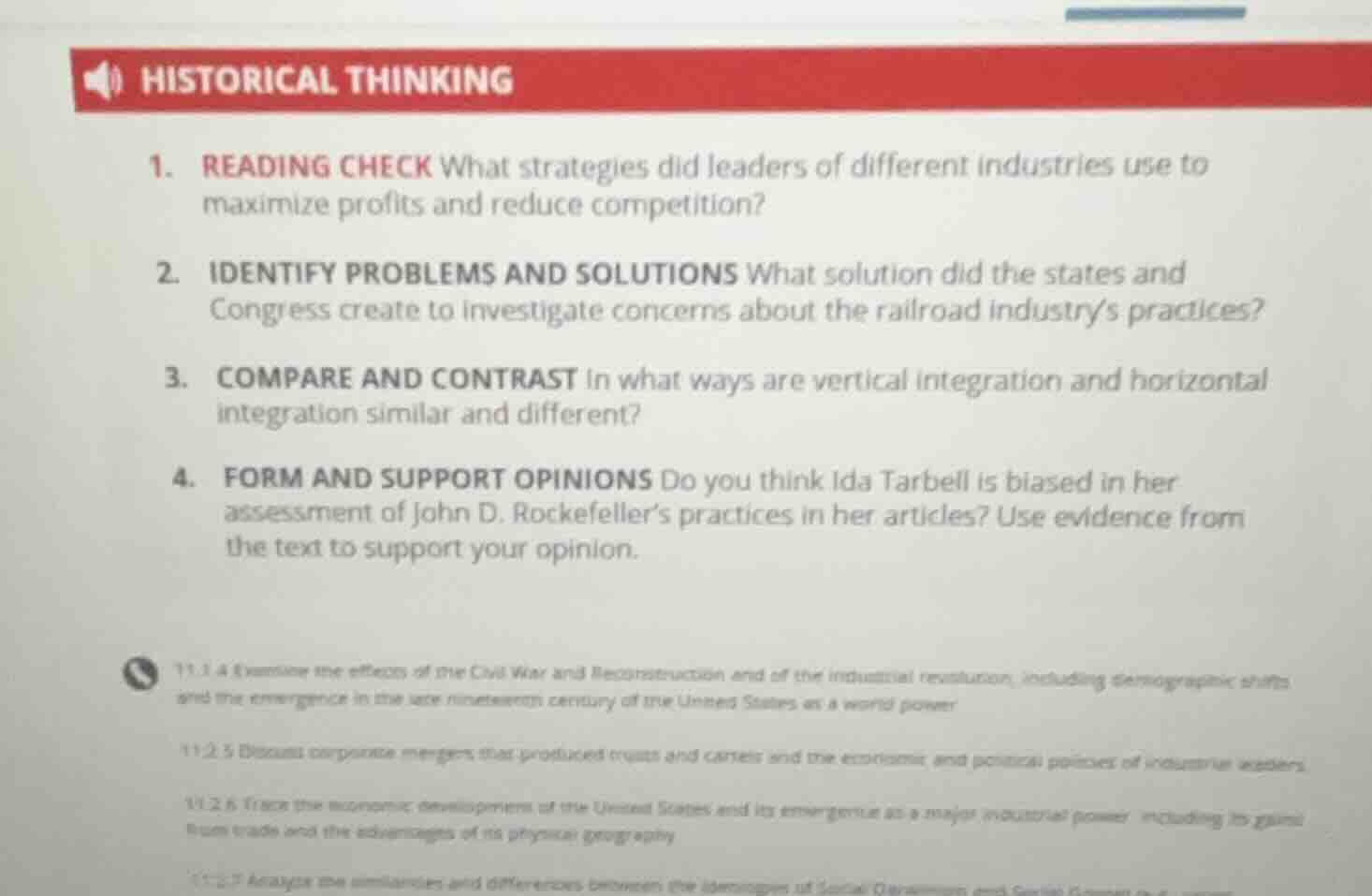
historical thinking
- reading check what strategies did leaders of different industries use to maximize profits and reduce competition?
- identify problems and solutions what solution did the states and congress create to investigate concerns about the railroad industry’s practices?
- compare and contrast in what ways are vertical integration and horizontal integration similar and different?
- form and support opinions do you think ida tarbell is biased in her assessment of john d. rockefeller’s practices in her articles? use evidence from the text to support your opinion.
11.1.4 examine the effects of the civil war and reconstruction and of the industrial revolution, including demographic shifts and the emergence in the late nineteenth century of the united states as a world power
11.2.5 discuss corporate mergers that produced trusts and cartels and the economic and political policies of industrial leaders
11.2.6 trace the economic development of the united states and its emergence as a major industrial power, including its gains from trade and the advantages of its physical geography
11.2.7 analyze the similarities and differences between the ideologies of social darwinism and gilded age
Question 1 (Reading Check)
Leaders in different industries used strategies like forming trusts (e.g., Standard Oil Trust), implementing horizontal integration (buying competing businesses) and vertical integration (controlling all stages of production), creating cartels, and using predatory pricing to drive out competitors. These methods helped maximize profits by reducing competition and gaining market control.
States and Congress created regulatory bodies and legislation. For the railroad industry, states established railroad commissions (like the Interstate Commerce Commission precursor at the state level), and Congress passed the Interstate Commerce Act (1887) to investigate and regulate railroad practices, addressing issues like unfair rates and discriminatory practices.
- Similarities: Both vertical and horizontal integration aim to increase a company's market power and profits. They reduce competition by either controlling more of the market (horizontal) or the supply chain (vertical). Both can lead to larger, more dominant corporations.
- Differences: Horizontal integration involves a company acquiring or merging with competitors (same stage of production, e.g., a steel company buying other steel companies). Vertical integration involves controlling different stages of production (e.g., a steel company buying iron mines, coal mines, and steel - finishing plants). Horizontal integration focuses on expanding within the same industry segment, while vertical integration focuses on the supply chain.

Snap & solve any problem in the app
Get step-by-step solutions on Sovi AI
Photo-based solutions with guided steps
Explore more problems and detailed explanations
Leaders used strategies such as forming trusts, horizontal integration (acquiring competing businesses), vertical integration (controlling all production stages), creating cartels, and predatory pricing to maximize profits and reduce competition.