QUESTION IMAGE
Question
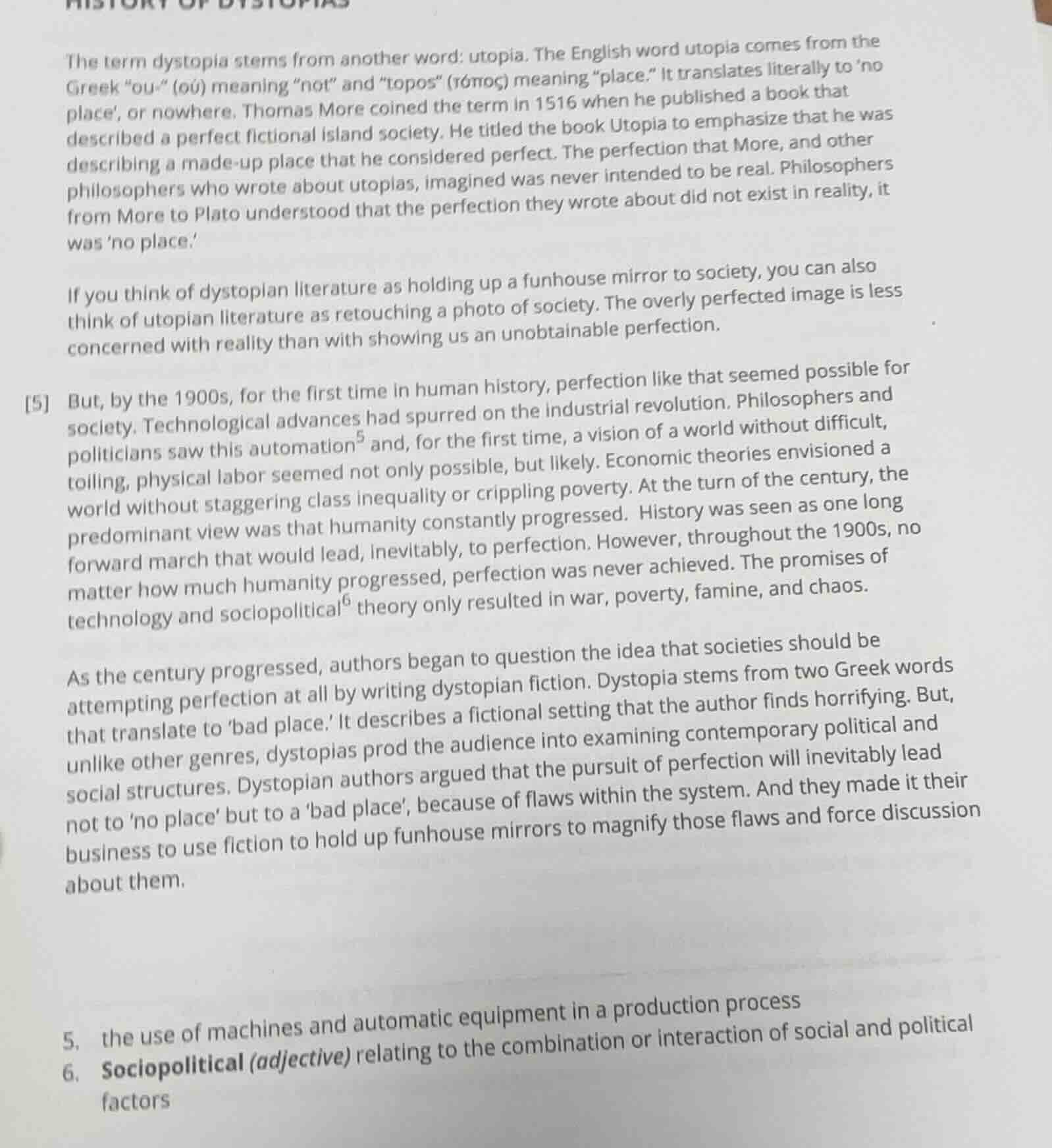
history of dystopias
the term dystopia stems from another word: utopia. the english word utopia comes from the
greek “ou-” (oú) meaning “not” and “topos” (τόπος) meaning “place.” it translates literally to ‘no
place’, or nowhere. thomas more coined the term in 1516 when he published a book that
described a perfect fictional island society. he titled the book utopia to emphasize that he was
describing a made - up place that he considered perfect. the perfection that more, and other
philosophers who wrote about utopias, imagined was never intended to be real. philosophers
from more to plato understood that the perfection they wrote about did not exist in reality, it
was ‘no place.’
if you think of dystopian literature as holding up a funhouse mirror to society, you can also
think of utopian literature as retouching a photo of society. the overly perfected image is less
concerned with reality than with showing us an unobtainable perfection.
5 but, by the 1900s, for the first time in human history, perfection like that seemed possible for
society. technological advances had spurred on the industrial revolution. philosophers and
politicians saw this automation⁵ and, for the first time, a vision of a world without difficult,
toiling, physical labor seemed not only possible, but likely. economic theories envisioned a
world without staggering class inequality or crippling poverty. at the turn of the century, the
predominant view was that humanity constantly progressed. history was seen as one long
forward march that would lead, inevitably, to perfection. however, throughout the 1900s, no
matter how much humanity progressed, perfection was never achieved. the promises of
technology and sociopolitical⁶ theory only resulted in war, poverty, famine, and chaos.
as the century progressed, authors began to question the idea that societies should be
attempting perfection at all by writing dystopian fiction. dystopia stems from two greek words
that translate to ‘bad place.’ it describes a fictional setting that the author finds horrifying. but,
unlike other genres, dystopias prod the audience into examining contemporary political and
social structures. dystopian authors argued that the pursuit of perfection will inevitably lead
not to ‘no place’ but to a ‘bad place’, because of flaws within the system. and they made it their
business to use fiction to hold up funhouse mirrors to magnify those flaws and force discussion
about them.
- the use of machines and automatic equipment in a production process
- sociopolitical (adjective) relating to the combination or interaction of social and political
factors
Since no specific question is provided about this text, it's not possible to give a targeted answer. If you have a question related to this passage, such as analyzing the concept of dystopia, the historical context of utopian/dystopian ideas, or the literary aspects of dystopian fiction, please clarify your question so that I can assist you.

Snap & solve any problem in the app
Get step-by-step solutions on Sovi AI
Photo-based solutions with guided steps
Explore more problems and detailed explanations
Since no specific question is provided about this text, it's not possible to give a targeted answer. If you have a question related to this passage, such as analyzing the concept of dystopia, the historical context of utopian/dystopian ideas, or the literary aspects of dystopian fiction, please clarify your question so that I can assist you.