QUESTION IMAGE
Question
homework: writing a recommendation to the econauts
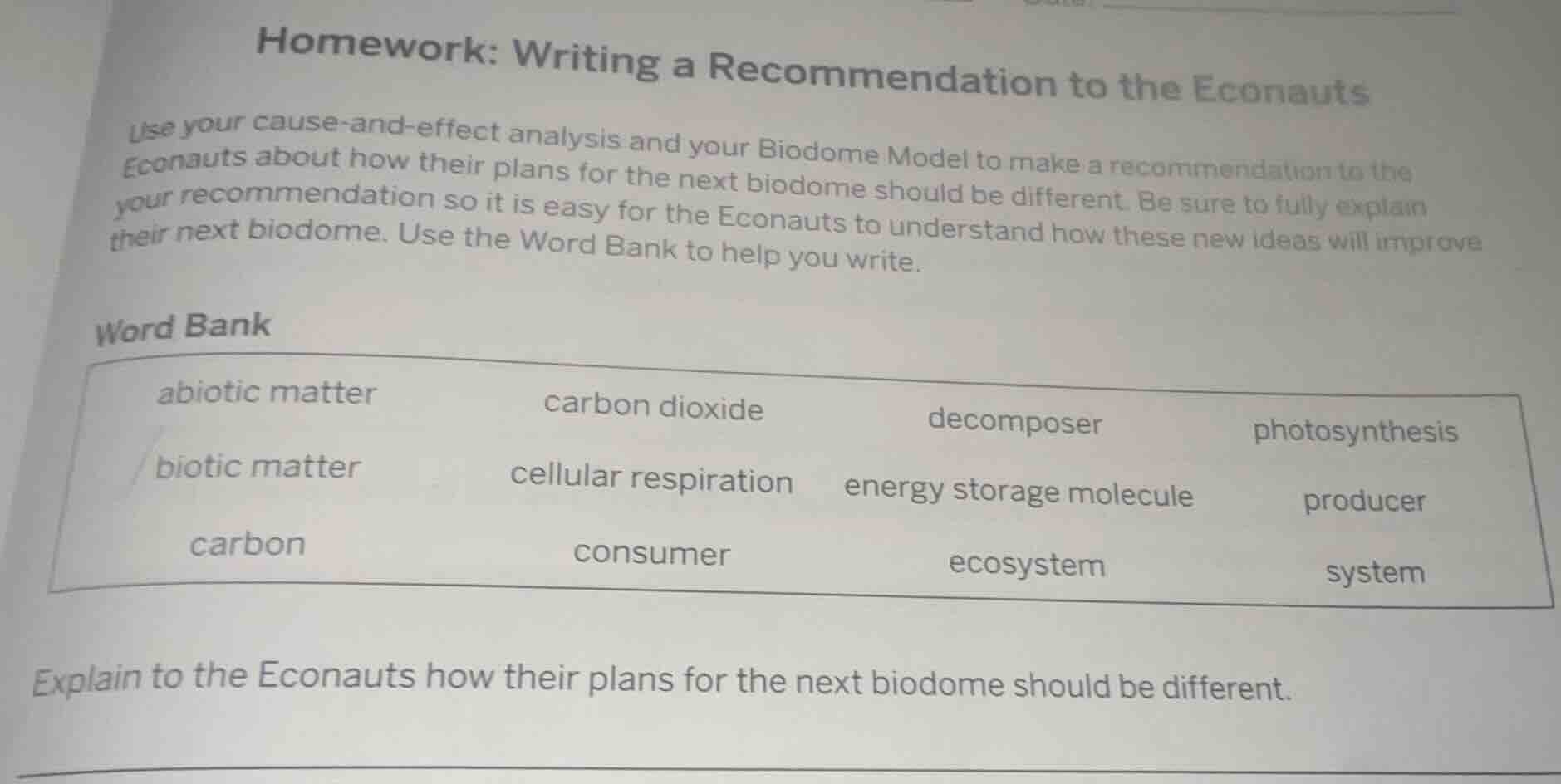
use your cause-and-effect analysis and your biodome model to make a recommendation to the econauts about how their plans for the next biodome should be different. be sure to fully explain your recommendation so it is easy for the econauts to understand how these new ideas will improve their next biodome. use the word bank to help you write.
word bank
abiotic matter carbon dioxide decomposer photosynthesis
biotic matter cellular respiration energy storage molecule producer
carbon consumer ecosystem system
explain to the econauts how their plans for the next biodome should be different.
To improve the next biodome, focus on balancing the carbon cycle and ecosystem interactions using the word bank terms:
- Boost producer diversity & photosynthesis: Add a wider range of producers (e.g., leafy plants, algae) to drive more $\text{photosynthesis}$, which converts $\text{carbon dioxide}$ into energy storage molecules while replenishing oxygen for the biodome.
- Add targeted decomposers: Include more decomposers to break down dead biotic matter, recycling carbon and nutrients back into the soil (abiotic matter) to feed producers, closing the ecosystem's nutrient loop.
- Balance consumers with producers: Limit the number of consumers to match the producer population, preventing overconsumption that would disrupt the food web and carbon flow via cellular respiration.
- Monitor the closed system: Track carbon levels, carbon dioxide concentrations, and organism populations to maintain a stable, self-sustaining ecosystem.

Snap & solve any problem in the app
Get step-by-step solutions on Sovi AI
Photo-based solutions with guided steps
Explore more problems and detailed explanations
Recommendation to the Econauts
To create a more stable, self-sustaining biodome, adjust your plans with these targeted changes:
- Expand producer variety and photosynthesis capacity: Introduce a mix of fast-growing leafy plants, aquatic algae, and native flowering producers. These organisms use photosynthesis to absorb excess carbon dioxide from the biodome air, convert it into energy storage molecules, and release oxygen—this will balance gas levels and provide a reliable food base for consumers.
- Integrate specialized decomposers: Add soil fungi and detritivorous insects as decomposers. These organisms break down dead biotic matter (like fallen leaves or uneaten food) and recycle carbon and nutrients back into abiotic matter (soil and water), which feeds producers and prevents waste buildup that could disrupt the ecosystem.
- Align consumer numbers with producers: Scale back the consumer population to match the energy output of your producers. Too many consumers will overeat producers, reducing photosynthesis and increasing carbon dioxide release via cellular respiration, which unbalances the closed system's gas and energy flow.
- Implement carbon cycle monitoring: Track carbon levels in abiotic matter, biotic matter, and the air to ensure the carbon cycle remains steady. This will help you adjust populations or resources to keep the biodome's ecosystem self-sustaining long-term.