QUESTION IMAGE
Question
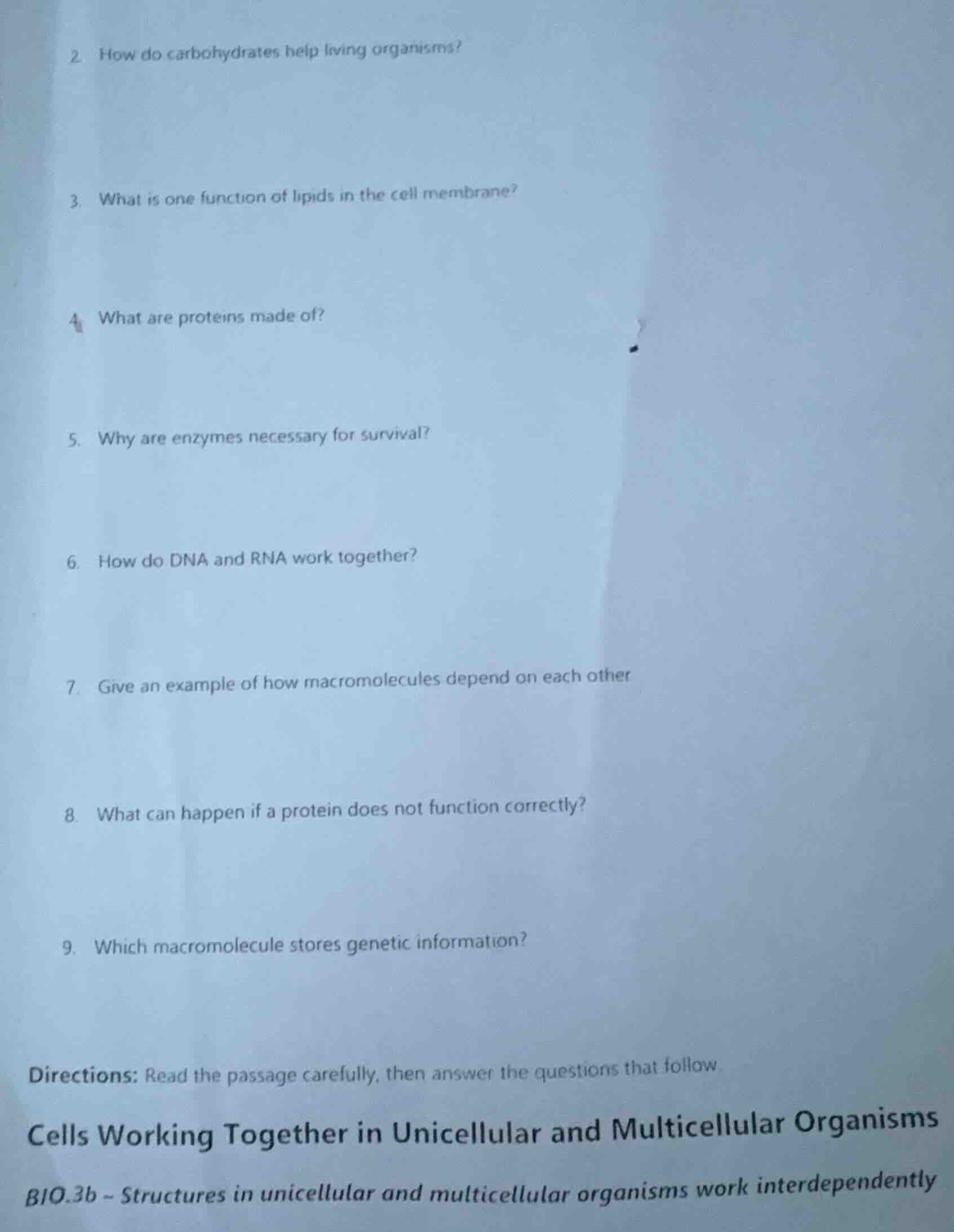
- how do carbohydrates help living organisms?
- what is one function of lipids in the cell membrane?
- what are proteins made of?
- why are enzymes necessary for survival?
- how do dna and rna work together?
- give an example of how macromolecules depend on each other
- what can happen if a protein does not function correctly?
- which macromolecule stores genetic information?
directions: read the passage carefully, then answer the questions that follow
cells working together in unicellular and multicellular organisms
bio.3b - structures in unicellular and multicellular organisms work interdependently
Question 2: How do carbohydrates help living organisms?
Carbohydrates are a primary energy source. Simple carbs (e.g., glucose) are quickly broken down for immediate energy. Complex carbs (e.g., starch in plants, glycogen in animals) store energy for later use. They also form structural components like cellulose in plant cell walls and chitin in fungal cell walls and arthropod exoskeletons.
Cell membranes are mainly composed of phospholipids, which form a bilayer. This bilayer acts as a barrier, controlling the entry and exit of substances (selective permeability). Lipids (like cholesterol) also help maintain membrane fluidity and stability.
Proteins are polymers made of amino acid monomers. Amino acids are linked by peptide bonds to form polypeptide chains, which fold into specific 3D structures (primary, secondary, tertiary, quaternary) determining protein function.

Snap & solve any problem in the app
Get step-by-step solutions on Sovi AI
Photo-based solutions with guided steps
Explore more problems and detailed explanations
Carbohydrates provide energy (e.g., glucose for immediate use, glycogen/starch for storage) and form structures (e.g., cellulose in plant cell walls, chitin in exoskeletons).