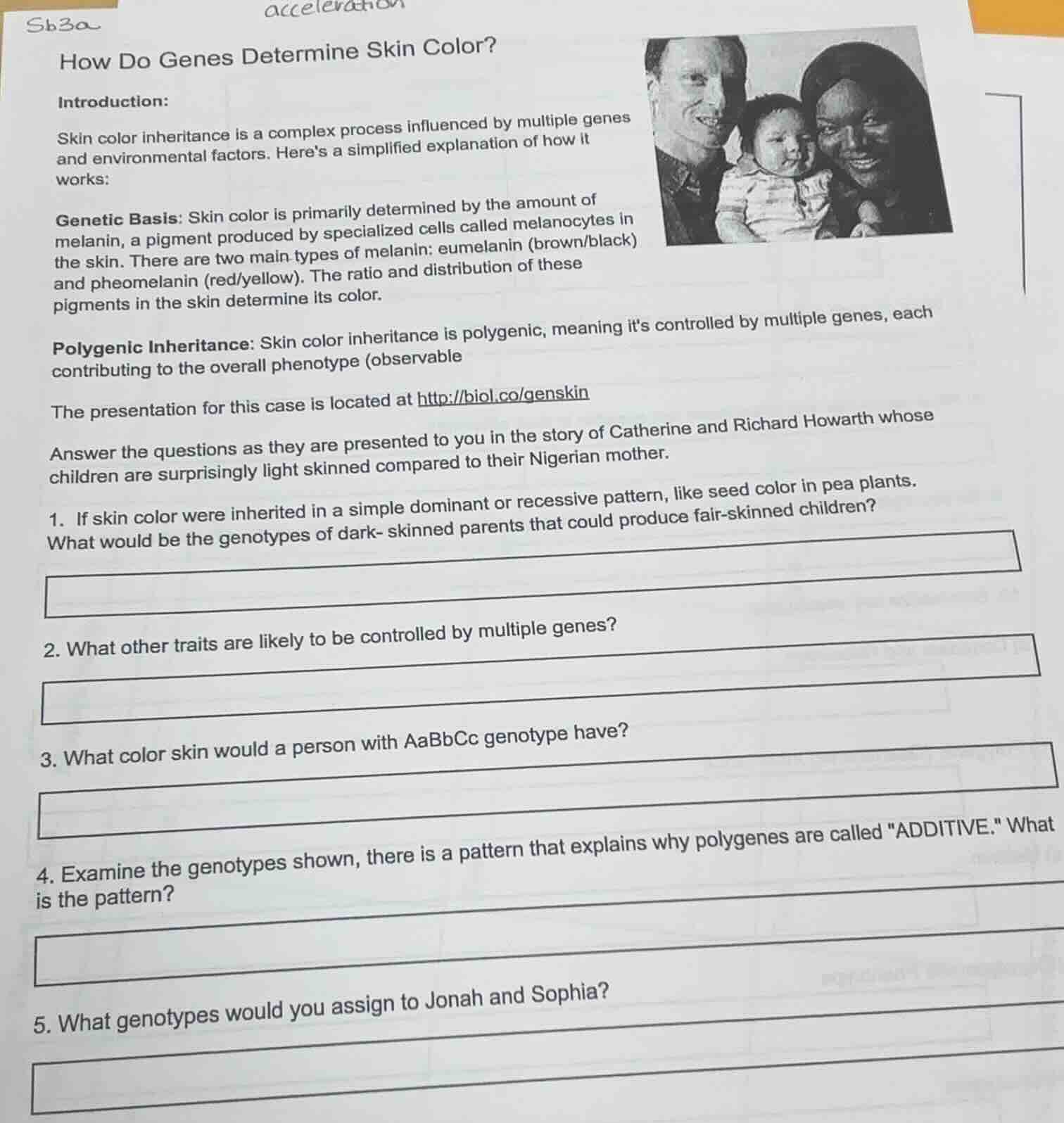
QUESTION IMAGE
Question
how do genes determine skin color?
introduction:
skin color inheritance is a complex process influenced by multiple genes and environmental factors. heres a simplified explanation of how it works:
genetic basis: skin color is primarily determined by the amount of melanin, a pigment produced by specialized cells called melanocytes in the skin. there are two main types of melanin: eumelanin (brown/black) and pheomelanin (red/yellow). the ratio and distribution of these pigments in the skin determine its color.
polygenic inheritance: skin color inheritance is polygenic, meaning its controlled by multiple genes, each contributing to the overall phenotype (observable
the presentation for this case is located at http://biol.co/genskin
answer the questions as they are presented to you in the story of catherine and richard howarth whose children are surprisingly light skinned compared to their nigerian mother.
- if skin color were inherited in a simple dominant or recessive pattern, like seed color in pea plants. what would be the genotypes of dark- skinned parents that could produce fair-skinned children?
- what other traits are likely to be controlled by multiple genes?
- what color skin would a person with aabbcc genotype have?
- examine the genotypes shown, there is a pattern that explains why polygenes are called \additive.\ what is the pattern?
- what genotypes would you assign to jonah and sophia?
- For simple dominant/recessive inheritance, dark skin (dominant) parents must carry the recessive allele for fair skin to pass it to offspring.
- Polygenic traits show continuous variation, with multiple genes contributing small effects.
- In a simplified 3-gene polygenic skin color model, each dominant allele adds to melanin production; this genotype has half dominant alleles.
- Polygenic "additive" refers to dominant alleles each contributing equally to the trait.
- The children have lighter skin than their Nigerian mother, so they have fewer dominant melanin-producing alleles than her, inheriting recessive alleles from both parents.

Snap & solve any problem in the app
Get step-by-step solutions on Sovi AI
Photo-based solutions with guided steps
Explore more problems and detailed explanations
- Both dark-skinned parents would be heterozygous for the skin color gene, e.g., $Dd$ (where $D$ = dominant dark skin allele, $d$ = recessive fair skin allele).
- Examples include height, eye color, hair color, and body weight.
- A person with the $AaBbCc$ genotype would have medium (intermediate) skin color.
- Each dominant allele in the polygenic genotype adds a small, equal amount to the skin color phenotype (more dominant alleles = darker skin, fewer = lighter skin).
- Assuming the mother (dark-skinned) has a genotype like $AABBCC$ and the father (light-skinned) has $aabbcc$, Jonah and Sophia would have a genotype with fewer dominant alleles than the mother, e.g., $AaBbCc$ (or another genotype with 3 dominant alleles, resulting in lighter skin than the mother).