QUESTION IMAGE
Question
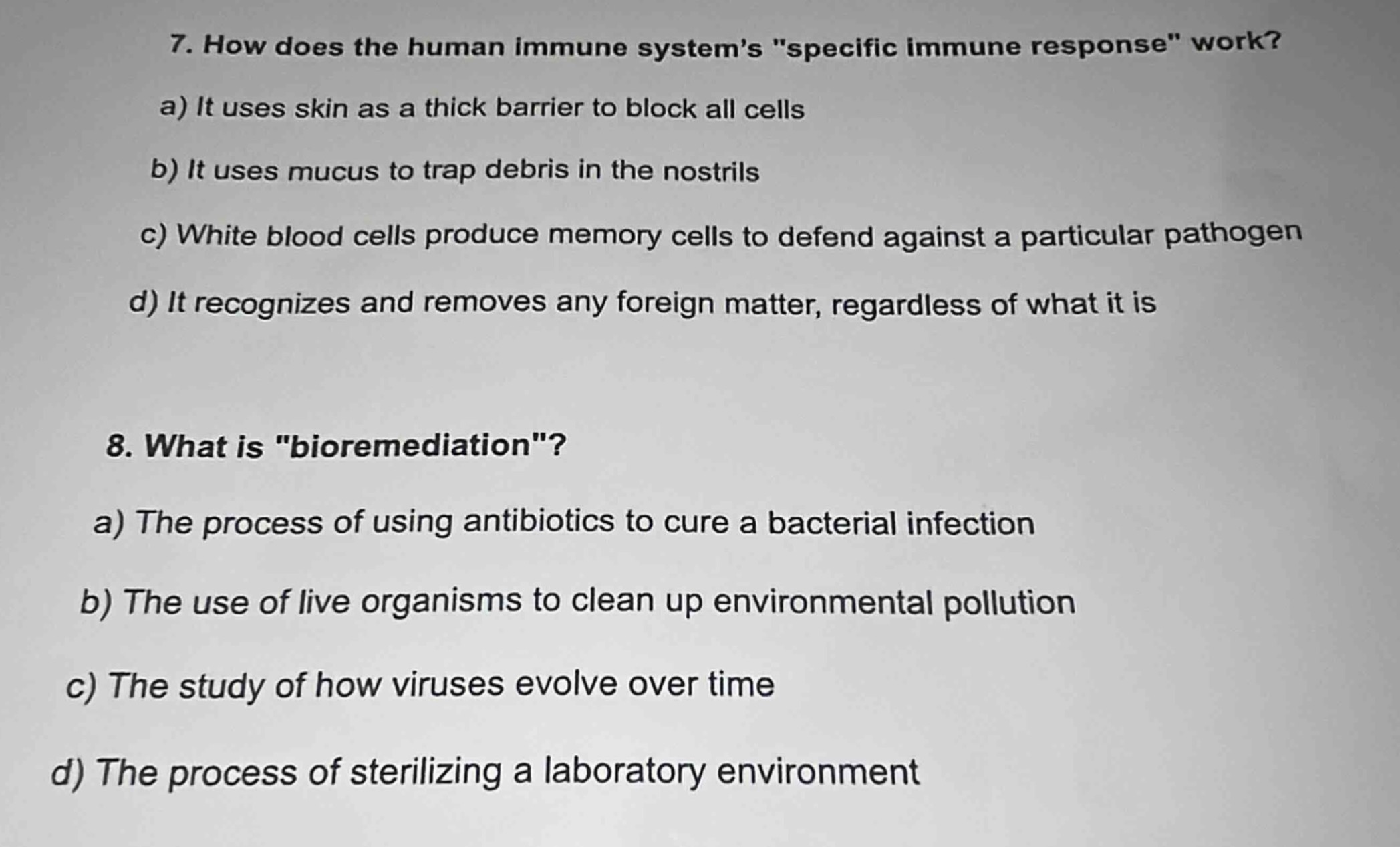
- how does the human immune system’s \specific immune response\ work?
a) it uses skin as a thick barrier to block all cells
b) it uses mucus to trap debris in the nostrils
c) white blood cells produce memory cells to defend against a particular pathogen
d) it recognizes and removes any foreign matter, regardless of what it is
- what is \bioremediation\?
a) the process of using antibiotics to cure a bacterial infection
b) the use of live organisms to clean up environmental pollution
c) the study of how viruses evolve over time
d) the process of sterilizing a laboratory environment
Response
Question 7
Brief Explanations
- Option a: Skin is a physical (innate) barrier, not part of specific immunity.
- Option b: Mucus trapping debris is an innate, non - specific defense.
- Option c: Specific immune response involves white blood cells (like lymphocytes) producing memory cells to target specific pathogens.
- Option d: Removing any foreign matter regardless of type is non - specific immunity.
Brief Explanations
- Option a: Using antibiotics to cure bacterial infections is not bioremediation.
- Option b: Bioremediation is defined as using living organisms (like bacteria, fungi) to clean up environmental pollutants (e.g., oil spills, heavy metals).
- Option c: Studying virus evolution is virology/evolutionary biology, not bioremediation.
- Option d: Sterilizing a lab environment is not related to bioremediation.

Snap & solve any problem in the app
Get step-by-step solutions on Sovi AI
Photo-based solutions with guided steps
Explore more problems and detailed explanations
c) White blood cells produce memory cells to defend against a particular pathogen