QUESTION IMAGE
Question
- how does looking at the net pay instead of the gross pay make you feel about the pay for this job?
- do you think ken should build his budget using his gross pay or his net pay? explain why you chose your option.
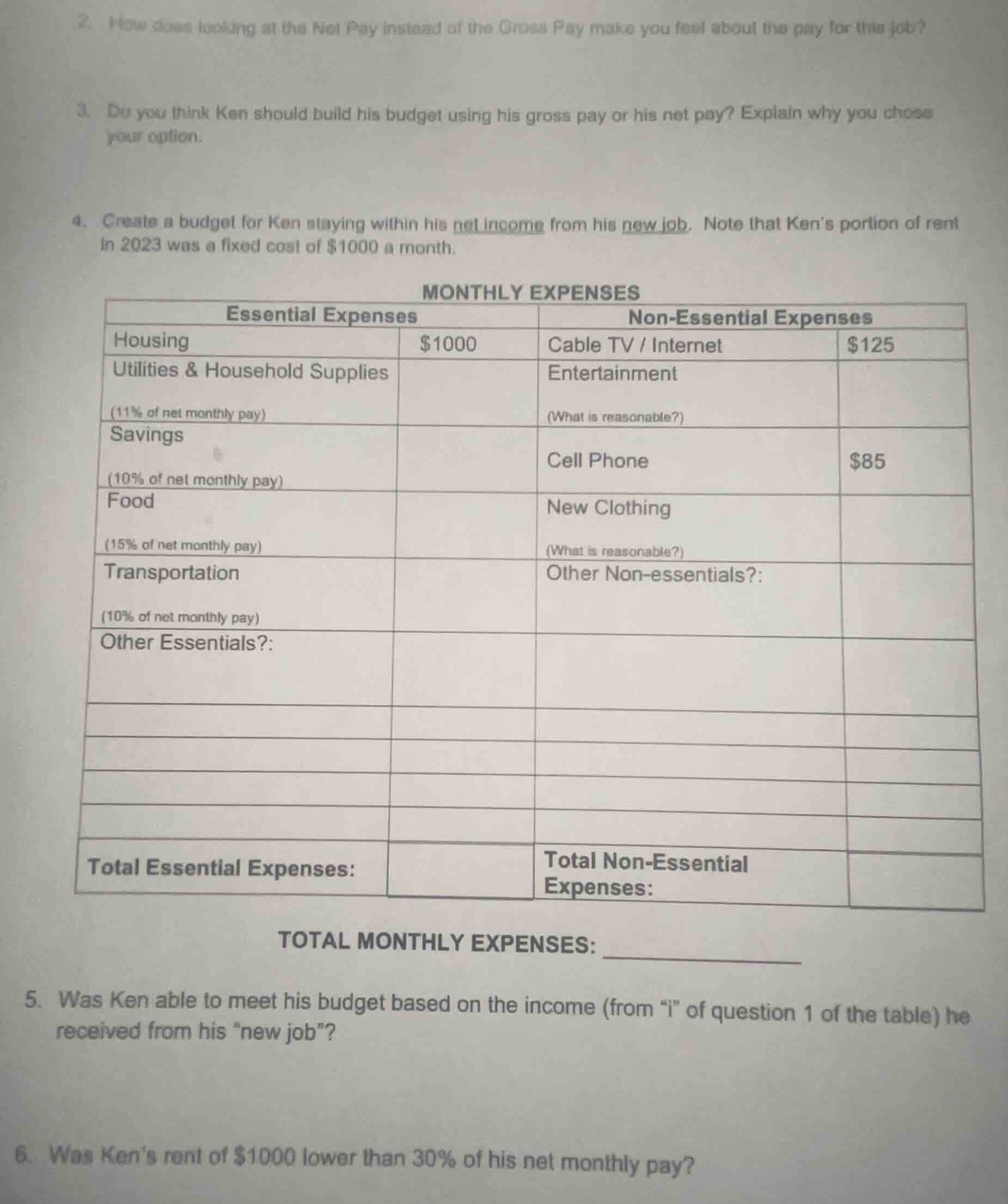
- create a budget for ken staying within his net income from his new job. note that ken’s portion of rent in 2023 was a fixed cost of $1000 a month.
monthly expenses
essential expenses non - essential expenses
housing $1000 cable tv / internet $125
utilities & household supplies
(11% of net monthly pay) entertainment
(what is reasonable?)
savings
(10% of net monthly pay) cell phone $85
food
(15% of net monthly pay) new clothing
(what is reasonable?)
transportation
(10% of net monthly pay) other non - essentials?:
other essentials?:
total essential expenses: total non - essential expenses:
total monthly expenses:
- was ken able to meet his budget based on the income (from “i” of question 1 of the table) he received from his “new job”?
- was ken’s rent of $1000 lower than 30% of his net monthly pay?
To solve these problems, we need to know Ken's net monthly pay from his new job (from question 1, which is not provided here). Let's assume Ken's net monthly pay is \( N \) (we'll use a placeholder for now, and you can substitute the actual value once known).
Problem 3: Gross vs. Net Pay for Budgeting
Budgeting should use net pay because gross pay is the amount before taxes and deductions, while net pay is the actual money Ken receives (take - home pay). Expenses are paid from net pay, so using net pay ensures the budget is based on available funds.
To determine if Ken meets his budget, compare total monthly expenses (from Problem 4) to his net pay \( N \). If Total Monthly Expenses \( \leq N \), then he meets the budget; otherwise, he doesn't.
Calculate 30% of net pay (\( 0.30N \)) and compare it to \( \$1000 \). If \( 1000<0.30N \), then rent is lower than 30% of net pay.

Snap & solve any problem in the app
Get step-by-step solutions on Sovi AI
Photo-based solutions with guided steps
Explore more problems and detailed explanations
Ken should build his budget using his net pay. This is because net pay is the actual income he takes home after taxes and other deductions, and it represents the money he has available to cover expenses and save.
Problem 4: Creating Ken’s Budget
First, we'll define the expense categories with the given percentages (assuming net pay \( N \)):
Essential Expenses:
- Housing: \( \$1000 \) (fixed)
- Utilities & Household Supplies: \( 0.11N \) (11% of net pay)
- Savings: \( 0.10N \) (10% of net pay)
- Food: \( 0.15N \) (15% of net pay)
- Transportation: \( 0.10N \) (10% of net pay)
- Other Essentials?: Let's assume \( \$0 \) (or a reasonable amount if specified)
Non - Essential Expenses:
- Cable TV / Internet: \( \$125 \) (fixed)
- Entertainment: Let's assume a reasonable amount, e.g., \( \$100 \) (can be adjusted)
- Cell Phone: \( \$85 \) (fixed)
- New Clothing: Let's assume a reasonable amount, e.g., \( \$50 \) (can be adjusted)
- Other Non - essentials?: Let's assume \( \$0 \) (or a reasonable amount if specified)
Step - by - Step Calculation (with \( N \) as net pay):
Step 1: Calculate Essential Expenses
- Housing: \( \$1000 \)
- Utilities: \( 0.11N \)
- Savings: \( 0.10N \)
- Food: \( 0.15N \)
- Transportation: \( 0.10N \)
- Other Essentials: \( \$0 \) (for simplicity)
Total Essential Expenses \( = 1000+0.11N + 0.10N+0.15N + 0.10N=1000 + 0.46N \)
Step 2: Calculate Non - Essential Expenses
- Cable TV / Internet: \( \$125 \)
- Entertainment: \( \$100 \) (assumed)
- Cell Phone: \( \$85 \)
- New Clothing: \( \$50 \) (assumed)
- Other Non - essentials: \( \$0 \) (for simplicity)
Total Non - Essential Expenses \( = 125 + 100+85 + 50=360 \)
Step 3: Total Monthly Expenses
Total Monthly Expenses \( = \) Total Essential Expenses \( + \) Total Non - Essential Expenses \(=1000 + 0.46N+360 = 1360+0.46N \)
This total must be \( \leq N \) (since we stay within net income).