QUESTION IMAGE
Question
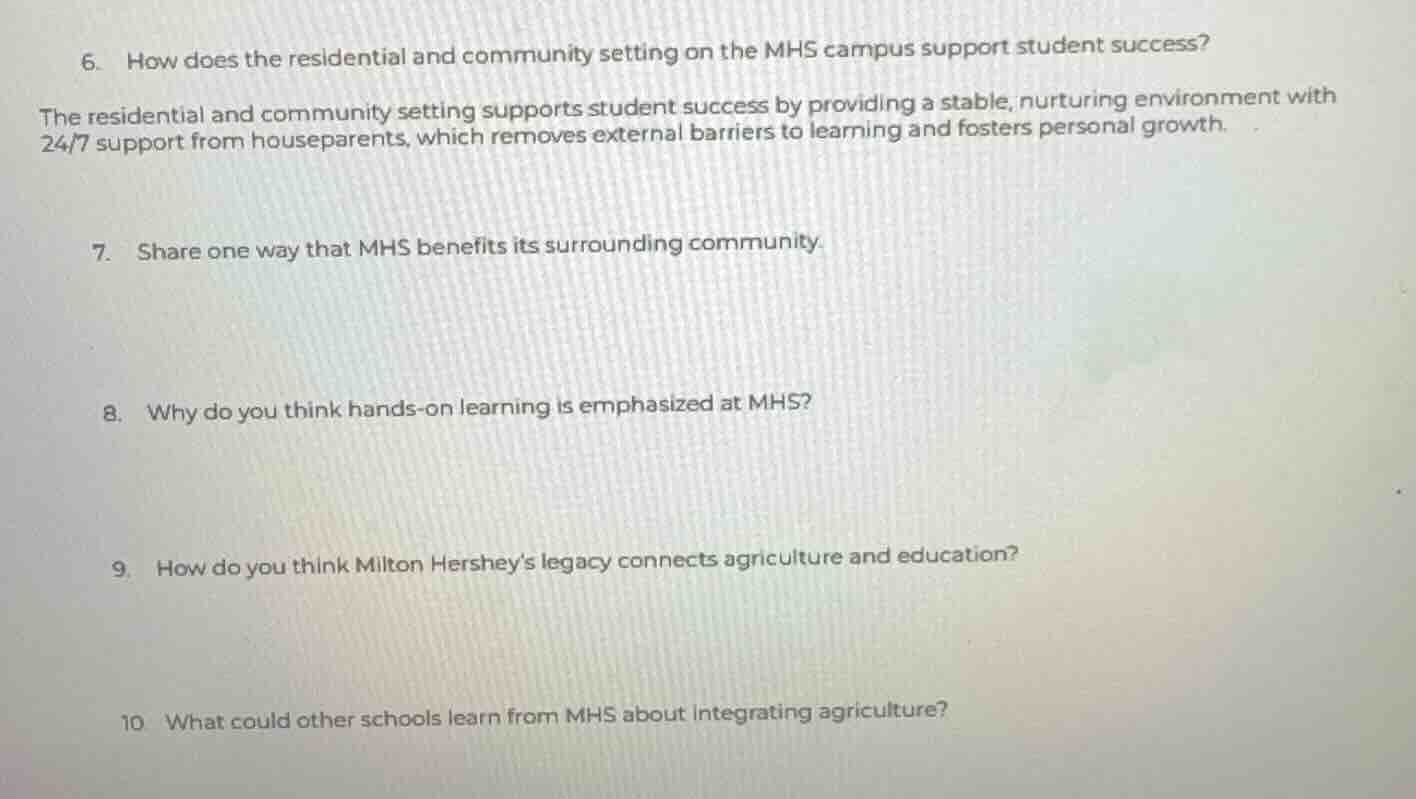
- how does the residential and community setting on the mhs campus support student success?
the residential and community setting supports student success by providing a stable, nurturing environment with 24/7 support from houseparents, which removes external barriers to learning and fosters personal growth.
- share one way that mhs benefits its surrounding community
- why do you think hands - on learning is emphasized at mhs?
- how do you think milton hershey’s legacy connects agriculture and education?
- what could other schools learn from mhs about integrating agriculture?
Brief Explanations
- MHS (Milton Hershey School) runs agricultural programs that supply local businesses with fresh, locally grown produce, boosting the local food economy and supporting community vendors.
- Hands-on learning at MHS is emphasized because it aligns with its agricultural and vocational roots, helping students build practical, job-ready skills while deepening their understanding of academic concepts through real-world application.
- Milton Hershey built his chocolate empire on a foundation of sustainable agriculture for cocoa and dairy; he tied this to education by creating MHS with working farms, so students learn agricultural practices alongside academics, linking food production, industry, and educational opportunity as part of his legacy of combining practical work with learning.
- Other schools could learn to integrate agriculture as both a vocational and academic tool: using school farms to teach science (soil chemistry, ecology), math (crop yield calculations), and business (farm management), while also providing students with hands-on, purpose-driven learning that can serve local community food needs.

Snap & solve any problem in the app
Get step-by-step solutions on Sovi AI
Photo-based solutions with guided steps
Explore more problems and detailed explanations
- MHS supports its surrounding community by supplying local businesses with fresh produce from its on-campus agricultural programs, strengthening the local food economy.
- Hands-on learning is emphasized to build practical, job-ready skills aligned with MHS's agricultural/vocational roots, while reinforcing academic concepts through real-world application.
- Milton Hershey's legacy connects agriculture and education via MHS's working farms: his chocolate business relied on agricultural supply chains, so he designed the school to teach sustainable farming alongside academics, linking food production to educational opportunity.
- Other schools can learn to integrate agriculture as a cross-curricular tool—using school farms to teach science, math, and business skills, while also addressing local community food needs through student-led agricultural projects.