QUESTION IMAGE
Question
Question was provided via image upload.
Brief Explanations
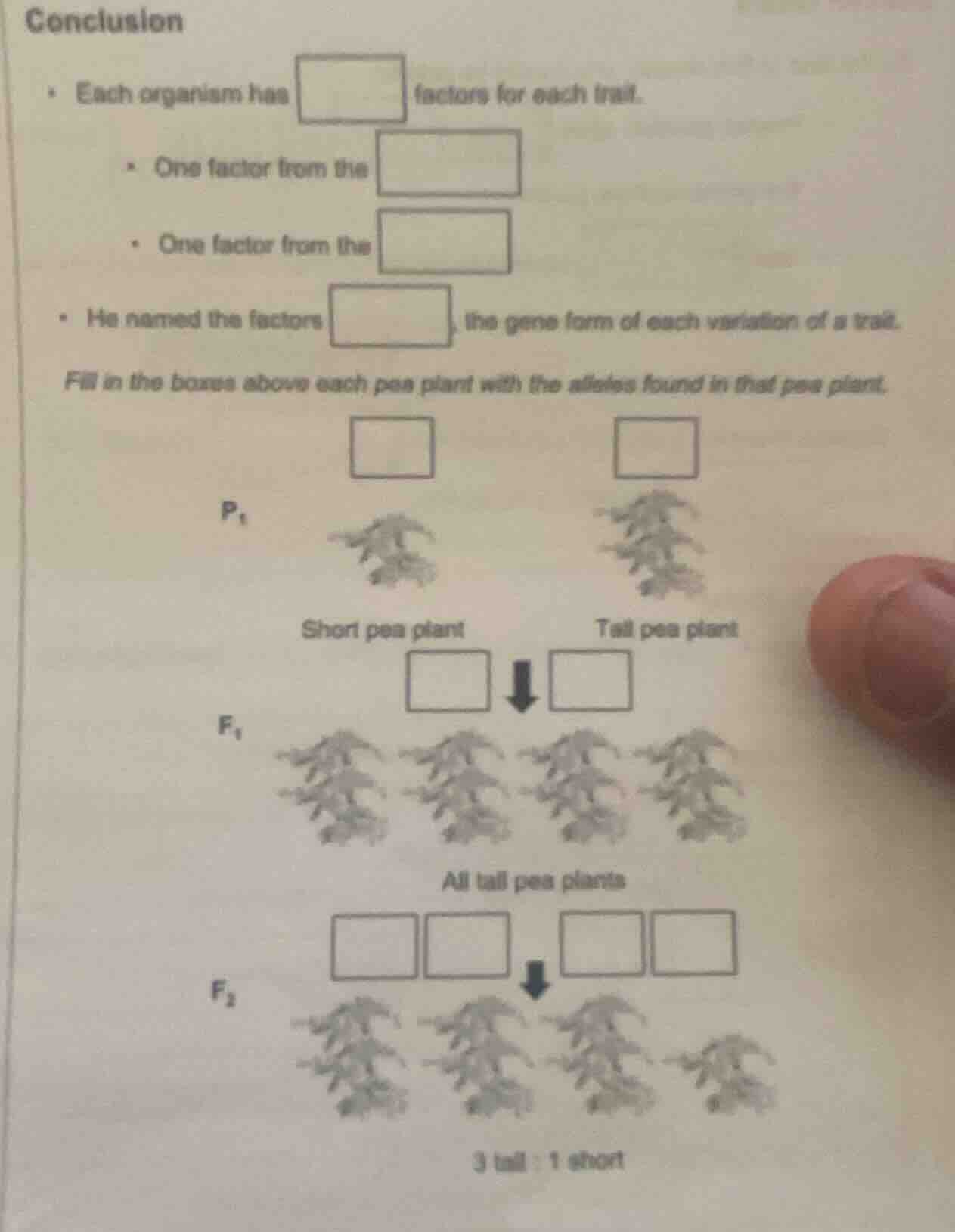
These are key conclusions from Mendel's pea plant experiments on inheritance, followed by a monohybrid cross. The conclusions describe Mendel's early model of heredity, and the cross uses dominant (T, tall) and recessive (t, short) alleles.
- Organisms have two heritable factors for each trait, one from each parent. Mendel called these factors alleles, which are variants of a gene.
- For the pea plant cross:
- P₁ generation: True-breeding short plants are homozygous recessive (tt), true-breeding tall plants are homozygous dominant (TT).
- F₁ generation: Offspring inherit one allele from each parent, making them heterozygous (Tt), which all show the dominant tall trait.
- F₂ generation: When F₁ plants self-pollinate, the alleles segregate, producing genotypes TT, Tt, Tt, tt, resulting in the 3:1 tall-to-short phenotype ratio.

Snap & solve any problem in the app
Get step-by-step solutions on Sovi AI
Photo-based solutions with guided steps
Explore more problems and detailed explanations
Conclusion Boxes (top section):
- Each organism has two factors for each trait.
- One factor from the mother
- One factor from the father
- He named the factors alleles, the gene form of each variation of a trait.
Pea Plant Allele Boxes:
P₁ Generation:
- Short pea plant: $\boldsymbol{tt}$
- Tall pea plant: $\boldsymbol{TT}$
F₁ Generation:
- All tall pea plants: $\boldsymbol{Tt}$
F₂ Generation (parental alleles for cross):
- Left parent (F₁): $\boldsymbol{Tt}$
- Right parent (F₁): $\boldsymbol{Tt}$
- Resulting offspring genotypes (matches 3:1 ratio): $\boldsymbol{TT}$, $\boldsymbol{Tt}$, $\boldsymbol{Tt}$, $\boldsymbol{tt}$