QUESTION IMAGE
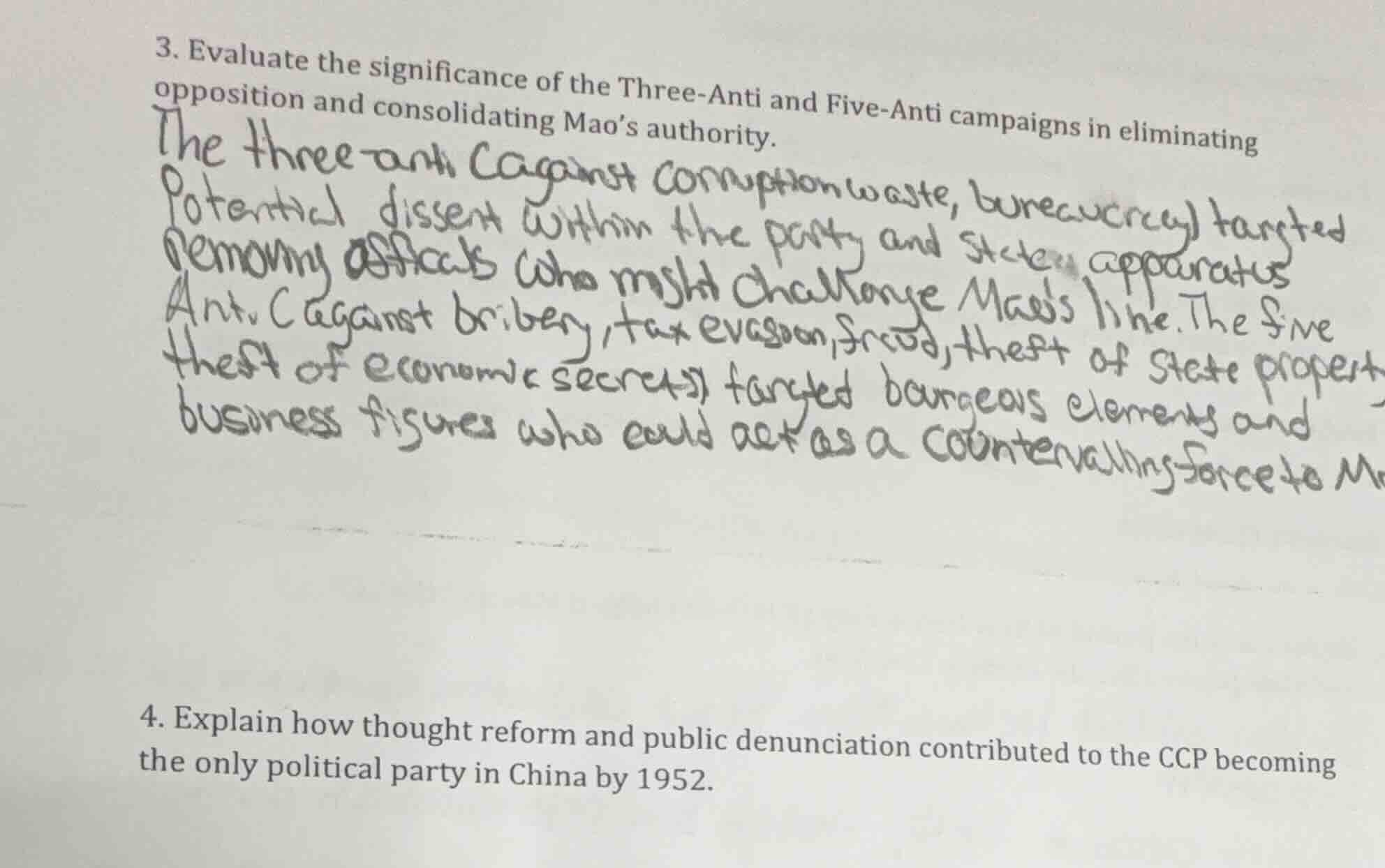
Question
Question was provided via image upload.
Brief Explanations
For Question 3:
- Three-Anti Campaign Impact: This campaign targeted corruption, waste, and bureaucracy within the CCP and state apparatus. By removing officials who could challenge Mao's line, it purged internal dissent, centralized power in Mao, and ensured party and state institutions aligned with his authority.
- Five-Anti Campaign Impact: Targeting bourgeois elements and business figures for bribery, tax evasion, fraud, theft of state property, and theft of economic secrets, it eliminated a potential countervailing social and economic force. This weakened groups that could oppose Mao's leadership, consolidated state control over the economy, and further solidified his political authority by removing alternative centers of power.
For Question 4:
- Thought Reform: This process re-educated intellectuals, members of other parties, and ordinary citizens to align their ideology with CCP doctrine. It suppressed alternative political ideas, ensured ideological uniformity, and eliminated support for rival political groups by framing non-CCP thought as "reactionary."
- Public Denunciation: These public events targeted individuals and groups associated with non-CCP parties, "counter-revolutionaries," or those deemed ideologically deviant. They publicly discredited opposition figures, created a culture of conformity through social pressure, and dismantled the public legitimacy of rival political organizations, leaving the CCP as the only politically viable and accepted party by 1952.

Snap & solve any problem in the app
Get step-by-step solutions on Sovi AI
Photo-based solutions with guided steps
Explore more problems and detailed explanations
Question 3:
- The Three-Anti Campaign eliminated internal dissent within the party/state by removing officials who might challenge Mao's