QUESTION IMAGE
Question
Question was provided via image upload.
Brief Explanations
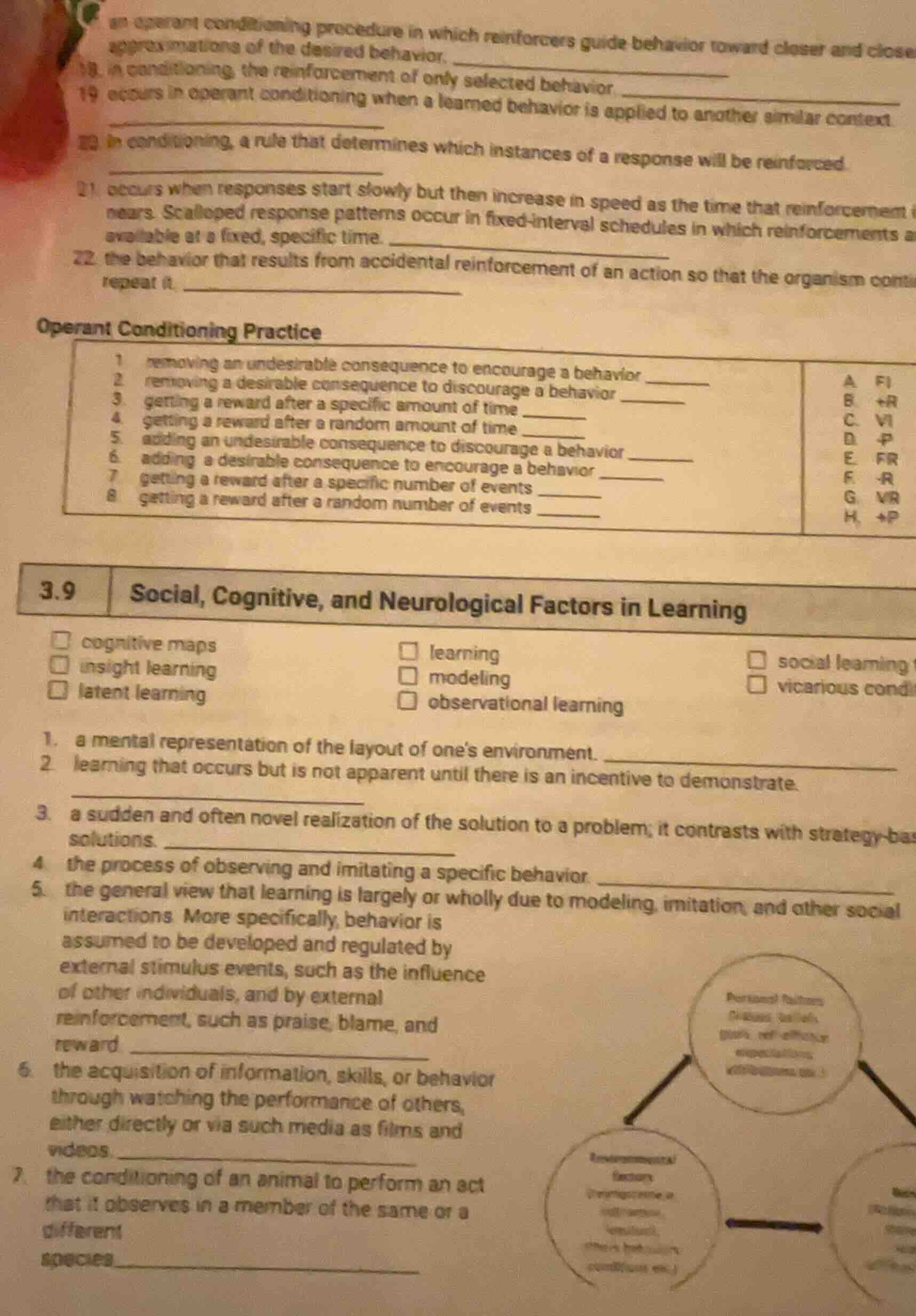
Top Fill-in-the-Blank Section (Operant Conditioning)
- Defines shaping, where reinforcers guide behavior to a target via approximations.
- Describes differential reinforcement, reinforcing only chosen behaviors.
- Refers to stimulus generalization, applying learned behavior to similar contexts.
- Is a reinforcement schedule, specifically fixed-interval (FI) which creates scalloped response patterns.
- Defines superstitious behavior, from accidental reinforcement of an action.
Operant Conditioning Practice Matching
- Removing an undesirable consequence (negative reinforcement) = F. -R
- Removing a desirable consequence (negative punishment) = D. -P
- Reward after specific time (fixed-interval) = A. FI
- Reward after random time (variable-interval) = C. VI
- Adding undesirable consequence (positive punishment) = H. +P
- Adding desirable consequence (positive reinforcement) = B. +R
- Reward after specific events (fixed-ratio) = E. FR
- Reward after random events (variable-ratio) = G. VR
3.9 Social, Cognitive, Neurological Factors in Learning
- Mental map of environment = cognitive maps
- Hidden learning revealed by incentive = latent learning
- Sudden problem-solving insight = insight learning
- Observing and imitating behavior = modeling
- Learning via social interactions/modeling = social learning
- Learning by watching others' performance = observational learning
- Conditioning via observing another animal = vicarious conditioning

Snap & solve any problem in the app
Get step-by-step solutions on Sovi AI
Photo-based solutions with guided steps
Explore more problems and detailed explanations
Top Fill-in-the-Blank Section
- shaping
- differential reinforcement
- stimulus generalization
- fixed-interval schedule
- superstitious behavior
Operant Conditioning Practice Matching
- F. -R
- D. -P
- A. FI
- C. VI
- H. +P
- B. +R
- E. FR
- G. VR
3.9 Social, Cognitive, Neurological Factors in Learning
- cognitive maps
- latent learning
- insight learning
- modeling
- social learning
- observational learning
- vicarious conditioning