QUESTION IMAGE
Question
Question was provided via image upload.
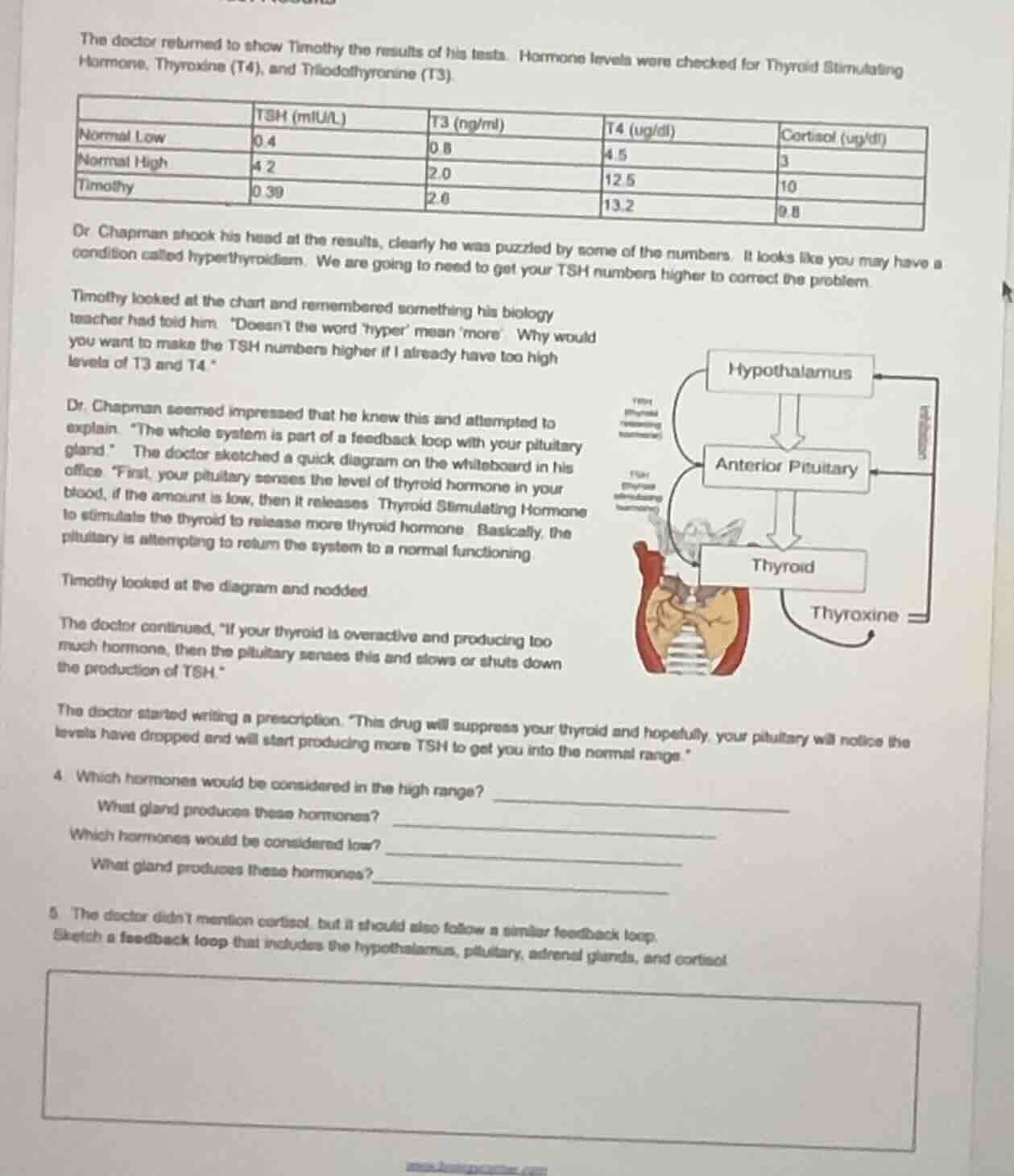
Step1: Compare values to normal ranges
Compare Timothy's hormone levels to the given Normal Low and Normal High ranges:
- TSH: $0.39$ mIU/L < $0.4$ mIU/L (Normal Low)
- T3: $2.0$ ng/ml = $2.0$ ng/ml (Normal High)
- T4: $13.2$ ug/dl > $12.5$ ug/dl (Normal High)
- Cortisol: $9.8$ ug/dl is between $3$ and $10$ ug/dl (normal range)
Step2: Identify high/low hormones and glands
- High hormones: T3, T4 (produced by the thyroid gland)
- Low hormone: TSH (produced by the anterior pituitary gland)
Step3: Sketch cortisol feedback loop
Map the negative feedback pathway for cortisol:
- Hypothalamus releases Corticotropin-Releasing Hormone (CRH)
- CRH stimulates the anterior pituitary to release Adrenocorticotropic Hormone (ACTH)
- ACTH stimulates the adrenal glands to release cortisol
- High cortisol levels inhibit the hypothalamus and anterior pituitary (negative feedback)
- Low cortisol levels remove inhibition, restarting the loop

Snap & solve any problem in the app
Get step-by-step solutions on Sovi AI
Photo-based solutions with guided steps
Explore more problems and detailed explanations
4.
- Which hormones would be considered in the high range? T3 (Triiodothyronine) and T4 (Thyroxine)
- What gland produces these hormones? Thyroid gland
- Which hormones would be considered low? TSH (Thyroid Stimulating Hormone)
- What gland produces these hormones? Anterior pituitary gland
5.
[Hypothalamus] → releases CRH → [Anterior Pituitary] → releases ACTH → [Adrenal Glands] → releases Cortisol
       ↑                                                                 ↓
       └────────────────────────── Negative Feedback ────────────────────┘
Note: When cortisol levels are high, it signals the hypothalamus and anterior pituitary to reduce production of CRH and ACTH, slowing cortisol release. When cortisol levels are low, this inhibition stops, and the cycle restarts.