QUESTION IMAGE
Question
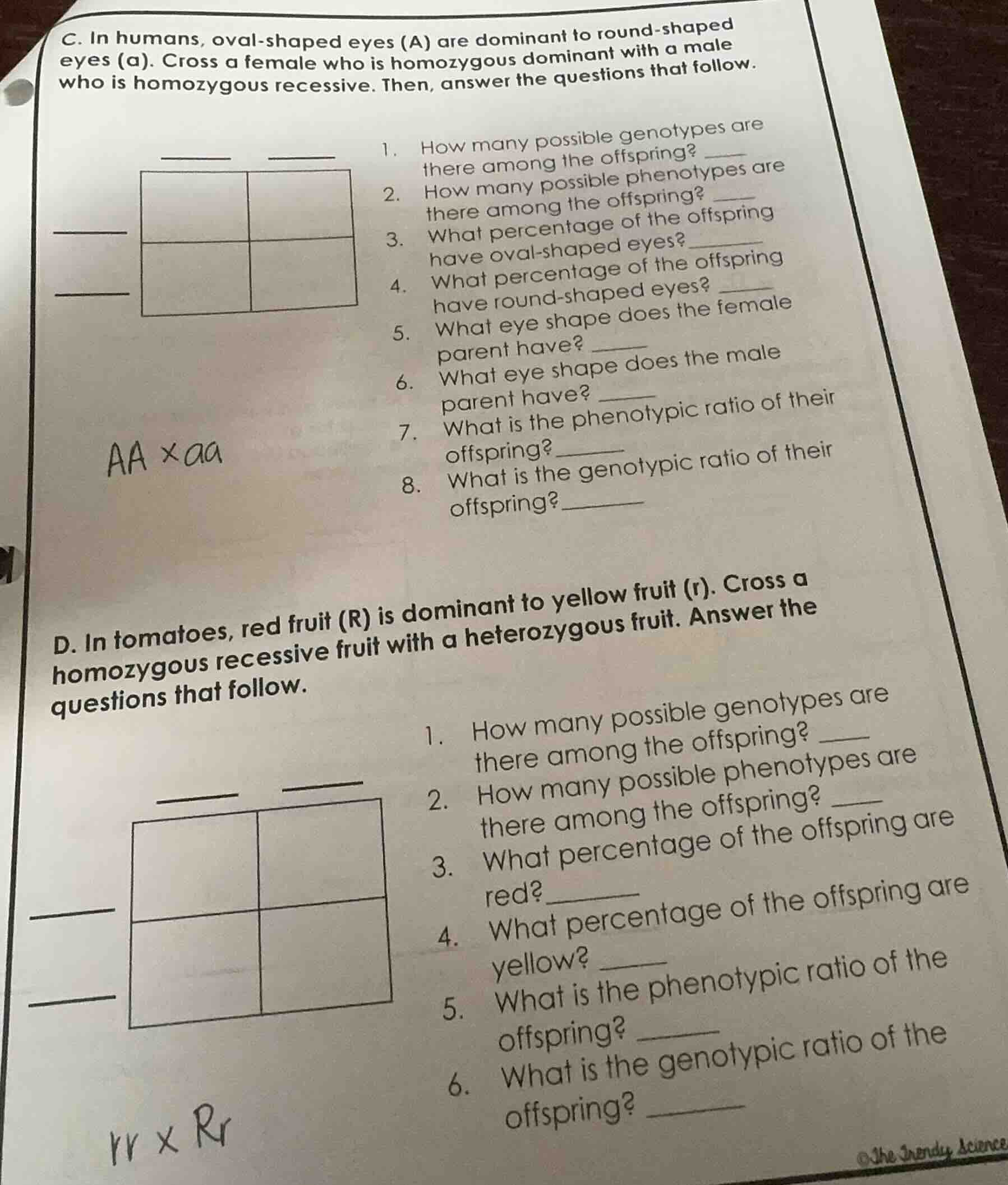
c. in humans, oval - shaped eyes (a) are dominant to round - shaped eyes (a). cross a female who is homozygous dominant with a male who is homozygous recessive. then, answer the questions that follow.
- how many possible genotypes are there among the offspring?
- how many possible phenotypes are there among the offspring?
- what percentage of the offspring have oval - shaped eyes?
- what percentage of the offspring have round - shaped eyes?
- what eye shape does the female parent have?
- what eye shape does the male parent have?
- what is the phenotypic ratio of their offspring?
- what is the genotypic ratio of their offspring?
aa × aa
d. in tomatoes, red fruit (r) is dominant to yellow fruit (r). cross a homozygous recessive fruit with a heterozygous fruit. answer the questions that follow.
- how many possible genotypes are there among the offspring?
- how many possible phenotypes are there among the offspring?
- what percentage of the offspring are red?
- what percentage of the offspring are yellow?
- what is the phenotypic ratio of the offspring?
- what is the genotypic ratio of the offspring?
rr × rr
Step1: Fill Punnett Square for AA × aa
Female (AA) contributes gametes: $A, A$; Male (aa) contributes gametes: $a, a$
$$\begin{array}{c|cc}
& A & A \\
\hline
a & Aa & Aa \\
a & Aa & Aa \\
\end{array}$$
Step2: Answer Set C questions
- Count unique genotypes: only $Aa$ → 1
- Count unique phenotypes: only oval (A dominant) → 1
- All offspring have Aa → 100% oval
- No aa offspring → 0% round
- Female is AA (dominant) → oval eyes
- Male is aa (recessive) → round eyes
- All offspring are oval → 1:0 (oval:round)
- All offspring are Aa → 1:0 (Aa:aa)
Step3: Fill Punnett Square for rr × Rr
Homozygous recessive (rr) contributes gametes: $r, r$; Heterozygous (Rr) contributes gametes: $R, r$
$$\begin{array}{c|cc}
& r & r \\
\hline
R & Rr & Rr \\
r & rr & rr \\
\end{array}$$
Step4: Answer Set D questions
- Count unique genotypes: $Rr, rr$ → 2
- Count unique phenotypes: red (Rr), yellow (rr) → 2
- 2 out of 4 offspring are Rr → $\frac{2}{4} \times 100\% = 50\%$ red
- 2 out of 4 offspring are rr → $\frac{2}{4} \times 100\% = 50\%$ yellow
- 2 red : 2 yellow → 1:1 (red:yellow)
- 2 Rr : 2 rr → 1:1 (Rr:rr)

Snap & solve any problem in the app
Get step-by-step solutions on Sovi AI
Photo-based solutions with guided steps
Explore more problems and detailed explanations
Set C (AA × aa)
- 1
- 1
- 100%
- 0%
- Oval-shaped eyes
- Round-shaped eyes
- 1:0 (oval:round)
- 1:0 (Aa:aa)
Set D (rr × Rr)
- 2
- 2
- 50%
- 50%
- 1:1 (red:yellow)
- 1:1 (Rr:rr)