QUESTION IMAGE
Question
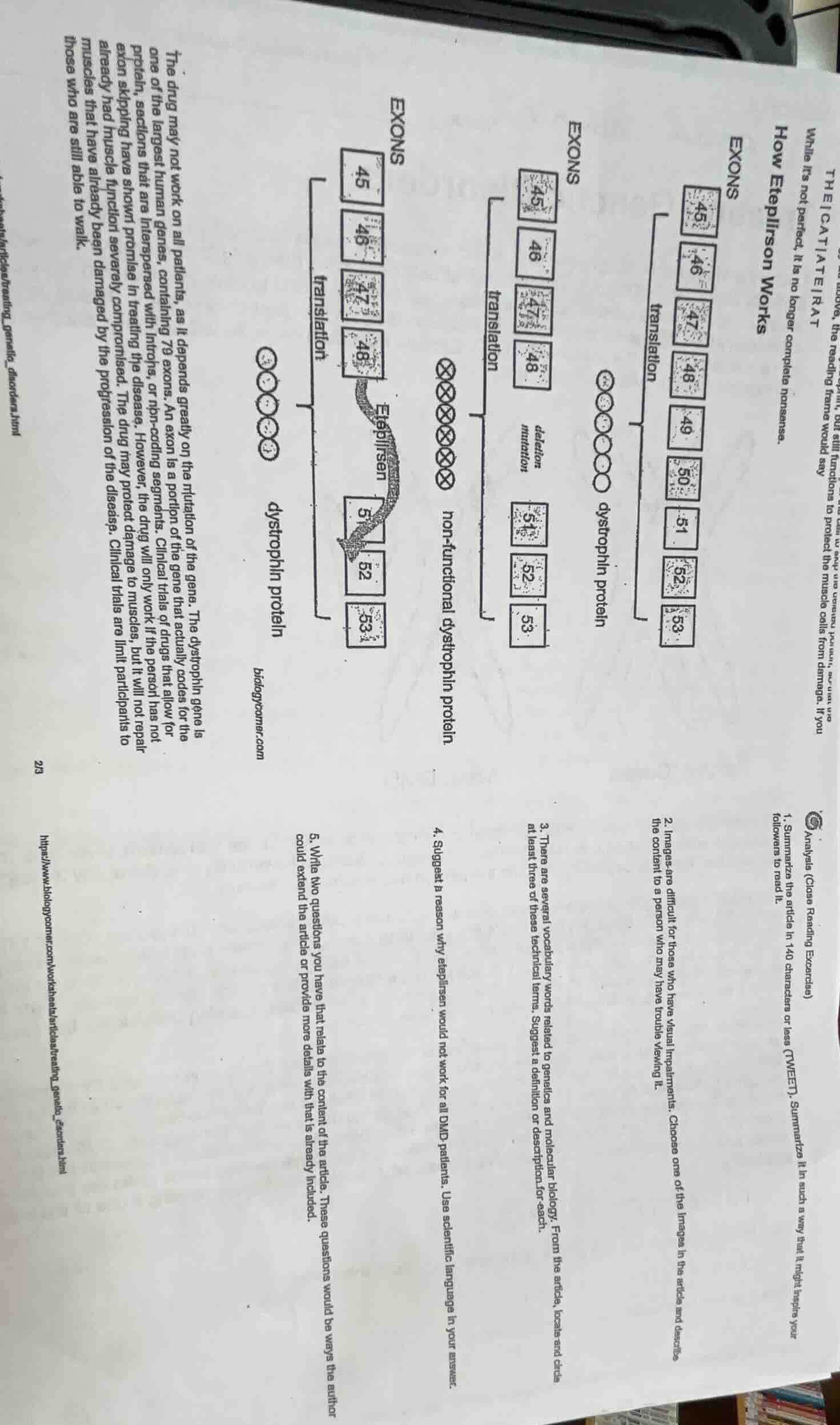
the icat|te|rat how eteplirson works exons translation dystrophin protein exons translation deletion mutation non - functional dystrophin protein exons translation eteplirson dystrophin protein biologycorner.com the drug may not work on all patients, as it depends greatly on the mutation of the gene. the dystrophin gene is one of the largest human genes, containing 79 exons. an exon is a portion of the gene that actually codes for the protein; sections that are interspersed with introns, or non - coding segments. exon skipping have shown promise in treating the disease. however, the drug will only work if the person has not already had muscle function severely compromised. the drug may protect damage to muscles, but it will not repair muscles that have already been damaged by the progression of the disease. clinical trials are limit participants to those who are still able to walk. 1. analysis (close reading exercise) summarize the article in 140 characters or less (tweet). summarize it in such a way that it might inspire your followers to read it. 2. images are difficult for those who have visual impairments. choose one of the images in the article and describe the content to a person who may have trouble viewing it. 3. there are several vocabulary words related to genetics and molecular biology. from the article, locate and circle at least three of these technical terms. suggest a definition or description for each. 4. suggest a reason why eteplirsen would not work for all dmd patients. use scientific language in your answer. 5. write two questions you have that relate to the content of the article. these questions would be ways the author could extend the article or provide more details with that is already included.
- Tweet Summary: Eteplirson is an exon-skipping drug for genetic muscle disease (targeting dystrophin gene). It fixes faulty gene reading frames to make functional dystrophin, protecting muscles—but only works for specific mutations, can't reverse severe damage, and is tested on mobile patients.
- Image Description (First Image): This image shows the normal dystrophin gene with exons 45-53. The gene is translated into a full, functional dystrophin protein (represented by a complete circle chain), which protects muscle cells.
- Technical Terms & Definitions:
- Exon: A coding segment of a gene that contains instructions for making part of a protein.
- Reading frame: The sequential grouping of 3 DNA/RNA bases that determines which amino acids are made during protein translation.
- Dystrophin: A protein produced by muscle cells that protects muscle fibers from damage during movement.
- Reason Eteplirson Fails for All Patients: Eteplirson is designed to skip a specific exon (exon 51) to restore the reading frame. It only works for patients with a mutation that disrupts the reading frame specifically at exon 51; patients with mutations in other exons of the dystrophin gene will not benefit from this targeted exon-skipping mechanism.
- Extension Questions:
- 1. How might the development of exon-skipping drugs like eteplirson be adapted to treat patients with mutations in exons other than 51?
- 2. What long-term effects could eteplirson have on preserving muscle function in patients with early-stage disease who maintain mobility?

Snap & solve any problem in the app
Get step-by-step solutions on Sovi AI
Photo-based solutions with guided steps
Explore more problems and detailed explanations
- Eteplirson is an exon-skipping drug for genetic muscle disease (targeting dystrophin gene). It fixes faulty gene reading frames to make functional dystrophin, protecting muscles—but only works for specific mutations, can't reverse severe damage, and is tested on mobile patients.
- This image shows the normal dystrophin gene with exons 45-53. The gene is translated into a full, functional dystrophin protein (represented by a complete circle chain), which protects muscle cells.
- - Exon: A coding segment of a gene that contains instructions for making part of a protein.
- Reading frame: The sequential grouping of 3 DNA/RNA bases that determines which amino acids are made during protein translation.
- Dystrophin: A protein produced by muscle cells that protects muscle fibers from damage during movement.
- Eteplirson is designed to skip a specific exon (exon 51) to restore the reading frame. It only works for patients with a mutation that disrupts the reading frame specifically at exon 51; patients with mutations in other exons of the dystrophin gene will not benefit from this targeted exon-skipping mechanism.
- - 1. How might the development of exon-skipping drugs like eteplirson be adapted to treat patients with mutations in exons other than 51?
- 2. What long-term effects could eteplirson have on preserving muscle function in patients with early-stage disease who maintain mobility?