QUESTION IMAGE
Question
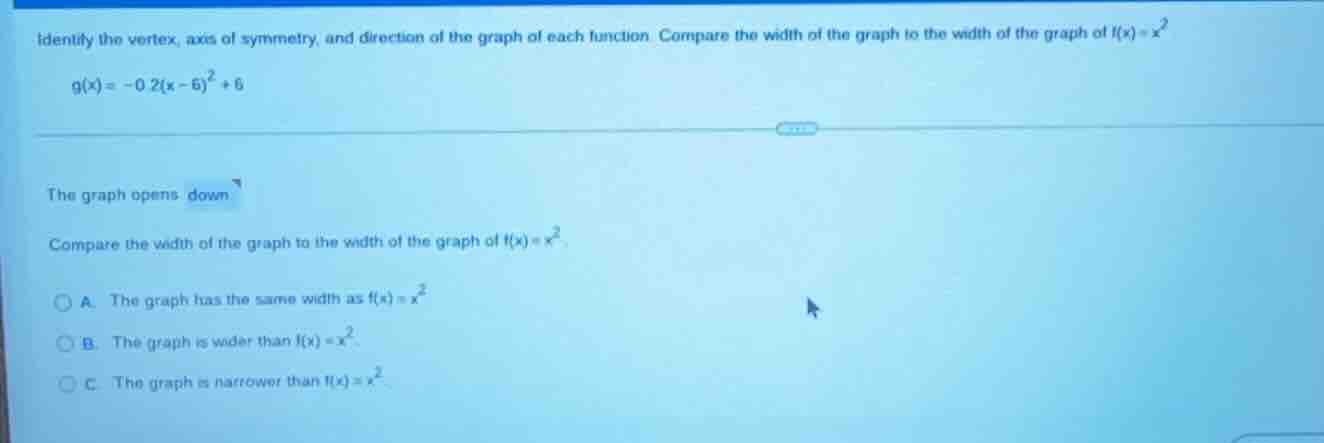
identify the vertex, axis of symmetry, and direction of the graph of each function. compare the width of the graph to the width of the graph of ( f(x)=x^2 )
( g(x)= - 0.2(x - 6)^2 + 6 )
the graph opens down
compare the width of the graph to the width of the graph of ( f(x)=x^2 ).
a. the graph has the same width as ( f(x)=x^2 )
b. the graph is wider than ( f(x)=x^2 ).
c. the graph is narrower than ( f(x)=x^2 ).
Step1: Recall the vertex form of a parabola
The vertex form of a parabola is \( g(x) = a(x - h)^2 + k \), where \((h, k)\) is the vertex, and \(|a|\) determines the width and direction. For \( f(x)=x^2 \), \( a = 1 \). For \( g(x)=-0.2(x - 6)^2+8 \), \( a=-0.2 \).
Step2: Compare the absolute values of \(a\)
The absolute value of \(a\) for \( f(x) \) is \(|1| = 1\), and for \( g(x) \) is \(|-0.2| = 0.2\). Since \( 0.2<1 \), a smaller \(|a|\) (in absolute value) means the graph is wider because the coefficient \(a\) affects the vertical stretch/compression. A coefficient with absolute value less than 1 stretches the graph horizontally (makes it wider), while a coefficient with absolute value greater than 1 compresses it (makes it narrower).

Snap & solve any problem in the app
Get step-by-step solutions on Sovi AI
Photo-based solutions with guided steps
Explore more problems and detailed explanations
B. The graph is wider than \( f(x)=x^2 \)