QUESTION IMAGE
Question
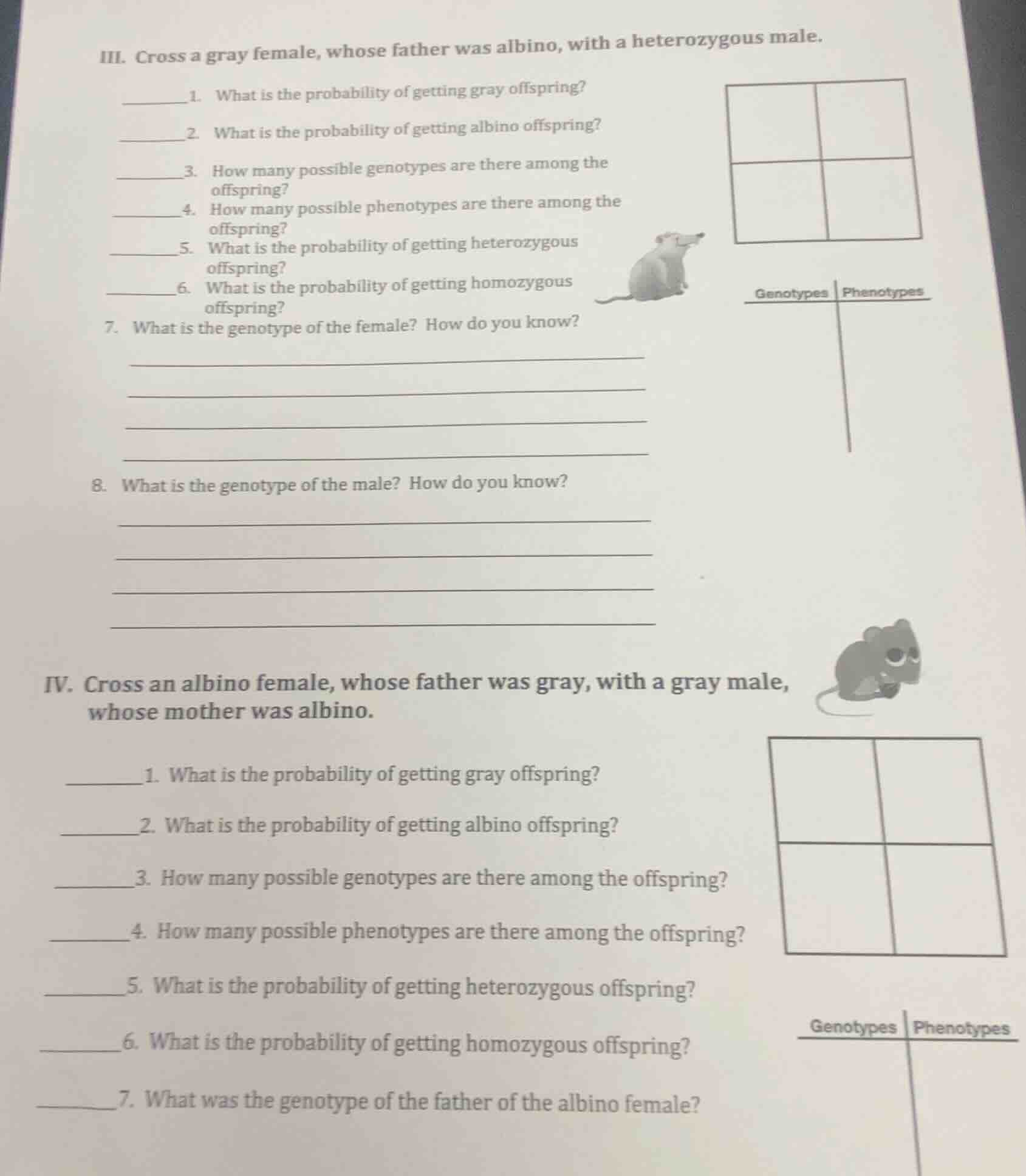
iii. cross a gray female, whose father was albino, with a heterozygous male.
- what is the probability of getting gray offspring?
- what is the probability of getting albino offspring?
- how many possible genotypes are there among the offspring?
- how many possible phenotypes are there among the offspring?
- what is the probability of getting heterozygous offspring?
- what is the probability of getting homozygous offspring?
- what is the genotype of the female? how do you know?
- what is the genotype of the male? how do you know?
iv. cross an albino female, whose father was gray, with a gray male, whose mother was albino.
- what is the probability of getting gray offspring?
- what is the probability of getting albino offspring?
- how many possible genotypes are there among the offspring?
- how many possible phenotypes are there among the offspring?
- what is the probability of getting heterozygous offspring?
- what is the probability of getting homozygous offspring?
- what was the genotype of the father of the albino female?
III. Cross a gray female (father was albino) with a heterozygous male
Step 1: Determine genotypes
- Let gray be dominant (\(G\)) and albino be recessive (\(g\)).
- Albino father of the female: genotype \(gg\) (recessive trait). He passes one \(g\) to the female.
- Female is gray (dominant phenotype), so her genotype must be \(Gg\) (since she received \(g\) from father, needs \(G\) to be gray).
- Male is heterozygous: genotype \(Gg\).
Step 2: Set up Punnett square
| \(G\) | \(g\) | |
|---|---|---|
| \(g\) | \(Gg\) | \(gg\) |
1. Probability of gray offspring
Gray genotypes: \(GG\), \(Gg\), \(Gg\) (3 out of 4).
Probability: \(\frac{3}{4}\) or \(75\%\).
2. Probability of albino offspring
Albino genotype: \(gg\) (1 out of 4).
Probability: \(\frac{1}{4}\) or \(25\%\).
3. Possible genotypes among offspring
Genotypes: \(GG\), \(Gg\), \(gg\) → 3 types.
4. Possible phenotypes among offspring
Phenotypes: gray (\(GG\), \(Gg\)) and albino (\(gg\)) → 2 types.
5. Probability of heterozygous (\(Gg\)) offspring
Heterozygous genotypes: \(Gg\), \(Gg\) (2 out of 4).
Probability: \(\frac{2}{4} = \frac{1}{2}\) or \(50\%\).
6. Probability of homozygous offspring
Homozygous genotypes: \(GG\), \(gg\) (2 out of 4).
Probability: \(\frac{2}{4} = \frac{1}{2}\) or \(50\%\).
7. Genotype of the female
The female’s genotype is \(Gg\). Her father (albino) has \(gg\), so he must pass \(g\). Since she is gray (dominant), she needs \(G\), so \(Gg\).
8. Genotype of the male
The male is heterozygous, so genotype \(Gg\) (given as “heterozygous male”).
---
IV. Cross an albino female (father was gray) with a gray male (mother was albino)
Step 1: Determine genotypes
- Albino female: genotype \(gg\) (recessive trait).
- Her father was gray: he must be \(Gg\) (to pass \(g\) to albino daughter, and show gray phenotype).
- Gray male: his mother was albino (\(gg\)), so he received \(g\) from mother. He is gray (dominant), so genotype \(Gg\).
Step 2: Set up Punnett square
| \(G\) | \(g\) | |
|---|---|---|
| \(g\) | \(Gg\) | \(gg\) |
1. Probability of gray offspring
Gray genotypes: \(Gg\), \(Gg\) (2 out of 4).
Probability: \(\frac{2}{4} = \frac{1}{2}\) or \(50\%\).
2. Probability of albino offspring
Albino genotypes: \(gg\), \(gg\) (2 out of 4).
Probability: \(\frac{2}{4} = \frac{1}{2}\) or \(50\%\).
3. Possible genotypes among offspring
Genotypes: \(Gg\), \(gg\) → 2 types.
4. Possible phenotypes among offspring
Phenotypes: gray (\(Gg\)) and albino (\(gg\)) → 2 types.
5. Probability of heterozygous (\(Gg\)) offspring
Heterozygous genotypes: \(Gg\), \(Gg\) (2 out of 4).
Probability: \(\frac{2}{4} = \frac{1}{2}\) or \(50\%\).
6. Probability of homozygous offspring
Homozygous genotype: \(gg\), \(gg\) (2 out of 4).
Probability: \(\frac{2}{4} = \frac{1}{2}\) or \(50\%\).
7. Genotype of the albino female’s father
The father was gray (dominant) and had an albino daughter (\(gg\)). He must pass \(g\) to his daughter, so his genotype is \(Gg\) (dominant phenotype with one recessive allele to pass).
---
Final Answers (III)
- \(\boldsymbol{\frac{3}{4}}\)
- \(\boldsymbol{\frac{1}{4}}\)
- \(\boldsymbol{3}\)
- \(\boldsymbol{2}\)
- \(\boldsymbol{\frac{1}{2}}\)
- \(\boldsymbol{\frac{1}{2}}\)
- Genotype: \(\boldsymbol{Gg}\) (explanation: Father is \(gg\) (albino), so female gets \(g\); she is gray, so needs \(G\), hence \(Gg\).)
- Genotype: \(\boldsymbol{Gg}\) (explanation: Given as heter…

Snap & solve any problem in the app
Get step-by-step solutions on Sovi AI
Photo-based solutions with guided steps
Explore more problems and detailed explanations
III. Cross a gray female (father was albino) with a heterozygous male
Step 1: Determine genotypes
- Let gray be dominant (\(G\)) and albino be recessive (\(g\)).
- Albino father of the female: genotype \(gg\) (recessive trait). He passes one \(g\) to the female.
- Female is gray (dominant phenotype), so her genotype must be \(Gg\) (since she received \(g\) from father, needs \(G\) to be gray).
- Male is heterozygous: genotype \(Gg\).
Step 2: Set up Punnett square
| \(G\) | \(g\) | |
|---|---|---|
| \(g\) | \(Gg\) | \(gg\) |
1. Probability of gray offspring
Gray genotypes: \(GG\), \(Gg\), \(Gg\) (3 out of 4).
Probability: \(\frac{3}{4}\) or \(75\%\).
2. Probability of albino offspring
Albino genotype: \(gg\) (1 out of 4).
Probability: \(\frac{1}{4}\) or \(25\%\).
3. Possible genotypes among offspring
Genotypes: \(GG\), \(Gg\), \(gg\) → 3 types.
4. Possible phenotypes among offspring
Phenotypes: gray (\(GG\), \(Gg\)) and albino (\(gg\)) → 2 types.
5. Probability of heterozygous (\(Gg\)) offspring
Heterozygous genotypes: \(Gg\), \(Gg\) (2 out of 4).
Probability: \(\frac{2}{4} = \frac{1}{2}\) or \(50\%\).
6. Probability of homozygous offspring
Homozygous genotypes: \(GG\), \(gg\) (2 out of 4).
Probability: \(\frac{2}{4} = \frac{1}{2}\) or \(50\%\).
7. Genotype of the female
The female’s genotype is \(Gg\). Her father (albino) has \(gg\), so he must pass \(g\). Since she is gray (dominant), she needs \(G\), so \(Gg\).
8. Genotype of the male
The male is heterozygous, so genotype \(Gg\) (given as “heterozygous male”).
---
IV. Cross an albino female (father was gray) with a gray male (mother was albino)
Step 1: Determine genotypes
- Albino female: genotype \(gg\) (recessive trait).
- Her father was gray: he must be \(Gg\) (to pass \(g\) to albino daughter, and show gray phenotype).
- Gray male: his mother was albino (\(gg\)), so he received \(g\) from mother. He is gray (dominant), so genotype \(Gg\).
Step 2: Set up Punnett square
| \(G\) | \(g\) | |
|---|---|---|
| \(g\) | \(Gg\) | \(gg\) |
1. Probability of gray offspring
Gray genotypes: \(Gg\), \(Gg\) (2 out of 4).
Probability: \(\frac{2}{4} = \frac{1}{2}\) or \(50\%\).
2. Probability of albino offspring
Albino genotypes: \(gg\), \(gg\) (2 out of 4).
Probability: \(\frac{2}{4} = \frac{1}{2}\) or \(50\%\).
3. Possible genotypes among offspring
Genotypes: \(Gg\), \(gg\) → 2 types.
4. Possible phenotypes among offspring
Phenotypes: gray (\(Gg\)) and albino (\(gg\)) → 2 types.
5. Probability of heterozygous (\(Gg\)) offspring
Heterozygous genotypes: \(Gg\), \(Gg\) (2 out of 4).
Probability: \(\frac{2}{4} = \frac{1}{2}\) or \(50\%\).
6. Probability of homozygous offspring
Homozygous genotype: \(gg\), \(gg\) (2 out of 4).
Probability: \(\frac{2}{4} = \frac{1}{2}\) or \(50\%\).
7. Genotype of the albino female’s father
The father was gray (dominant) and had an albino daughter (\(gg\)). He must pass \(g\) to his daughter, so his genotype is \(Gg\) (dominant phenotype with one recessive allele to pass).
---
Final Answers (III)
- \(\boldsymbol{\frac{3}{4}}\)
- \(\boldsymbol{\frac{1}{4}}\)
- \(\boldsymbol{3}\)
- \(\boldsymbol{2}\)
- \(\boldsymbol{\frac{1}{2}}\)
- \(\boldsymbol{\frac{1}{2}}\)
- Genotype: \(\boldsymbol{Gg}\) (explanation: Father is \(gg\) (albino), so female gets \(g\); she is gray, so needs \(G\), hence \(Gg\).)
- Genotype: \(\boldsymbol{Gg}\) (explanation: Given as heterozygous.)
Final Answers (IV)
- \(\boldsymbol{\frac{1}{2}}\)
- \(\boldsymbol{\frac{1}{2}}\)
- \(\boldsymbol{2}\)
- \(\boldsymbol{2}\)
- \(\boldsymbol{\frac{1}{2}}\)
- \(\boldsymbol{\frac{1}{2}}\)
- Genotype: \(\boldsymbol{Gg}\) (explanation: Father is gray (dominant) and has an albino daughter (\(gg\)), so he must carry \(g\) (genotype \(Gg\)).)