QUESTION IMAGE
Question
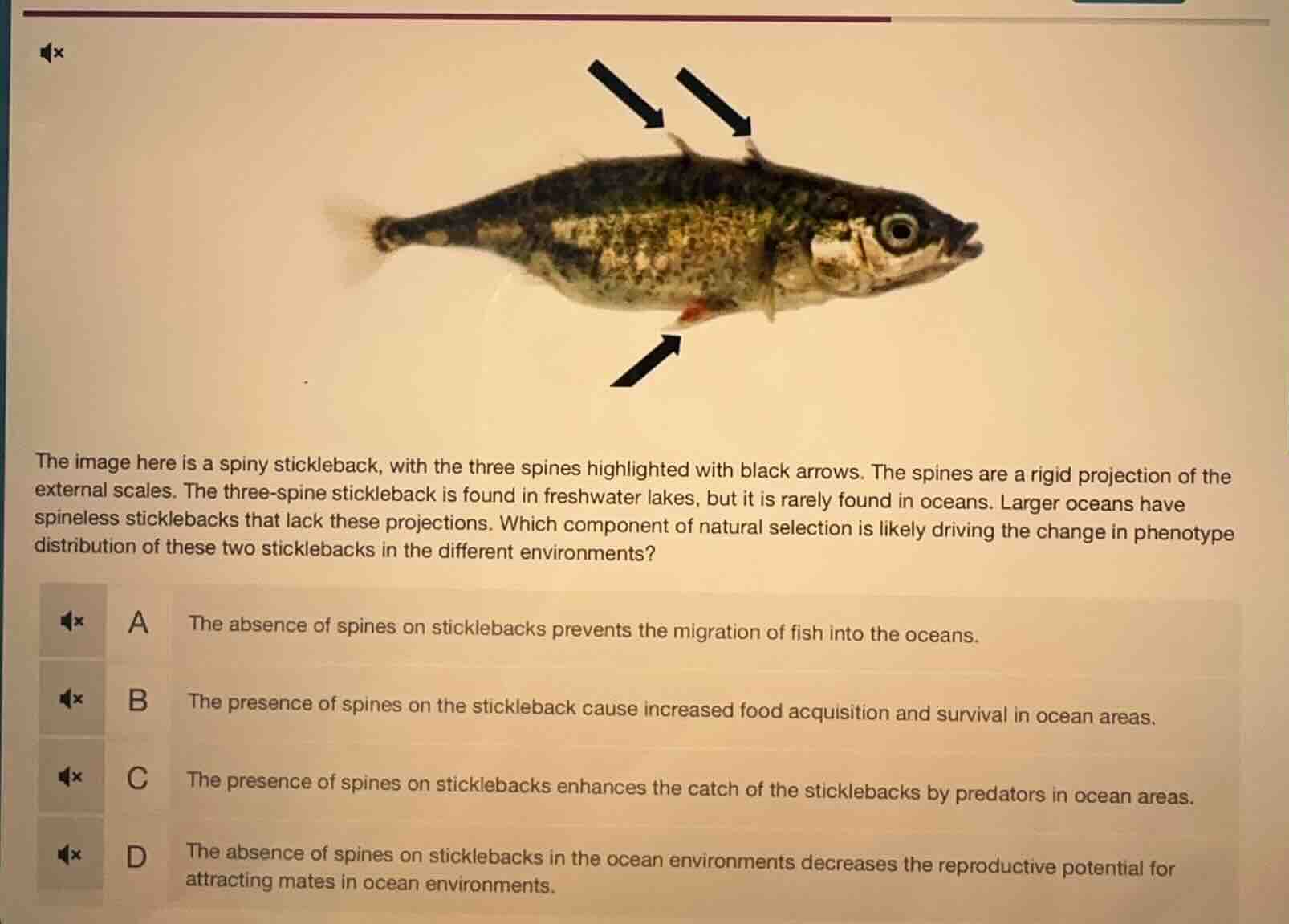
the image here is a spiny stickleback, with the three spines highlighted with black arrows. the spines are a rigid projection of the external scales. the three - spine stickleback is found in freshwater lakes, but it is rarely found in oceans. larger oceans have spineless sticklebacks that lack these projections. which component of natural selection is likely driving the change in phenotype distribution of these two sticklebacks in the different environments?
a the absence of spines on sticklebacks prevents the migration of fish into the oceans.
b the presence of spines on the stickleback cause increased food acquisition and survival in ocean areas.
c the presence of spines on sticklebacks enhances the catch of the sticklebacks by predators in ocean areas.
d the absence of spines on sticklebacks in the ocean environments decreases the reproductive potential for attracting mates in ocean environments.
To solve this, we analyze each option:
- Option A: The question is about natural selection driving phenotype change, not migration prevention. Eliminate A.
- Option B: If spines helped in food acquisition and survival in oceans, we'd expect spiny sticklebacks there, but they're rare. Eliminate B.
- Option C: If spines make sticklebacks easier for predators to catch in oceans, spineless ones would be favored (natural selection), which matches the observation (spiny in fresh water, spineless in oceans). This makes sense.
- Option D: There's no info suggesting spines affect mate attraction. Eliminate D.

Snap & solve any problem in the app
Get step-by-step solutions on Sovi AI
Photo-based solutions with guided steps
Explore more problems and detailed explanations
C. The presence of spines on sticklebacks enhances the catch of the sticklebacks by predators in ocean areas.