QUESTION IMAGE
Question
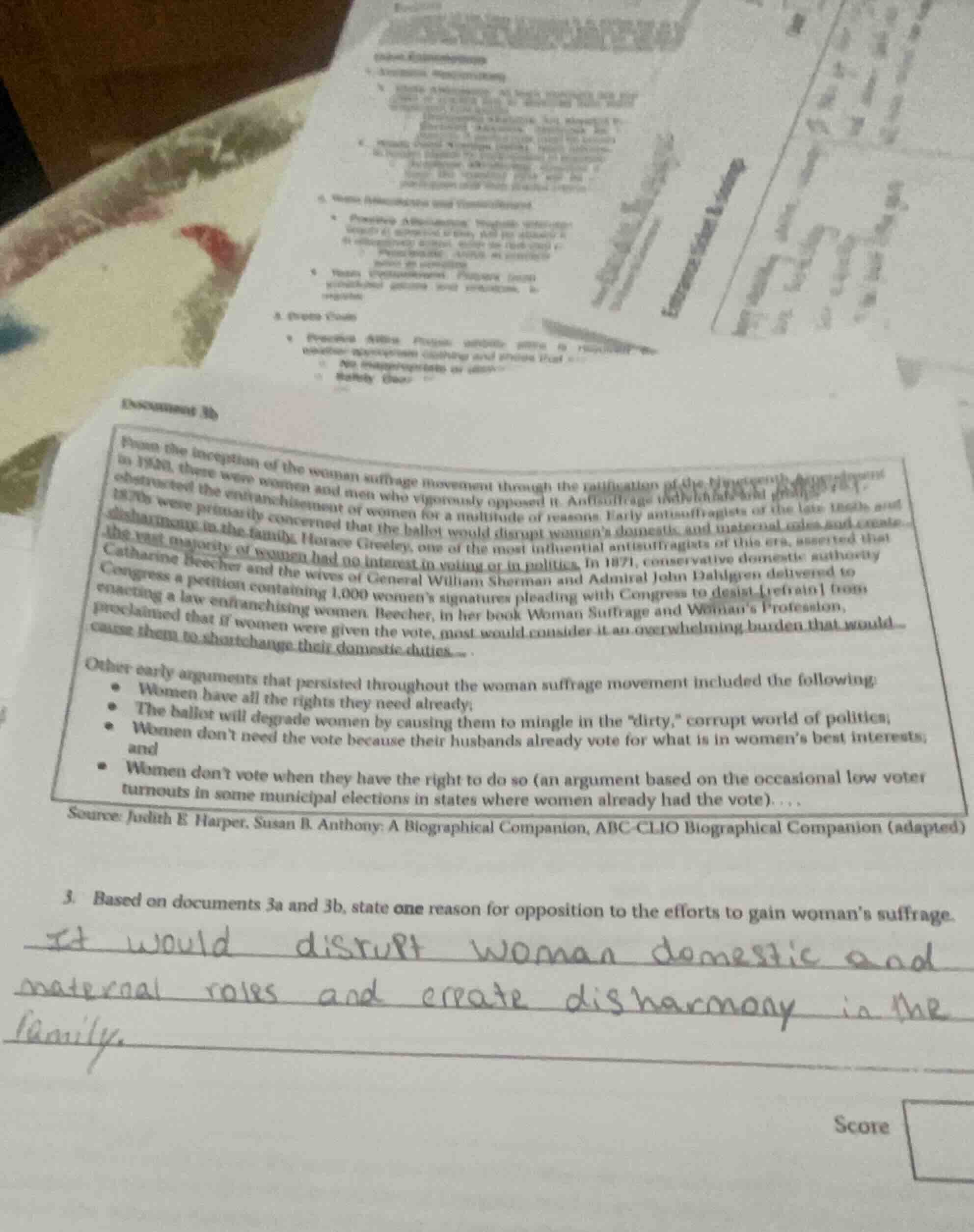
from the inception of the woman suffrage movement through the ratification of the nineteenth amendment in 1920, there were women and men who vigorously opposed it. antisuffrage individuals and groups obstructed the enfranchisement of women for a multitude of reasons. early antisuffragists of the late 1860s and 1870s were primarily concerned that the ballot would disrupt women’s domestic and maternal roles and create disharmony in the family. horace greeley, one of the most influential antisuffragists of this era, asserted that the vast majority of women had no interest in voting or in politics. in 1871, conservative domestic authority catharine beecher and the wives of general william sherman and admiral john dahlgren delivered to congress a petition containing 1,000 women’s signatures pleading with congress to desist refrain from enacting a law enfranchising women. beecher, in her book woman suffrage and woman’s profession, proclaimed that if women were given the vote, most would consider it an overwhelming burden that would cause them to shortchange their domestic duties.... other early arguments that persisted throughout the woman suffrage movement included the following: - women have all the rights they need already; - the ballot will degrade women by causing them to mingle in the “dirty,” corrupt world of politics; - women don’t need the vote because their husbands already vote for what is in women’s best interests; and - women don’t vote when they have the right to do so (an argument based on the occasional low voter turnouts in some municipal elections in states where women already had the vote).... source: judith e harper, susan b anthony: a biographical companion, abc - clio biographical companion (adapted) 3. based on documents 3a and 3b, state one reason for opposition to the efforts to gain woman’s suffrage.
To answer this, we analyze Document 3b. It lists several reasons for opposing women's suffrage. One key reason is that antisuffragists believed the ballot would disrupt women’s domestic and maternal roles, creating family disharmony. Another is that many thought women had no interest in voting/politics, or that voting would burden them and make them neglect domestic duties. We can pick one, like the disruption of domestic roles.

Snap & solve any problem in the app
Get step-by-step solutions on Sovi AI
Photo-based solutions with guided steps
Explore more problems and detailed explanations
One reason for opposition to woman’s suffrage was that antisuffragists believed the ballot would disrupt women’s domestic and maternal roles and create disharmony in the family. (Other valid reasons from the document, such as the belief that most women had no interest in voting or politics, or that voting would be an overwhelming burden causing neglect of domestic duties, would also be acceptable.)