QUESTION IMAGE
Question
industrial growth
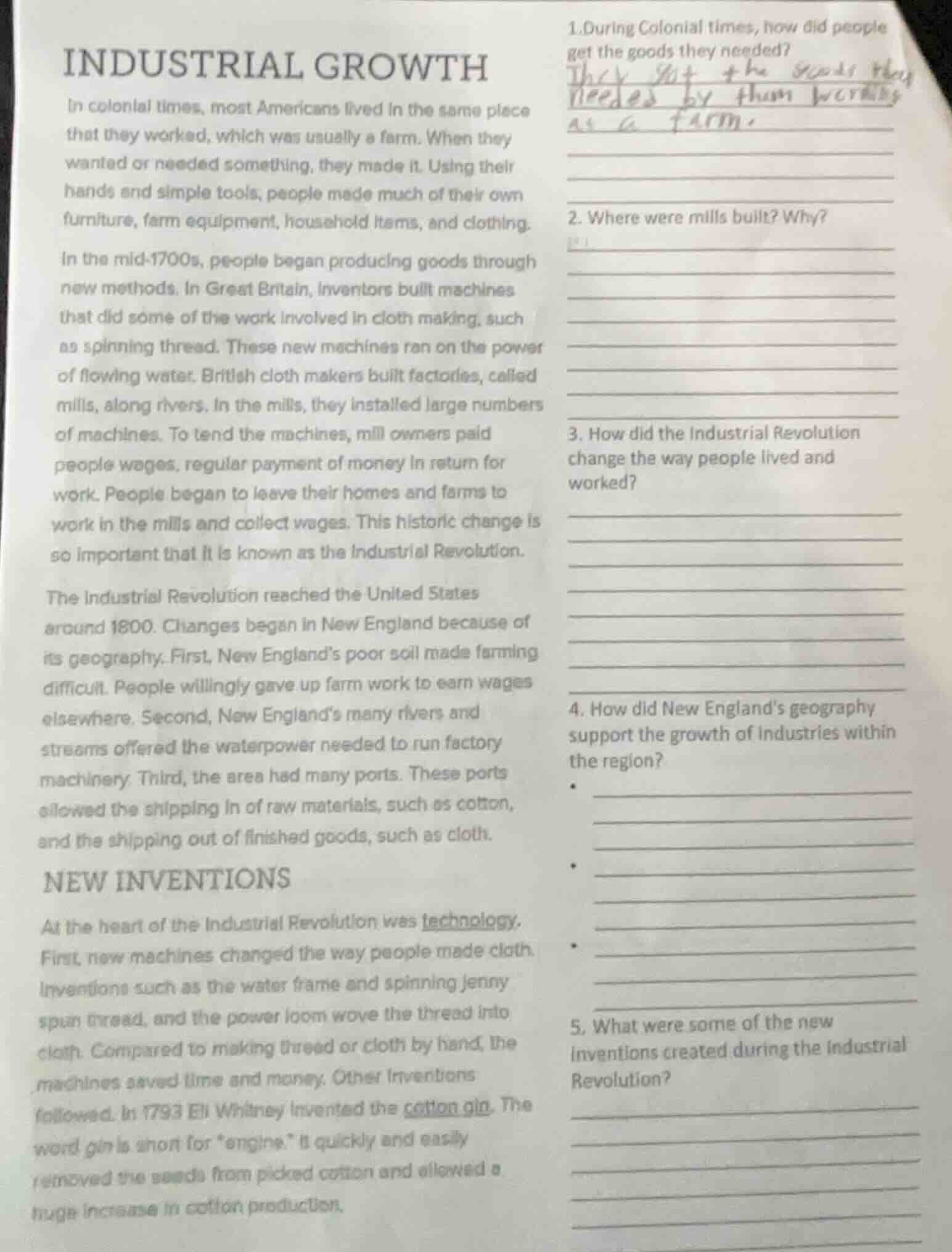
in colonial times, most americans lived in the same piece that they worked, which was usually a farm. when they wanted or needed something, they made it. using their hands and simple tools, people made much of their own furniture, farm equipment, household items, and clothing.
in the mid-1700s, people began producing goods through new methods. in great britain, inventors built machines that did some of the work involved in cloth making, such as spinning thread. these new machines ran on the power of flowing water. british cloth makers built factories, called mills, along rivers. in the mills, they installed large numbers of machines. to tend the machines, mill owners paid people wages, regular payment of money in return for work. people began to leave their homes and farms to work in the mills and collect wages. this historic change is so important that it is known as the industrial revolution.
the industrial revolution reached the united states around 1800. changes began in new england because of its geography. first, new englands poor soil made farming difficult. people willingly gave up farm work to earn wages elsewhere. second, new englands many rivers and streams offered the waterpower needed to run factory machinery. third, the area had many ports. these ports allowed the shipping in of raw materials, such as cotton, and the shipping out of finished goods, such as cloth.
new inventions
at the heart of the industrial revolution was technology. first, new machines changed the way people made cloth. inventions such as the water frame and spinning jenny spun thread, and the power loom wove the thread into cloth. compared to making thread or cloth by hand, the machines saved time and money. other inventions followed. in 1793 eli whitney invented the cotton gin. the word gin is short for \engine.\ it quickly and easily removed the seeds from picked cotton and allowed a huge increase in cotton production.
1.during colonial times, how did people get the goods they needed?
- where were mills built? why?
- how did the industrial revolution change the way people lived and worked?
- how did new englands geography support the growth of industries within the region?
- what were some of the new inventions created during the industrial revolution?
- Uses the provided text about colonial self-sufficiency to answer.
- References the text's details on mill location and power source.
- Summarizes the core shift from home production to wage labor in mills.
- Breaks down the three geographic factors from the text.
- Lists the specific inventions named in the text.

Snap & solve any problem in the app
Get step-by-step solutions on Sovi AI
Photo-based solutions with guided steps
Explore more problems and detailed explanations
- Most people made the goods they needed themselves using their hands and simple tools on their farms.
- Mills were built along rivers. The new machines used to make cloth ran on the power of flowing water, so rivers provided the necessary power for the mills.
- Instead of making goods by hand on their own farms, people began leaving their homes to work in mills for regular wages, shifting from self-sufficient home production to factory-based wage labor.
- - New England's poor soil made farming difficult, so people were willing to leave farm work for industrial jobs.
- Its many rivers and streams provided the waterpower needed to run factory machinery.
- The region had many ports, which allowed for shipping in raw materials (like cotton) and shipping out finished goods (like cloth).
- Some new inventions included the water frame, spinning jenny, power loom, and cotton gin.