QUESTION IMAGE
Question
interactive
lesson 4: why is there a higher frequency of sickle cell disease in some parts of the world? sickle cell disease storyline student handout
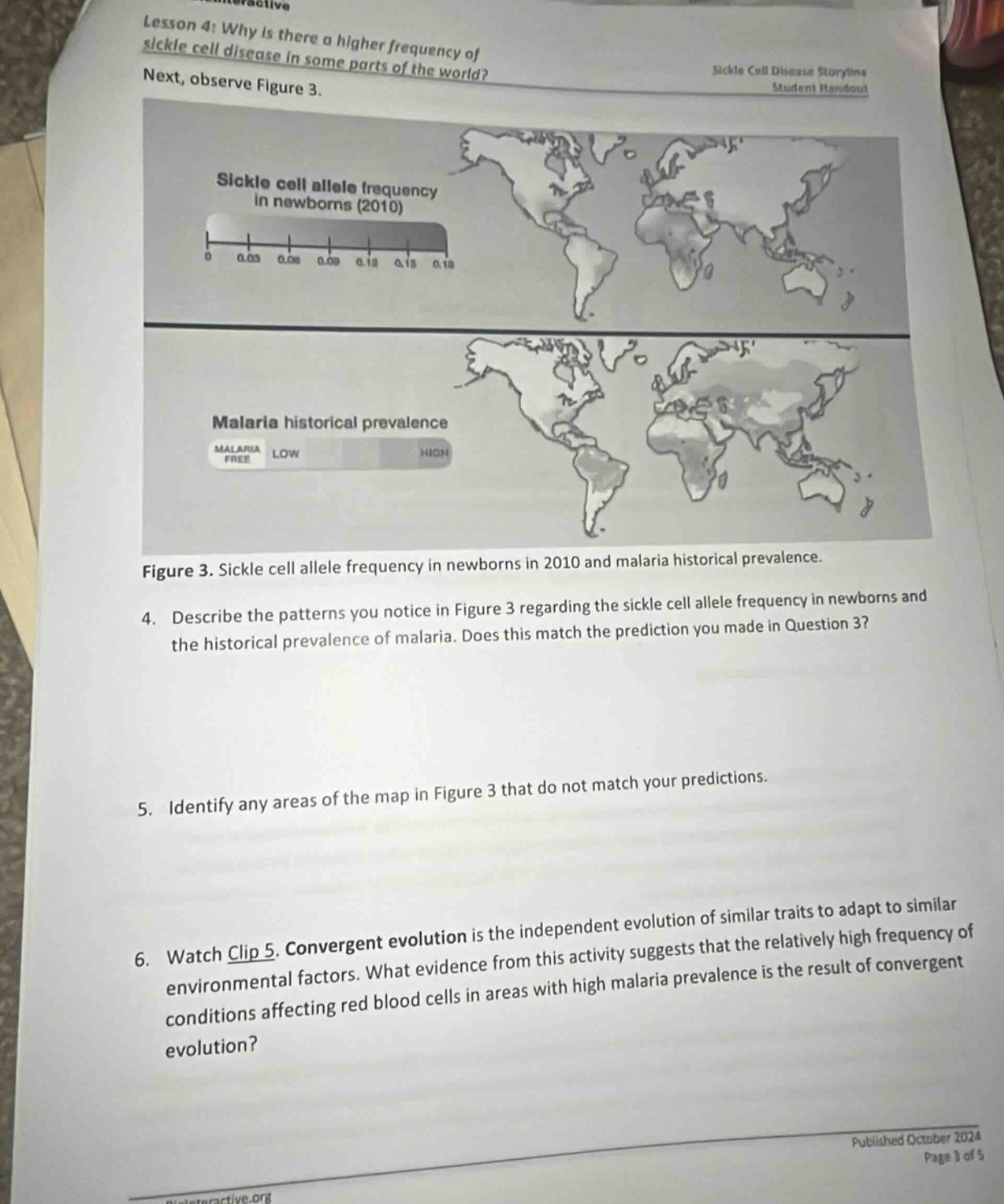
next, observe figure 3.
figure 3. sickle cell allele frequency in newborns in 2010 and malaria historical prevalence.
- describe the patterns you notice in figure 3 regarding the sickle cell allele frequency in newborns and the historical prevalence of malaria. does this match the prediction you made in question 3?
- identify any areas of the map in figure 3 that do not match your predictions.
- watch clip 5. convergent evolution is the independent evolution of similar traits to adapt to similar environmental factors. what evidence from this activity suggests that the relatively high frequency of conditions affecting red blood cells in areas with high malaria prevalence is the result of convergent evolution?
published october 2024
page 3 of 5
For Question 4:
The maps show that regions with high historical malaria prevalence (sub-Saharan Africa, parts of South Asia, and the Caribbean) have the highest frequencies of the sickle cell allele in newborns. Regions with low or no malaria (Europe, North America, most of East Asia) have very low sickle cell allele frequencies. This matches the typical prediction that sickle cell allele frequency correlates with malaria prevalence, as the heterozygous sickle cell trait provides resistance to malaria.
For Question 5:
One notable mismatch is parts of the Arabian Peninsula: it has relatively high historical malaria prevalence but lower sickle cell allele frequency than predicted. Additionally, some regions in South America have moderate malaria prevalence but lower sickle cell allele frequencies compared to similar malaria-prevalent areas in Africa, likely due to differences in population genetic history.
For Question 6:
The evidence is that the high frequency of red blood cell variants (like the sickle cell allele) independently evolved in geographically separate regions (sub-Saharan Africa, parts of India, the Caribbean) that all have high historical malaria prevalence. These distinct populations developed similar red blood cell adaptations to the same environmental pressure (malaria) without shared ancestral genetic links, which fits the definition of convergent evolution.

Snap & solve any problem in the app
Get step-by-step solutions on Sovi AI
Photo-based solutions with guided steps
Explore more problems and detailed explanations
- Regions with high historical malaria prevalence (e.g., sub-Saharan Africa, parts of South Asia) have the highest sickle cell allele frequencies, while low/no malaria regions (e.g., Europe, North America) have very low frequencies. This matches the standard prediction of a positive correlation between the two.
- Mismatched areas include parts of the Arabian Peninsula (high malaria, low sickle cell allele frequency) and some South American regions (moderate malaria, lower sickle cell allele frequency than comparable African regions).
- The independent evolution of high frequencies of red blood cell adaptations (like the sickle cell allele) in geographically separate regions with high malaria prevalence (sub-Saharan Africa, parts of India, the Caribbean) serves as evidence for convergent evolution, as these traits arose separately to adapt to the same environmental pressure.