QUESTION IMAGE
Question
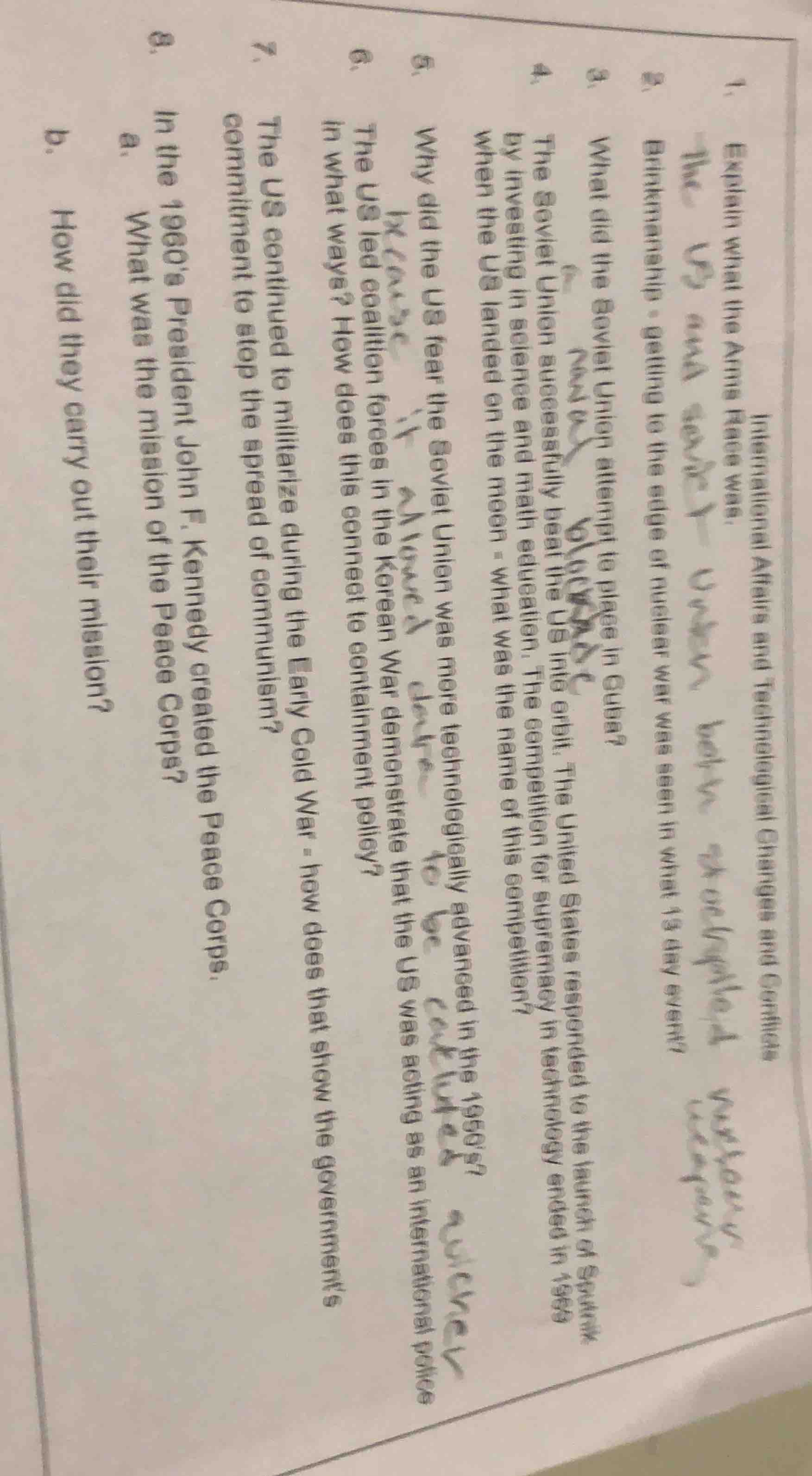
international affairs and technological changes and conflicts
- explain what the arms race was.
- the us and soviet union before explored nuclear warfare
brinkmanship - getting to the edge of nuclear war was seen in what 13 day event?
- what did the soviet union attempt to place in cuba?
- the soviet union successfully beat the us into orbit. the united states responded to the launch of sputnik by investing in science and math education. the competition for supremacy in technology ended in 1969 when the us landed on the moon - what was the name of this competition?
- why did the us fear the soviet union was more technologically advanced in the 1950’s?
- the us led coalition forces in the korean war demonstrate that the us was acting as an international police in what ways? how does this connect to containment policy?
- the us continued to militarize during the early cold war - how does that show the government’s commitment to stop the spread of communism?
- in the 1960’s president john f. kennedy created the peace corps.
a. what was the mission of the peace corps?
b. how did they carry out their mission?
- The Arms Race was a Cold War competition between the U.S. and Soviet Union to develop and stockpile increasingly powerful nuclear and conventional military weapons, driven by mutual distrust and the goal of deterrence.
- Brinkmanship at the edge of nuclear war was seen in the 13-day Cuban Missile Crisis (October 1962), where the U.S. and USSR nearly clashed over Soviet nuclear missiles in Cuba.
- The Soviet Union attempted to place nuclear missiles in Cuba to counter U.S. missile deployments in Turkey and strengthen its strategic position against the U.S.
- This competition for technological supremacy was called the Space Race.
- The U.S. feared Soviet technological advancement in the 1950s because it suggested the USSR could develop long-range nuclear missiles that could strike the U.S. mainland, undermining American security.
- The U.S. led a UN-authorized coalition in the Korean War to push back against North Korean (Soviet/Chinese-backed) expansion into South Korea. This aligned with containment policy, which aimed to stop the spread of communism by opposing its expansion globally.
- The U.S. militarized by expanding its nuclear arsenal, creating NATO, increasing defense spending, and developing new weapons systems. This reflected the government's commitment to containment, using military buildup to deter communist expansion and respond to Soviet aggression.
8a. The Peace Corps' mission was to provide technical assistance, promote mutual understanding between Americans and people in developing nations, and support grassroots development projects.
8b. Volunteers lived and worked in host countries, sharing skills in areas like education, agriculture, and healthcare, while learning local cultures to foster cross-cultural exchange.

Snap & solve any problem in the app
Get step-by-step solutions on Sovi AI
Photo-based solutions with guided steps
Explore more problems and detailed explanations
- The Arms Race was a Cold War-era competition between the United States and the Soviet Union to build and stockpile more advanced, destructive nuclear and conventional military weaponry, fueled by mutual suspicion and a desire for strategic deterrence.
- Cuban Missile Crisis (October 1962)
- The Soviet Union attempted to place nuclear missiles in Cuba.
- Space Race
- The U.S. feared the Soviet Union could develop intercontinental ballistic missiles (ICBMs) capable of delivering nuclear warheads to the U.S. mainland, threatening national security.
- The U.S. led a UN coalition to defend South Korea from communist North Korean invasion. This directly implemented containment policy, as it blocked the spread of communism into South Korea.
- The U.S. expanded its nuclear weapons program, formed the North Atlantic Treaty Organization (NATO), increased military spending, and developed new defense technologies. This demonstrated the government's commitment to containment by using military buildup to deter and counter Soviet communist expansion.
8a. The mission was to provide technical aid to developing nations, foster cross-cultural understanding between Americans and global communities, and support grassroots development.
8b. Volunteers lived in host countries, worked on local projects (e.g., teaching, agricultural support, healthcare assistance), and engaged with local communities to share skills and build mutual respect.