QUESTION IMAGE
Question
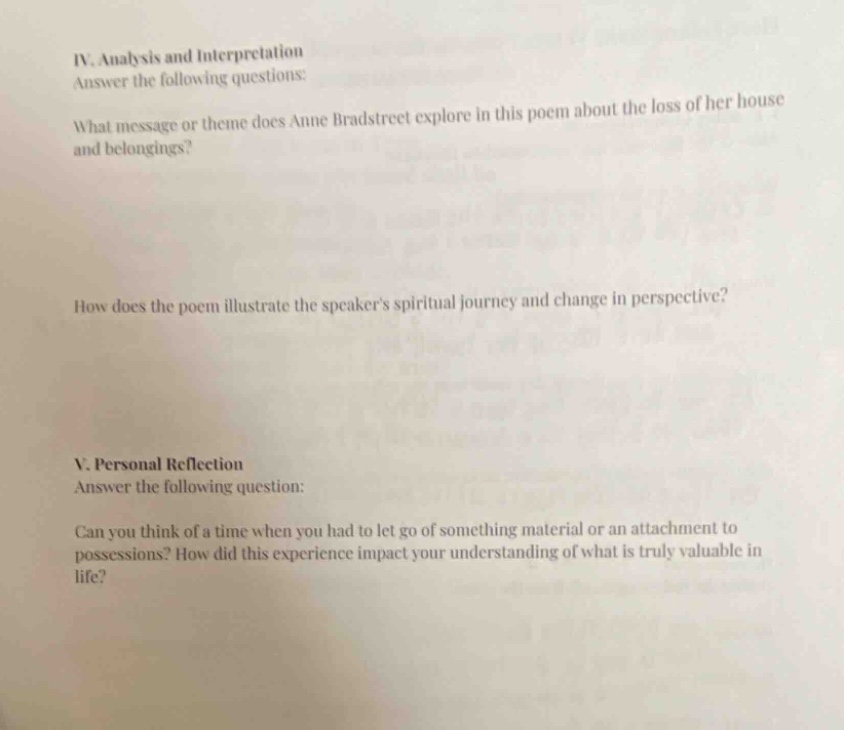
iv. analysis and interpretation
answer the following questions:
what message or theme does anne bradstreet explore in this poem about the loss of her house and belongings?
how does the poem illustrate the speakers spiritual journey and change in perspective?
v. personal reflection
answer the following question:
can you think of a time when you had to let go of something material or an attachment to possessions? how did this experience impact your understanding of what is truly valuable in life?
For the first question:
Anne Bradstreet's poem (typically Upon the Burning of Our House, July 10th, 1666) explores the tension between earthly material attachment and spiritual devotion. She grapples with grief over lost worldly possessions but reframes the loss to emphasize that true, eternal "treasure" lies in heaven, not in temporary earthly goods.
For the second question:
The poem traces the speaker's shift from immediate, distraught grief over her physical home and belongings (crying out over her lost "goods and store") to a spiritual awakening. Through a divine reminder (the voice that tells her "Thou hast an house on high erect"), she moves from mourning earthly loss to embracing the idea that her true home is in heaven, letting go of material attachment and reframing her perspective to prioritize spiritual wealth.
For the third question:
(Example reflection) When I had to sell my childhood home after my parent's passing, I initially grieved the loss of physical memories stored there. Over time, I realized the true value was not the house itself, but the love and experiences shared within it—these were not tied to the material space, so my understanding shifted to prioritize intangible, relational and emotional treasures over physical possessions.

Snap & solve any problem in the app
Get step-by-step solutions on Sovi AI
Photo-based solutions with guided steps
Explore more problems and detailed explanations
- Anne Bradstreet explores the theme of letting go of earthly material attachment to prioritize eternal spiritual treasure, contrasting temporary worldly possessions with the enduring "home" and wealth in heaven.
- The poem illustrates the speaker's spiritual journey by first depicting raw grief over her burned house and belongings, then a divine-inspired shift in perspective: she moves from mourning physical loss to embracing the belief that her true, permanent home and treasures exist in heaven, freeing herself from material attachment.
- (Example answer) When I had to donate my late grandmother's old furniture during a move, I was devastated at first, clinging to the physical items as a link to her. Over time, I realized the real value was the stories and love tied to her, not the furniture. This experience taught me that intangible memories and relationships are far more valuable than physical possessions.