QUESTION IMAGE
Question
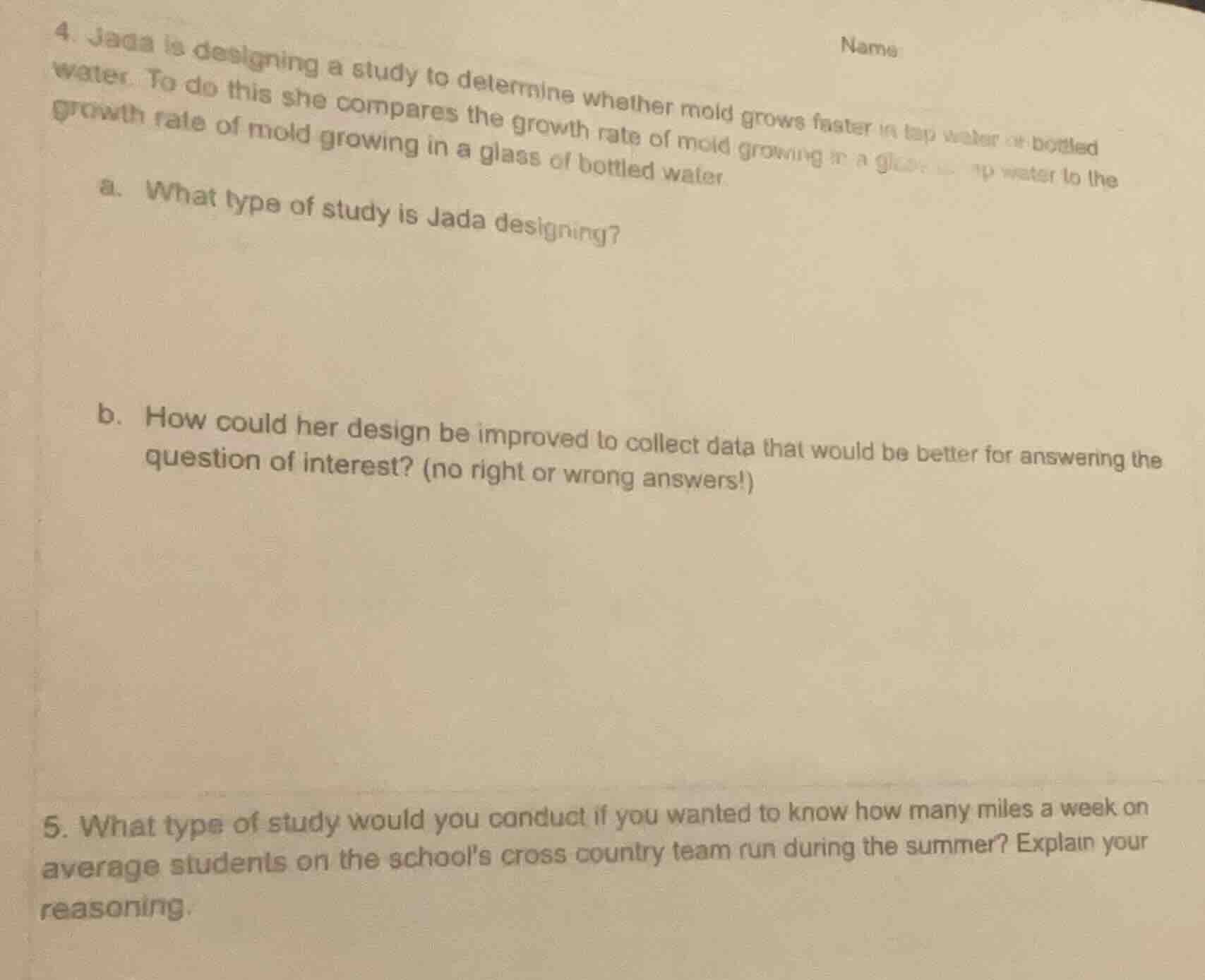
- jada is designing a study to determine whether mold grows faster in tap water or bottled water. to do this she compares the growth rate of mold growing in a glass of tap water to the growth rate of mold growing in a glass of bottled water
\ta. what type of study is jada designing?
\tb. how could her design be improved to collect data that would be better for answering the question of interest? (no right or wrong answers!)
- what type of study would you conduct if you wanted to know how many miles a week on average students on the school’s cross country team run during the summer? explain your reasoning.
4a
Jada is comparing mold growth in two types of water (tap and bottled) by observing their growth rates. This is an observational study (or a comparative study) as she is observing and comparing existing conditions without manipulating variables (like adding/removing factors) but just observing the growth in different water types.
To improve, she could use multiple samples (e.g., more than one glass of each water type) to reduce variability, control environmental factors (like temperature, humidity) to ensure they are the same for both groups, or use a standardized method to measure growth (like counting mold spores or measuring colony area at regular intervals).
To find the average miles run per week by cross - country team students in summer, a survey (or a descriptive study) would be appropriate. We can ask the students (or have them log their miles) to collect data on the number of miles they run each week during summer. Since we are just gathering data on an existing behavior (miles run) without manipulating any variables, a survey - based study (or a descriptive observational study) is suitable.

Snap & solve any problem in the app
Get step-by-step solutions on Sovi AI
Photo-based solutions with guided steps
Explore more problems and detailed explanations
It is an observational (or comparative) study. She is observing and comparing the mold growth rates in tap water and bottled water without manipulating other variables.