QUESTION IMAGE
Question
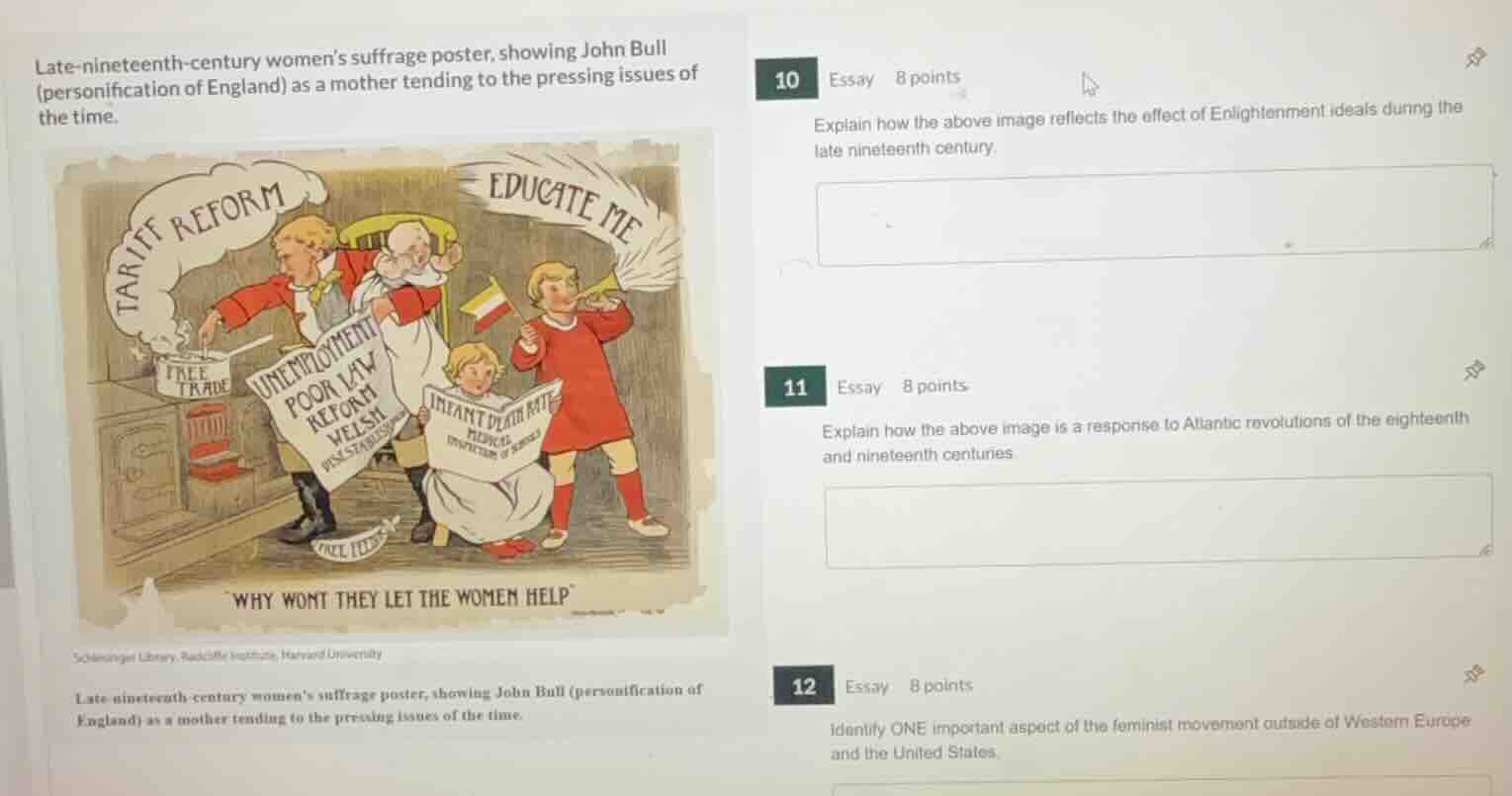
late - nineteenth - century women’s suffrage poster, showing john bull (personification of england) as a mother tending to the pressing issues of the time.
late nineteenth century women’s suffrage poster, showing john bull (personification of england) as a mother tending to the pressing issues of the time.
10 essay 8 points
explain how the above image reflects the effect of enlightenment ideals during the late nineteenth century.
11 essay 8 points
explain how the above image is a response to atlantic revolutions of the eighteenth and nineteenth centuries.
12 essay 8 points
identify one important aspect of the feminist movement outside of western europe and the united states.

Snap & solve any problem in the app
Get step-by-step solutions on Sovi AI
Photo-based solutions with guided steps
Explore more problems and detailed explanations
Question 10:
The poster reflects Enlightenment ideals through its embrace of reason, equality, and the social contract:
- Enlightenment emphasis on reason and education is visible in the child's demand "EDUCATE ME", aligning with ideals that knowledge (not traditional hierarchy) drives progress, and women argued their educated voices should address societal ills like poverty and unemployment shown in the poster.
- The core question "WHY WON'T THEY LET THE WOMEN HELP" draws on Enlightenment equality ideals. Thinkers like Rousseau challenged unjust hierarchies, and suffragists extended this to gender, arguing women (as rational beings) had a right to participate in solving public issues, just as men did, framing exclusion as a violation of the Enlightenment's push for fair, rational governance.
- The poster ties women's participation to solving collective social problems (unemployment, poor law reform), reflecting the Enlightenment social contract idea that society should work for the common good—suffragists argued women's perspectives were necessary to uphold this contract for all members of society.
Question 11:
The poster is a direct response to Atlantic revolutions (American, French, Haitian) in two key ways:
- Atlantic revolutions were rooted in the ideals of popular sovereignty and political participation (e.g., "no taxation without representation" in the American Revolution, the French Revolution's Declaration of the Rights of Man). The poster extends these unfulfilled ideals: it demands that women, who were excluded from the political rights promised by these revolutions, be allowed to participate in addressing societal issues. The revolutions opened a discourse about who deserved political voice, and suffragists used this framework to critique women's continued disenfranchisement.
- Many Atlantic revolutions also highlighted the gap between revolutionary ideals and lived inequality (e.g., enslavement persisting in the U.S. after independence, gender exclusion in France). The poster echoes this critique by pointing out that the "pressing issues" of the time (unemployment, poor living conditions) were not being fully addressed because half the population (women) was barred from contributing. It frames women's suffrage as a necessary step to complete the unfinished work of the Atlantic revolutions' push for a more inclusive, just society.
Question 12:
One important aspect of the feminist movement outside Western Europe and the U.S. is the Indian women's suffrage and social reform movement led by Sarojini Naidu and the All India Women's Conference (AIWC).
- Naidu, a poet and activist, advocated for women's voting rights alongside broader anti-colonial efforts, framing suffrage as part of India's fight for self-determination from British rule. The AIWC, founded in 1927, linked women's political rights to social reforms like ending child marriage, improving access to education for girls, and addressing gender-based violence. Unlike Western suffrage movements that often focused solely on voting rights, this movement was deeply intertwined with anti-colonialism, arguing that women's emancipation was critical to building a free, equitable post-colonial India. Indian women gained limited voting rights in 1919 (for property-owning women) and universal suffrage when India became independent in 1947.