QUESTION IMAGE
Question
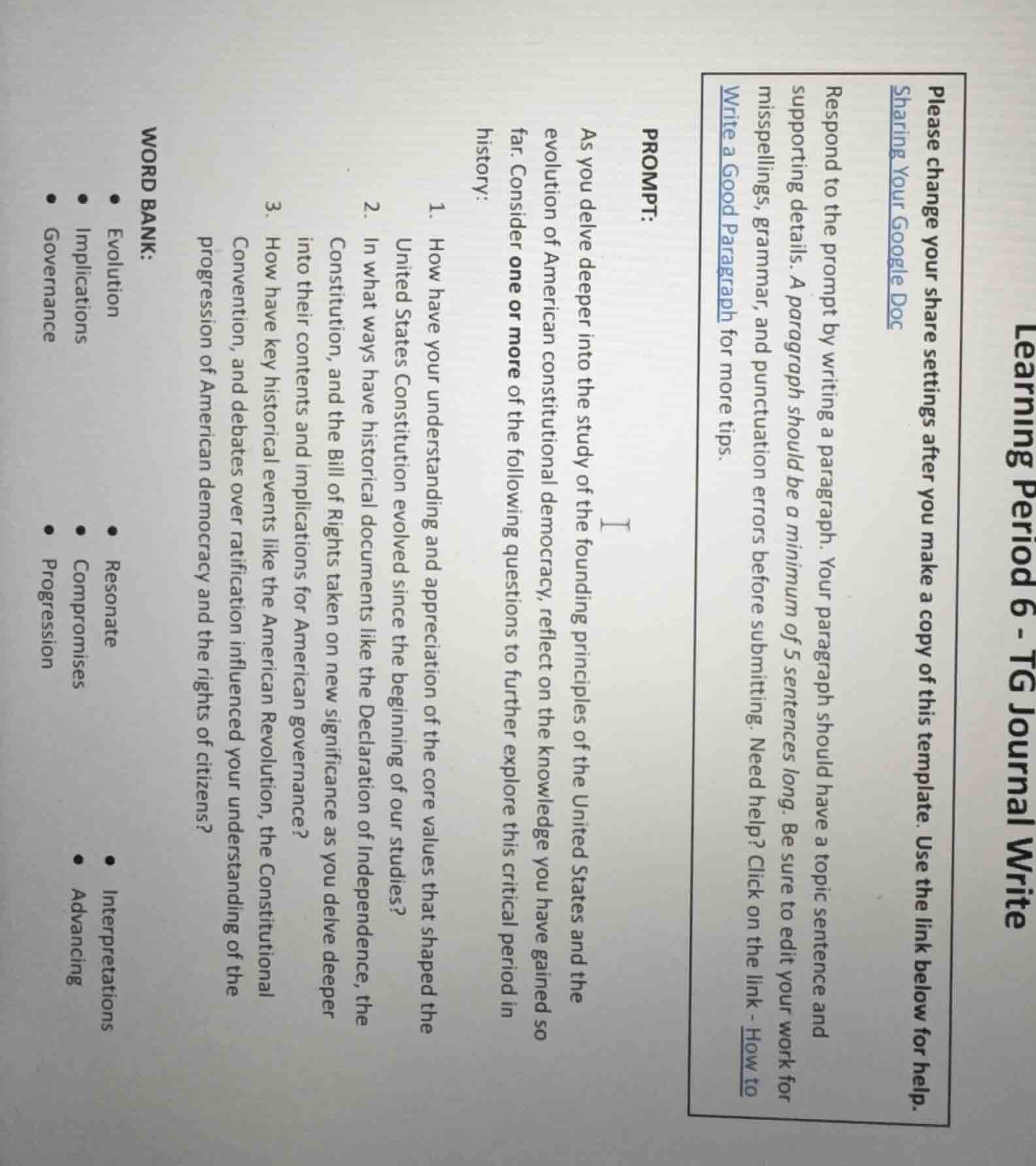
learning period 6 - tg journal write
please change your share settings after you make a copy of this template. use the link below for help.
sharing your google doc
respond to the prompt by writing a paragraph. your paragraph should have a topic sentence and supporting details. a paragraph should be a minimum of 5 sentences long. be sure to edit your work for misspellings, grammar, and punctuation errors before submitting. need help? click on the link - how to write a good paragraph for more tips.
prompt:
as you delve deeper into the study of the founding principles of the united states and the evolution of american constitutional democracy, reflect on the knowledge you have gained so far. consider one or more of the following questions to further explore this critical period in history:
- how have your understanding and appreciation of the core values that shaped the united states constitution evolved since the beginning of our studies?
- in what ways have historical documents like the declaration of independence, the constitution, and the bill of rights taken on new significance as you delve deeper into their contents and implications for american governance?
- how have key historical events like the american revolution, the constitutional convention, and debates over ratification influenced your understanding of the progression of american democracy and the rights of citizens?
word bank:
- evolution
- implications
- governance
- resonate
- compromises
- progression
- interpretations
- advancing
The paragraph focuses on how key historical events shaped the progression of American democracy and citizen rights, drawing on the study of founding principles and constitutional evolution. It uses a clear topic sentence, supporting details from critical historical events, and ties in core concepts from the word bank.

Snap & solve any problem in the app
Get step-by-step solutions on Sovi AI
Photo-based solutions with guided steps
Explore more problems and detailed explanations
The progression of American democracy and citizen rights has been deeply shaped by pivotal historical events and the compromises and debates that defined the nation’s founding era. The American Revolution, sparked by grievances over unrepresented taxation and authoritarian governance, laid the ideological groundwork for a system centered on popular sovereignty, a core value that would later be enshrined in the Declaration of Independence’s assertion that “governments derive their just powers from the consent of the governed.” The Constitutional Convention of 1787 further refined this vision, though bitter debates over state representation, federal power, and the exclusion of enslaved people exposed tensions that would reverberate through American history; the Great Compromise, which established a bicameral legislature, was a critical negotiation that balanced the interests of large and small states to preserve the fragile union. Ratification debates over the Constitution also led to the addition of the Bill of Rights, a set of amendments that codified fundamental citizen rights like freedom of speech and due process, addressing fears of an overreaching federal government and laying the foundation for future interpretations and expansions of civil liberties. Over time, these founding events and their associated compromises have continued to resonate, as subsequent movements for equality—from suffrage to civil rights—have drawn on the nation’s core founding values to push for a more inclusive and equitable democracy, demonstrating that the evolution of American governance is an ongoing process shaped by both its foundational principles and the struggles to live up to them.