QUESTION IMAGE
Question
length of telomeres:
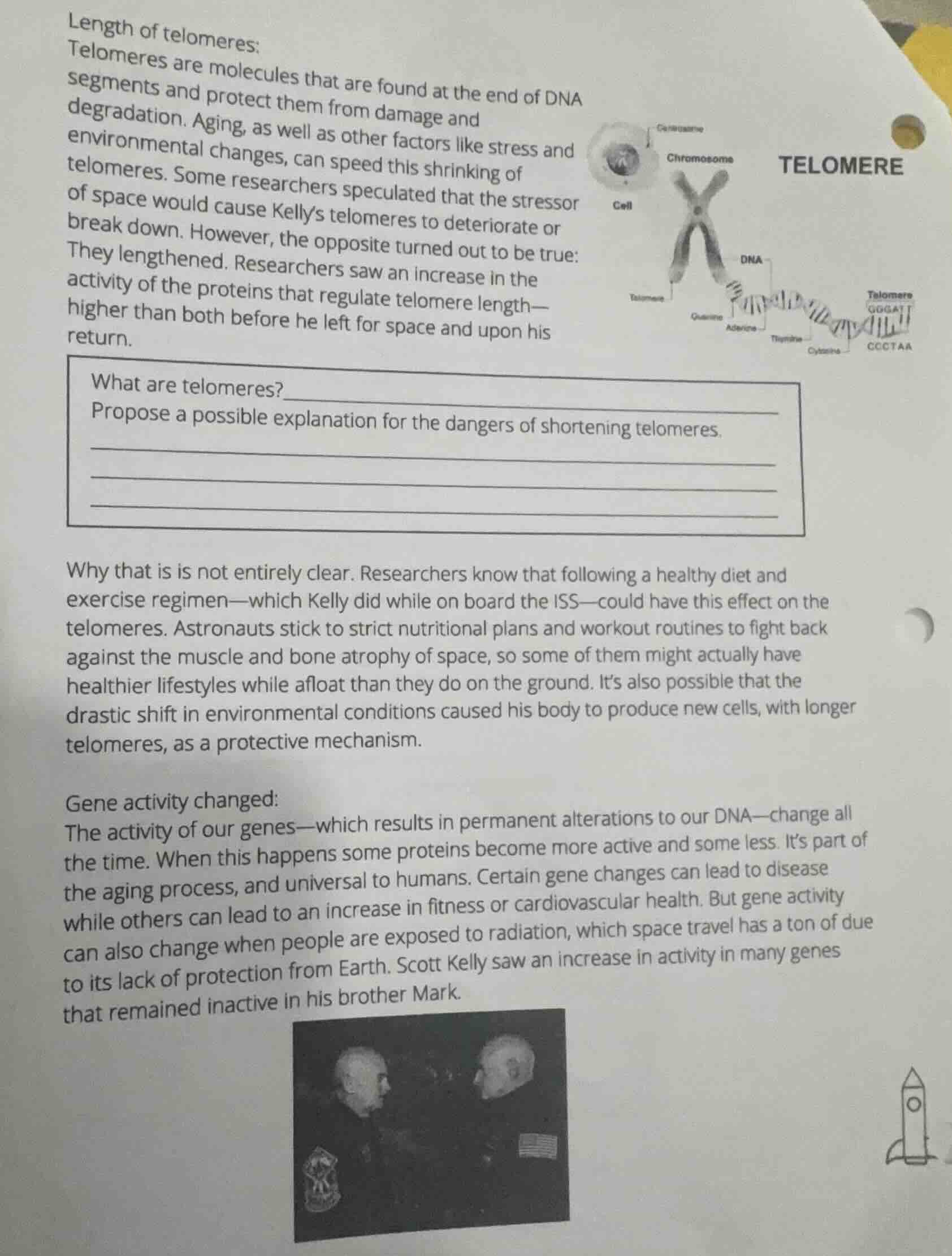
telomeres are molecules that are found at the end of dna segments and protect them from damage and degradation. aging, as well as other factors like stress and environmental changes, can speed this shrinking of telomeres. some researchers speculated that the stressor of space would cause kelly’s telomeres to deteriorate or break down. however, the opposite turned out to be true: they lengthened. researchers saw an increase in the activity of the proteins that regulate telomere length—higher than both before he left for space and upon his return.
what are telomeres?
propose a possible explanation for the dangers of shortening telomeres.
why that is is not entirely clear. researchers know that following a healthy diet and exercise regimen—which kelly did while on board the iss—could have this effect on the telomeres. astronauts stick to strict nutritional plans and workout routines to fight back against the muscle and bone atrophy of space, so some of them might actually have healthier lifestyles while afloat than they do on the ground. it’s also possible that the drastic shift in environmental conditions caused his body to produce new cells, with longer telomeres, as a protective mechanism.
gene activity changed:
the activity of our genes—which results in permanent alterations to our dna—change all the time. when this happens some proteins become more active and some less. it’s part of the aging process, and universal to humans. certain gene changes can lead to disease while others can lead to an increase in fitness or cardiovascular health. but gene activity can also change when people are exposed to radiation, which space travel has a ton of due to its lack of protection from earth. scott kelly saw an increase in activity in many genes that remained inactive in his brother mark.
- For the definition of telomeres, the text directly states their location and function.
- For the danger of shortening telomeres, we infer from their protective role: if they shrink, the DNA segments they protect are exposed to damage and degradation, which can accelerate aging or lead to cell dysfunction.

Snap & solve any problem in the app
Get step-by-step solutions on Sovi AI
Photo-based solutions with guided steps
Explore more problems and detailed explanations
- Telomeres are molecules found at the end of DNA segments that protect the DNA from damage and degradation.
- If telomeres shorten, they lose their ability to protect DNA. This exposes the DNA to damage and degradation, which can speed up the aging process, impair cell function, and potentially lead to increased risk of disease or cell death.