QUESTION IMAGE
Question
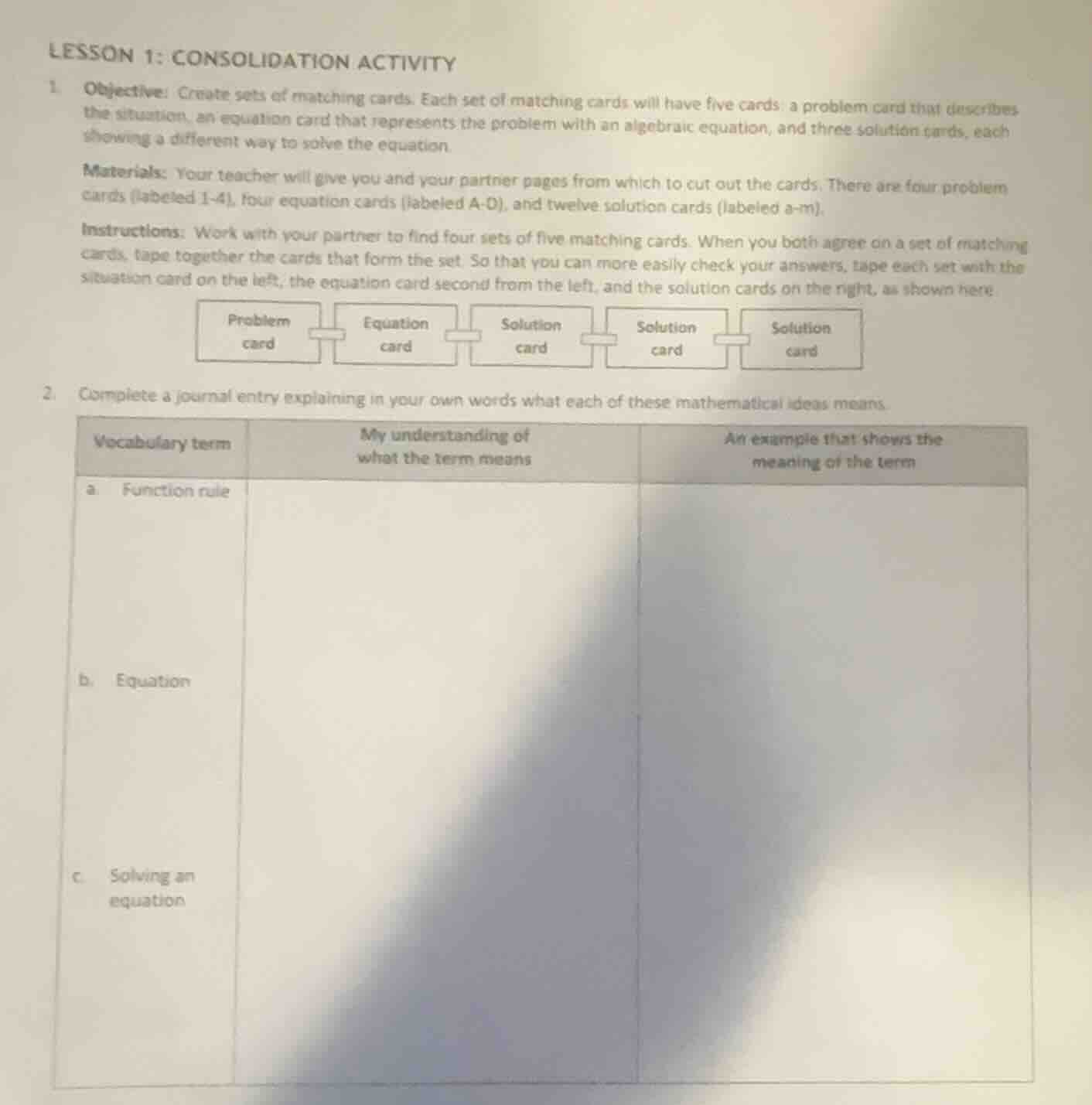
lesson 1: consolidation activity
- objective: create sets of matching cards. each set of matching cards will have five cards: a problem card that describes the situation, an equation card that represents the problem with an algebraic equation, and three solution cards, each showing a different way to solve the equation.
materials: your teacher will give you and your partner pages from which to cut out the cards. there are four problem cards (labeled 1 - 4), four equation cards (labeled a - d), and twelve solution cards (labeled a - m).
instructions: work with your partner to find four sets of five matching cards. when you both agree on a set of matching cards, tape together the cards that form the set. so that you can more easily check your answers, tape each set with the situation card on the left, the equation card second from the left, and the solution cards on the right, as shown here.
diagram of problem card, equation card, solution card, solution card, solution card connected
- complete a journal entry explaining in your own words what each of these mathematical ideas means.
table with columns: vocabulary term, my understanding of what the term means, an example that shows the meaning of the term; rows: a. function rule, b. equation, c. solving an equation
Part 2: Journal Entry Explanations
a. Function Rule
- My understanding of what the term means: A function rule is a mathematical relationship that defines how to calculate the output (dependent variable) from the input (independent variable) in a function. It’s like a formula or a set of instructions that tells you how one quantity relates to another.
- An example that shows the meaning of the term: Consider the function rule \( y = 2x + 1 \). Here, the rule tells us that for any input value \( x \), we multiply it by 2 and then add 1 to get the output value \( y \). If \( x = 3 \), then using the rule, \( y = 2(3) + 1 = 7 \).
b. Equation
- My understanding of what the term means: An equation is a mathematical statement that shows two expressions are equal. It has an equal sign (\( = \)) between two sides, and the goal is often to find the value(s) of the variable(s) that make the statement true.
- An example that shows the meaning of the term: The equation \( 3x + 5 = 14 \) states that the expression \( 3x + 5 \) is equal to 14. To solve it, we find the value of \( x \) (in this case, \( x = 3 \) because \( 3(3) + 5 = 9 + 5 = 14 \)) that satisfies the equality.
c. Solving an Equation
- My understanding of what the term means: Solving an equation means finding the value(s) of the variable(s) that make the equation true. This involves using mathematical operations (like adding, subtracting, multiplying, dividing, or using inverse operations) to isolate the variable on one side of the equal sign.
- An example that shows the meaning of the term: Let’s solve the equation \( 2x - 7 = 5 \). First, we add 7 to both sides to get \( 2x = 5 + 7 \), so \( 2x = 12 \). Then, we divide both sides by 2: \( x = \frac{12}{2} = 6 \). We can check that \( x = 6 \) makes the original equation true: \( 2(6) - 7 = 12 - 7 = 5 \), which matches the right - hand side.

Snap & solve any problem in the app
Get step-by-step solutions on Sovi AI
Photo-based solutions with guided steps
Explore more problems and detailed explanations
Part 2: Journal Entry Explanations
a. Function Rule
- My understanding of what the term means: A function rule is a mathematical relationship that defines how to calculate the output (dependent variable) from the input (independent variable) in a function. It’s like a formula or a set of instructions that tells you how one quantity relates to another.
- An example that shows the meaning of the term: Consider the function rule \( y = 2x + 1 \). Here, the rule tells us that for any input value \( x \), we multiply it by 2 and then add 1 to get the output value \( y \). If \( x = 3 \), then using the rule, \( y = 2(3) + 1 = 7 \).
b. Equation
- My understanding of what the term means: An equation is a mathematical statement that shows two expressions are equal. It has an equal sign (\( = \)) between two sides, and the goal is often to find the value(s) of the variable(s) that make the statement true.
- An example that shows the meaning of the term: The equation \( 3x + 5 = 14 \) states that the expression \( 3x + 5 \) is equal to 14. To solve it, we find the value of \( x \) (in this case, \( x = 3 \) because \( 3(3) + 5 = 9 + 5 = 14 \)) that satisfies the equality.
c. Solving an Equation
- My understanding of what the term means: Solving an equation means finding the value(s) of the variable(s) that make the equation true. This involves using mathematical operations (like adding, subtracting, multiplying, dividing, or using inverse operations) to isolate the variable on one side of the equal sign.
- An example that shows the meaning of the term: Let’s solve the equation \( 2x - 7 = 5 \). First, we add 7 to both sides to get \( 2x = 5 + 7 \), so \( 2x = 12 \). Then, we divide both sides by 2: \( x = \frac{12}{2} = 6 \). We can check that \( x = 6 \) makes the original equation true: \( 2(6) - 7 = 12 - 7 = 5 \), which matches the right - hand side.