QUESTION IMAGE
Question
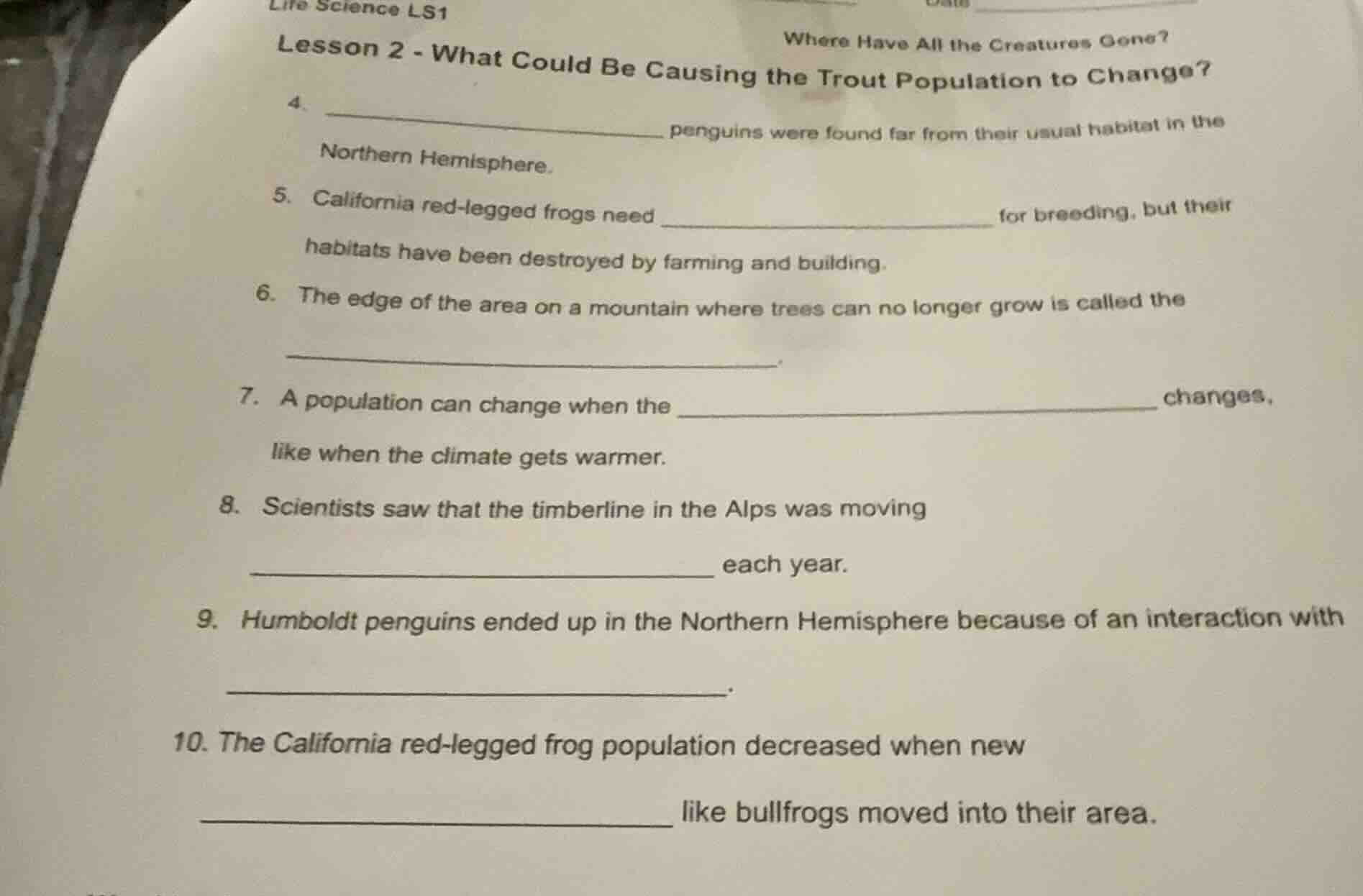
life science ls1
where have all the creatures gone?
lesson 2 - what could be causing the trout population to change?
- __________________ penguins were found far from their usual habitat in the northern hemisphere.
- california red - legged frogs need ______________________ for breeding, but their habitats have been destroyed by farming and building.
- the edge of the area on a mountain where trees can no longer grow is called the __________________________
- a population can change when the __________________________ changes, like when the climate gets warmer.
- scientists saw that the timberline in the alps was moving ________________________ each year.
- humboldt penguins ended up in the northern hemisphere because of an interaction with ______________________
- the california red - legged frog population decreased when new ______________________ like bullfrogs moved into their area.
Brief Explanations
- Humboldt penguins are native to the Southern Hemisphere, so they are the species found stranded in the Northern Hemisphere.
- California red-legged frogs rely on freshwater wetlands/marshes, shallow ponds, and slow-moving streams for breeding, which are destroyed by development.
- The timberline (or tree line) is the elevation on mountains where trees stop growing.
- Environmental conditions (like climate) directly drive population changes.
- With global warming, the Alps timberline moves higher up the mountain as temperatures become suitable for trees at higher elevations.
- Humboldt penguins are carried north by ocean currents (like the Humboldt Current shifting or El Niño events) outside their natural range.
- Invasive species such as bullfrogs prey on red-legged frogs and compete for resources, reducing their population.

Snap & solve any problem in the app
Get step-by-step solutions on Sovi AI
Photo-based solutions with guided steps
Explore more problems and detailed explanations
- Humboldt
- freshwater wetlands (or shallow, slow-moving water/riparian habitats)
- timberline (or tree line)
- environment (or climate/habitat conditions)
- higher up the mountain (or upward)
- ocean currents (or shifting marine currents/El Niño events)
- species (or invasive species/predatory species)