QUESTION IMAGE
Question
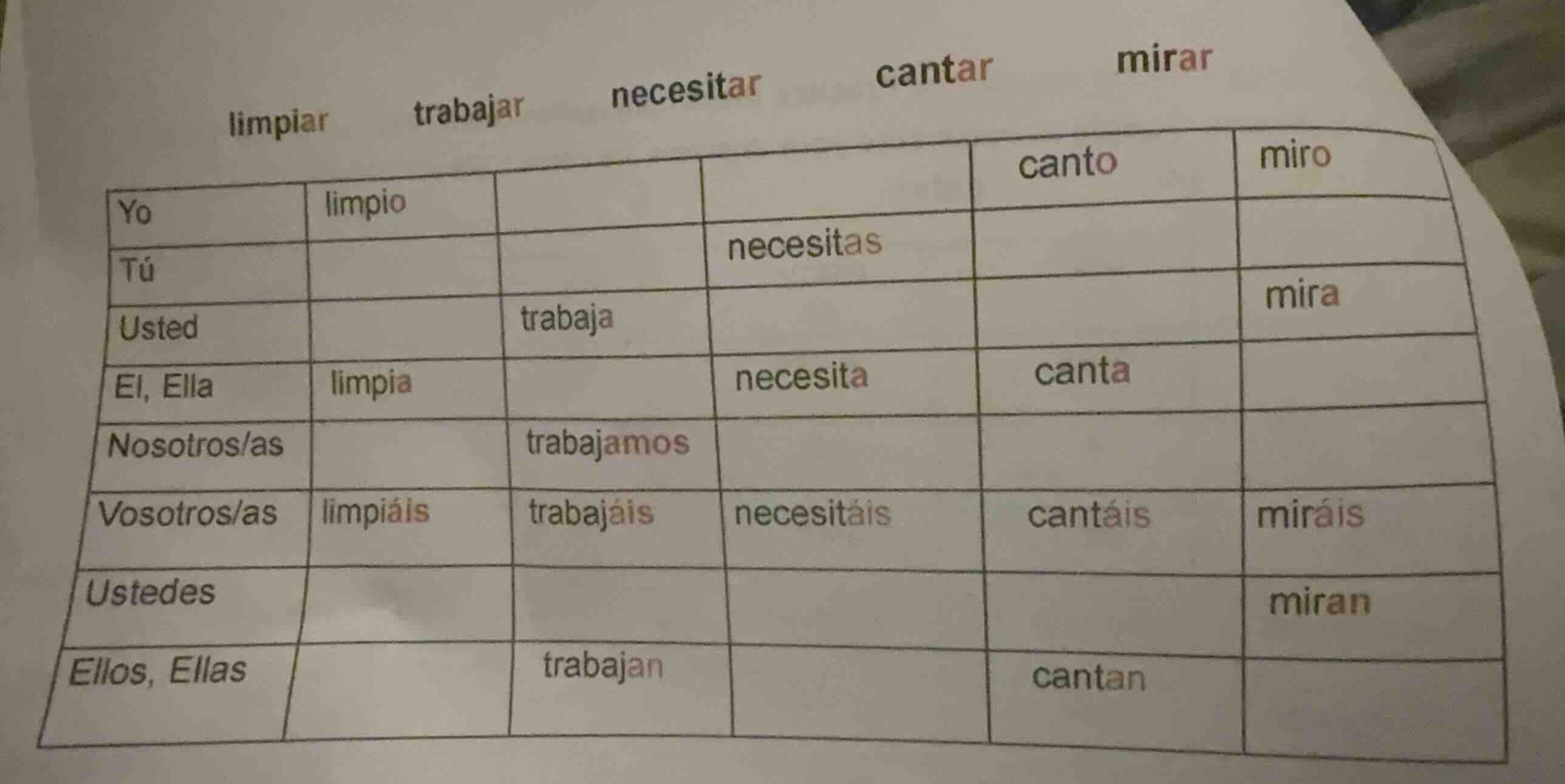
limpiar trabajar necesitar cantar mirar
yo limpio canto miro
tú necesitas
usted trabaja mira
el, ella limpia necesita canta
nosotros/as trabajamos
vosotros/as limpiáis trabajáis necesitáis cantáis miráis
ustedes miran
ellos, ellas trabajan cantan
To solve this, we analyze the conjugation pattern of regular -ar verbs in Spanish. Let's fill each cell by identifying the subject and applying the correct conjugation:
Step 1: "Yo" row (1st person singular)
- trabajar: For "yo", -ar verbs end with -o. So trabajo.
- necesitar: For "yo", -ar verbs end with -o. So necesito.
Step 2: "Tú" row (2nd person singular, informal)
- limpiar: For "tú", -ar verbs end with -as. So limpias.
- trabajar: For "tú", -ar verbs end with -as. So trabajas.
- cantar: For "tú", -ar verbs end with -as. So cantas.
- mirar: For "tú", -ar verbs end with -as. So miras.
Step 3: "Usted" row (2nd person singular, formal)
- limpiar: For "usted", -ar verbs end with -a (same as él/ella). So limpia.
- necesitar: For "usted", -ar verbs end with -a. So necesita.
- cantar: For "usted", -ar verbs end with -a. So canta.
Step 4: "Él, Ella" row (3rd person singular)
- trabajar: For "él/ella", -ar verbs end with -a. So trabaja.
- mirar: For "él/ella", -ar verbs end with -a. So mira (wait, no—wait, "mira" is already there? Wait, no, "él/ella" for mirar: mira (wait, the table has "mira" for usted, but for él/ella, it's also mira? Wait, no, let's check. Wait, "mirar" conjugation: yo miro, tú miras, usted/él/ella mira, nosotros miramos, vosotros miráis, ustedes/ellos/ellas miran. So for "él, Ella" row, mirar: mira. Wait, but in the table, "Usted" has "mira", so "Él, Ella" for mirar is mira (correct). Wait, maybe I misread. Let's recheck.
Wait, the "Él, Ella" row for limpiar is "limpia" (correct, -ar verb: limpiar → limpia for él/ella). For trabajar: trabaja (since trabajar is -ar, él/ella: trabaja). For necesitar: necesita (correct, as given). For cantar: canta (correct, as given). For mirar: mira (since mirar is -ar, él/ella: mira).
Step 5: "Nosotros/as" row (1st person plural)
- limpiar: For "nosotros/as", -ar verbs end with -amos. So limpiamos (wait, "limpiar" → "limpiamos"? Wait, no: "limpiar" is -ar, so nosotros: limpiamos? Wait, no: "limpiar" conjugation: yo limpio, tú limpias, usted/él/ella limpia, nosotros limpiamos, vosotros limpiáis, ustedes/ellos/ellas limpian. Wait, no—wait, "limpiar" is a regular -ar verb? Wait, "limpiar" is -ar, so the stem is "limpia-", then:
- limpiar: nosotros → limpiamos (wait, no: "limpiar" → infinitive is limpiar, stem is "limpia-", so nosotros: limpiamos? Wait, no, -ar verbs: the conjugation for nosotros is stem + amos. So "limpiar" → limpi + amos? Wait, no: "limpiar" is spelled l-i-m-p-i-a-r. So the stem is "limpia-"? Wait, no, the infinitive is limpiar, so to conjugate, we remove -ar: limpi-, then add endings. Wait, no: -ar verbs: the stem is the infinitive minus -ar. So limpiar → limpi- (stem). Then:
- yo: limpi + o = limpio
- tú: limpi + as = limpias
- usted/él/ella: limpi + a = limpia
- nosotros: limpi + amos = limpiamos
- vosotros: limpi + áis = limpiáis (correct, as given: "limpiáis" for vosotros)
- ustedes/ellos/ellas: limpi + an = limpian
So for "Nosotros/as" row:
- limpiar: limpiamos
- necesitar: necesit + amos = necesitamos (since necesitar is -ar, stem necesit-)
- cantar: cant + amos = cantamos (cantar → stem cant-)
- mirar: mir + amos = miramos (mirar → stem mir-)
Step 6: "Ustedes" row (2nd person plural, formal)
- limpiar: For "ustedes", -ar verbs end with -an (same as ellos/ellas). So limpian.
- trabajar: For "ustedes", -ar verbs end with -an. So trabajan (wait, the "Ellos, Ellas" row has "trabajan" for trabajar, so "…

Snap & solve any problem in the app
Get step-by-step solutions on Sovi AI
Photo-based solutions with guided steps
Explore more problems and detailed explanations
To solve this, we analyze the conjugation pattern of regular -ar verbs in Spanish. Let's fill each cell by identifying the subject and applying the correct conjugation:
Step 1: "Yo" row (1st person singular)
- trabajar: For "yo", -ar verbs end with -o. So trabajo.
- necesitar: For "yo", -ar verbs end with -o. So necesito.
Step 2: "Tú" row (2nd person singular, informal)
- limpiar: For "tú", -ar verbs end with -as. So limpias.
- trabajar: For "tú", -ar verbs end with -as. So trabajas.
- cantar: For "tú", -ar verbs end with -as. So cantas.
- mirar: For "tú", -ar verbs end with -as. So miras.
Step 3: "Usted" row (2nd person singular, formal)
- limpiar: For "usted", -ar verbs end with -a (same as él/ella). So limpia.
- necesitar: For "usted", -ar verbs end with -a. So necesita.
- cantar: For "usted", -ar verbs end with -a. So canta.
Step 4: "Él, Ella" row (3rd person singular)
- trabajar: For "él/ella", -ar verbs end with -a. So trabaja.
- mirar: For "él/ella", -ar verbs end with -a. So mira (wait, no—wait, "mira" is already there? Wait, no, "él/ella" for mirar: mira (wait, the table has "mira" for usted, but for él/ella, it's also mira? Wait, no, let's check. Wait, "mirar" conjugation: yo miro, tú miras, usted/él/ella mira, nosotros miramos, vosotros miráis, ustedes/ellos/ellas miran. So for "él, Ella" row, mirar: mira. Wait, but in the table, "Usted" has "mira", so "Él, Ella" for mirar is mira (correct). Wait, maybe I misread. Let's recheck.
Wait, the "Él, Ella" row for limpiar is "limpia" (correct, -ar verb: limpiar → limpia for él/ella). For trabajar: trabaja (since trabajar is -ar, él/ella: trabaja). For necesitar: necesita (correct, as given). For cantar: canta (correct, as given). For mirar: mira (since mirar is -ar, él/ella: mira).
Step 5: "Nosotros/as" row (1st person plural)
- limpiar: For "nosotros/as", -ar verbs end with -amos. So limpiamos (wait, "limpiar" → "limpiamos"? Wait, no: "limpiar" is -ar, so nosotros: limpiamos? Wait, no: "limpiar" conjugation: yo limpio, tú limpias, usted/él/ella limpia, nosotros limpiamos, vosotros limpiáis, ustedes/ellos/ellas limpian. Wait, no—wait, "limpiar" is a regular -ar verb? Wait, "limpiar" is -ar, so the stem is "limpia-", then:
- limpiar: nosotros → limpiamos (wait, no: "limpiar" → infinitive is limpiar, stem is "limpia-", so nosotros: limpiamos? Wait, no, -ar verbs: the conjugation for nosotros is stem + amos. So "limpiar" → limpi + amos? Wait, no: "limpiar" is spelled l-i-m-p-i-a-r. So the stem is "limpia-"? Wait, no, the infinitive is limpiar, so to conjugate, we remove -ar: limpi-, then add endings. Wait, no: -ar verbs: the stem is the infinitive minus -ar. So limpiar → limpi- (stem). Then:
- yo: limpi + o = limpio
- tú: limpi + as = limpias
- usted/él/ella: limpi + a = limpia
- nosotros: limpi + amos = limpiamos
- vosotros: limpi + áis = limpiáis (correct, as given: "limpiáis" for vosotros)
- ustedes/ellos/ellas: limpi + an = limpian
So for "Nosotros/as" row:
- limpiar: limpiamos
- necesitar: necesit + amos = necesitamos (since necesitar is -ar, stem necesit-)
- cantar: cant + amos = cantamos (cantar → stem cant-)
- mirar: mir + amos = miramos (mirar → stem mir-)
Step 6: "Ustedes" row (2nd person plural, formal)
- limpiar: For "ustedes", -ar verbs end with -an (same as ellos/ellas). So limpian.
- trabajar: For "ustedes", -ar verbs end with -an. So trabajan (wait, the "Ellos, Ellas" row has "trabajan" for trabajar, so "Ustedes" for trabajar is also trabajan).
- necesitar: For "ustedes", -ar verbs end with -an. So necesitan.
- cantar: For "ustedes", -ar verbs end with -an. So cantan (wait, "Ellos, Ellas" row has "cantan" for cantar, so "Ustedes" for cantar is cantan).
- mirar: miran (already given in "Ustedes" row? Wait, the table has "miran" for "Ustedes" row? Wait, the original table's "Ustedes" row for mirar is "miran" (given). So that's correct (ustedes/ellos/ellas: miran).
Step 7: "Ellos, Ellas" row (3rd person plural)
- limpiar: For "ellos/ellas", -ar verbs end with -an. So limpian.
- necesitar: For "ellos/ellas", -ar verbs end with -an. So necesitan.
- mirar: For "ellos/ellas", -ar verbs end with -an. So miran (correct, as "Ustedes" row has "miran", and ellos/ellas also miran).
Now, let's summarize the filled table (row by row):
| Subject | limpiar | trabajar | necesitar | cantar | mirar |
|---|---|---|---|---|---|
| Tú | limpias | trabajas | necesitas | cantas | miras |
| Usted | limpia | trabaja | necesita | canta | mira |
| Él, Ella | limpia | trabaja | necesita | canta | mira |
| Nosotros/as | limpiamos | trabajamos | necesitamos | cantamos | miramos |
| Vosotros/as | limpiáis | trabajáis | necesitáis | cantáis | miráis |
| Ustedes | limpian | trabajan | necesitan | cantan | miran |
| Ellos, Ellas | limpian | trabajan | necesitan | cantan | miran |
Wait, but the original table has some cells filled. Let's check which cells were empty and fill them:
- Yo row:
- trabajar: trabajo
- necesitar: necesito
- Tú row:
- limpiar: limpias
- trabajar: trabajas
- cantar: cantas
- mirar: miras
- Usted row:
- limpiar: limpia
- necesitar: necesita
- cantar: canta
- Él, Ella row:
- trabajar: trabaja
- mirar: mira (wait, the table has "mira" for Usted, so for Él, Ella, it's also mira)
- Nosotros/as row:
- limpiar: limpiamos
- necesitar: necesitamos
- cantar: cantamos
- mirar: miramos
- Ustedes row:
- limpiar: limpian
- trabajar: trabajan
- necesitar: necesitan
- cantar: cantan
- Ellos, Ellas row:
- limpiar: limpian
- necesitar: necesitan
- mirar: miran
This follows the regular -ar verb conjugation in Spanish, where the endings for each subject are:
- Yo: -o
- Tú: -as
- Usted/Él/Ella: -a
- Nosotros/as: -amos
- Vosotros/as: -áis
- Ustedes/Ellos/Ellas: -an