QUESTION IMAGE
Question
lit reading assessment
10 at last, the clay was taken from the furnace and set down upon a board, in the cool air, under the blue sky. the tribulation had passed; the reward was at hand.
close beside the board, there was a pool of water, not very deep, nor very clear, but calm enough to reflect, with undeniable truth, every image that fell upon it. there, for the first time, as it was lifted from the board, the clay saw its new shape — the reward of all its patience and pain, the conclusion of its hopes — a common flower pot: straight and stiff, red and ugly.
the clay felt that it was not destined for a king’s house, nor for a palace of art, because it had been created without glory or beauty or honor; it murmured to its unknown artisan, saying, “why have you made me like this?”
many days it passed in sullen discontent. then it was filled with earth, and something — the clay knew not what — but something rough and brown and dead - looking, was thrust into the middle of the earth and covered over. the clay rebelled at this new disgrace. “this is the worst of all that has happened to me, to be filled with dirt and rubbish. surely i am a failure.”
but presently it was set in a greenhouse, where the sunlight fell warmly upon it, and water was sprinkled over it, and day by day as it waited, a change began to form. something was stirring within the earth — a new hope. still, the clay was ignorant and knew not what the hope meant.
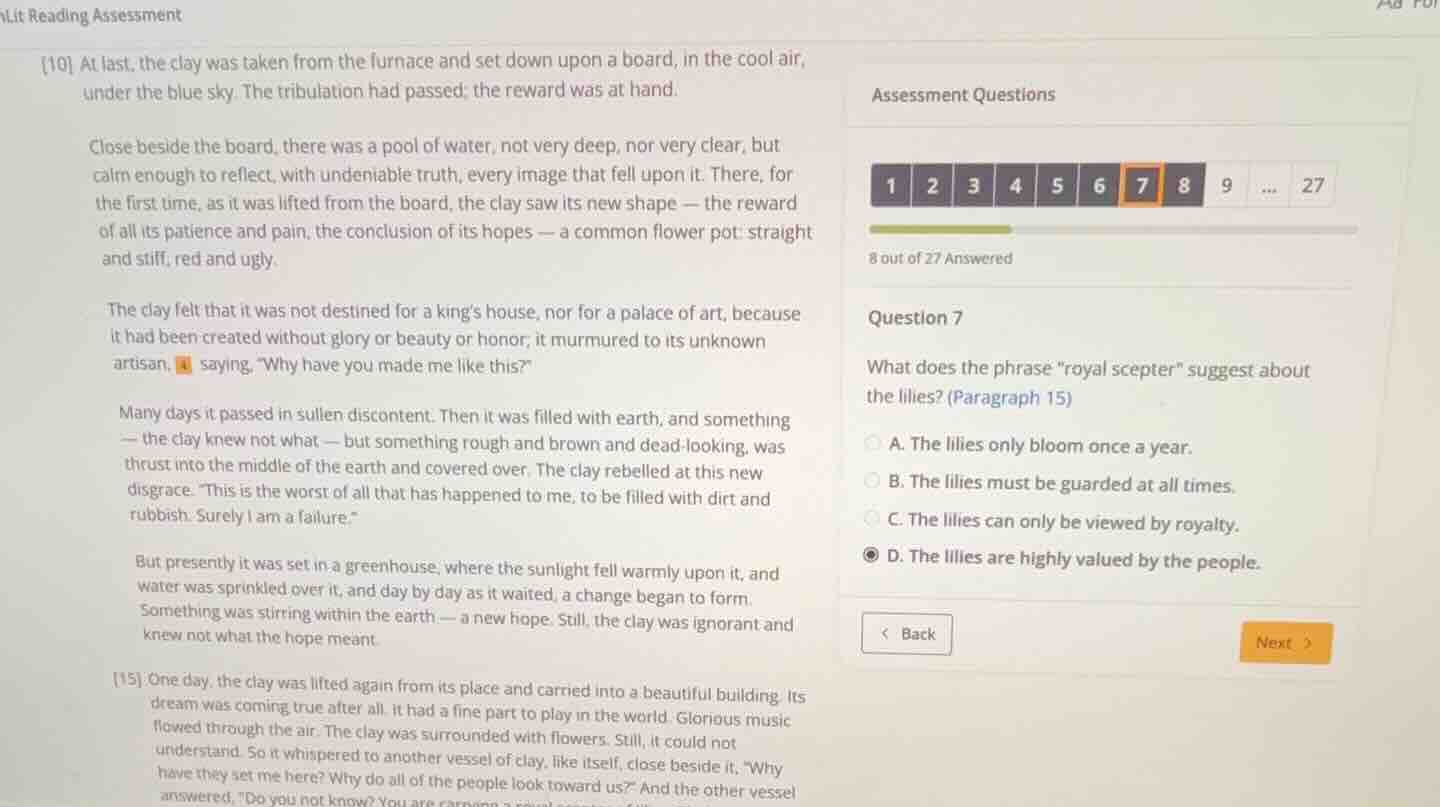
15 one day, the clay was lifted again from its place and carried into a beautiful building. its dream was coming true after all. it had a fine part to play in the world. glorious music flowed through the air. the clay was surrounded with flowers. still, it could not understand. so it whispered to another vessel of clay, like itself, close beside it, “why have they set me here? why do all of the people look toward us?” and the other vessel answered, “do you not know? you are...
assessment questions
1 2 3 4 5 6 7 8 9... 27
8 out of 27 answered
question 7
what does the phrase “royal scepter” suggest about the lilies? (paragraph 15)
a. the lilies only bloom once a year.
b. the lilies must be guarded at all times.
c. the lilies can only be viewed by royalty.
d. the lilies are highly valued by the people.
< back next >
To determine the meaning of "royal scepter" in relation to the lilies, we analyze the options:
- Option A: The phrase "royal scepter" doesn't imply blooming frequency. Eliminate A.
- Option B: There's no indication the lilies need constant guarding from the phrase. Eliminate B.
- Option C: "Royal scepter" suggests the lilies are so valued they're treated like a royal symbol, not that only royalty can view them. Eliminate C.
- Option D: A royal scepter is a symbol of high value and importance. If the lilies are compared to a royal scepter, it implies they are highly valued by people. This matches the context of the story where the clay's purpose becomes clear with the lilies.

Snap & solve any problem in the app
Get step-by-step solutions on Sovi AI
Photo-based solutions with guided steps
Explore more problems and detailed explanations
D. The lilies are highly valued by the people.