QUESTION IMAGE
Question
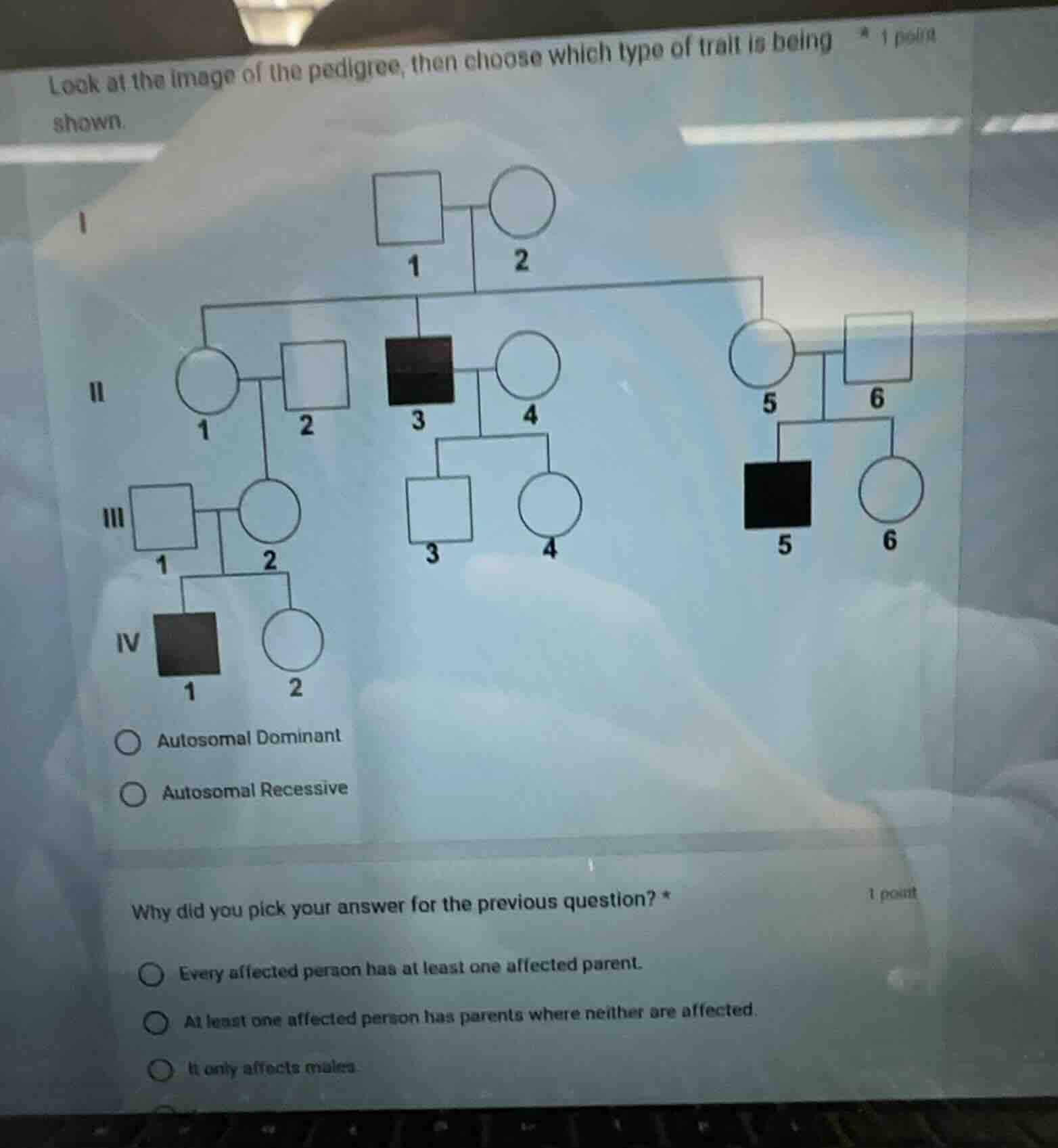
look at the image of the pedigree, then choose which type of trait is being shown.
autosomal dominant
autosomal recessive
why did you pick your answer for the previous question?
every affected person has at least one affected parent.
at least one affected person has parents where neither are affected.
it only affects males
Response
First Question (Trait Type)
Brief Explanations
To determine the trait type, we analyze the pedigree:
- For Autosomal Recessive: Affected individuals (filled symbols) often have unaffected parents (who are carriers). Looking at the pedigree, e.g., in generation IV - 1, parents (III - 1 and III - 2) are unaffected, but the child is affected. Also, in generation II - 3, parents (I - 1 and I - 2) are unaffected, yet he is affected. For Autosomal Dominant, affected individuals should have at least one affected parent, which is not the case here. The trait does not show sex - linkage (affects both males and females in a non - sex - specific way, but here we see affected males with unaffected parents, fitting recessive).
Brief Explanations
- Option 1: "Every affected person has at least one affected parent" is for Autosomal Dominant, not Recessive, so incorrect.
- Option 2: "At least one affected person has parents where neither are affected" is correct for Autosomal Recessive. For example, II - 3 (affected) has parents I - 1 and I - 2 (unaffected), IV - 1 (affected) has parents III - 1 and III - 2 (unaffected), and III - 5 (affected) has parents II - 5 and II - 6 (unaffected).
- Option 3: "It only affects males" is incorrect as the pedigree analysis shows the trait is autosomal (not sex - linked), and while the shown affected are males, the key is the parent - child relationship for recessive, not sex - specificity.

Snap & solve any problem in the app
Get step-by-step solutions on Sovi AI
Photo-based solutions with guided steps
Explore more problems and detailed explanations
Autosomal Recessive