QUESTION IMAGE
Question
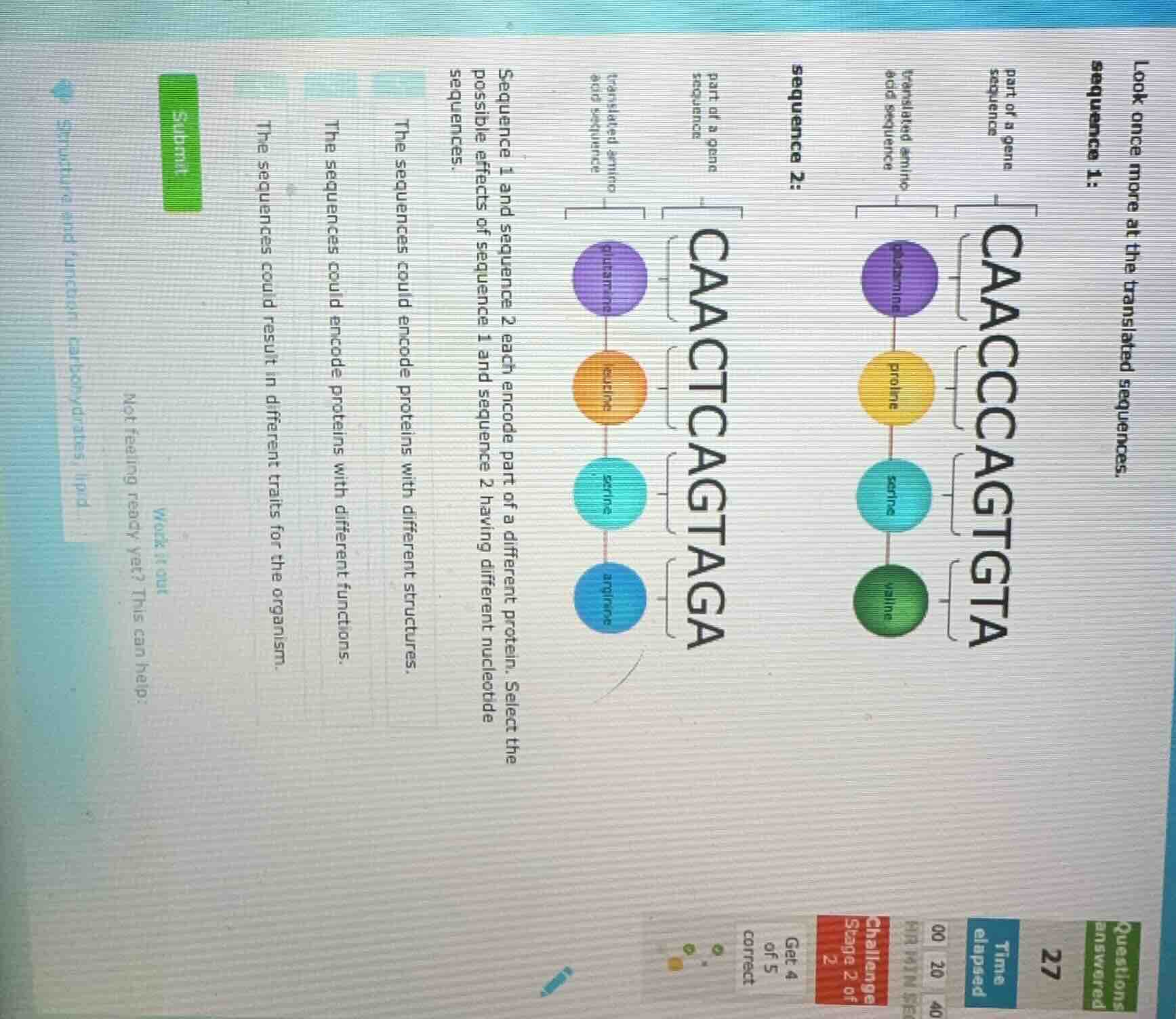
look once more at the translated sequences.
sequence 1:
part of a gene
sequences
caaccagtgta
franslated amino
add sequence
proline
serine
valine
sequence 2:
part of a gene
sequence
caactcagtaga
franslated amino
add sequence
glutamine
leucine
serine
arginine
sequence 1 and sequence 2 each encode part of a different protein. select the possible effects of sequence 1 and sequence 2 having different nucleotide sequences.
the sequences could encode proteins with different structures.
the sequences could encode proteins with different functions.
the sequences could result in different traits for the organism.
submit
work it out
not feeling ready yet? this can help:
structure and function: carbohydrates, lipd
The question is about gene sequences and their translated amino acid sequences, which relates to the study of biological molecules and their functions, falling under the subfield of Biology in Natural Science. The possible effects of different nucleotide sequences (sequence 1 and 2) on the encoded proteins include different protein structures (since different amino acid sequences can lead to different folding/structure), different protein functions (structure determines function), and different traits (as proteins are involved in phenotypic expression). All three statements about sequences encoding proteins with different structures, different functions, and resulting in different traits are correct as different gene sequences (due to different nucleotides) lead to different amino acid sequences, which impact protein structure, function, and ultimately the organism's traits. But if we have to pick the most fundamental or direct effect first, different nucleotide sequences lead to different amino acid sequences, which directly affects protein structure. However, all three options are valid in the context of genetic variation and protein synthesis. But looking at the options: "The sequences could encode proteins with different structures" is a direct result of different amino acid sequences (from different nucleotide sequences), "The sequences could encode proteins with different functions" (since structure determines function), and "The sequences could result in different traits for the organism" (as proteins are part of the phenotype). But the question says "Select the possible effects" (maybe multiple, but if we assume the options are the three statements, all are correct. But perhaps the question is to select all, but the way it's presented, maybe the options are the three sentences. Wait, the original problem's options (the three statements) are all correct because different gene sequences (nucleotide sequences) lead to different amino acid sequences, which cause different protein structures, which then lead to different functions, and ultimately different traits. So all three statements are valid. But maybe the question is to check which of the three is a possible effect. Let's analyze each:
- "The sequences could encode proteins with different structures": Correct, because different amino acid sequences (from different nucleotides) lead to different primary, secondary, tertiary structures.
- "The sequences could encode proteins with different functions": Correct, because protein function is determined by its structure.
- "The sequences could result in different traits for the organism": Correct, because proteins are involved in phenotypic characteristics (traits).
But maybe the question is to select all, but the way the options are listed (the three sentences), so all three are possible effects. But perhaps the user is asking which of the three options (the three statements) are correct. So the answer would be all three, but let's check the options again. The three statements are:
- The sequences could encode proteins with different structures.
- The sequences could encode proteins with different functions.
- The sequences could result in different traits for the organism.
All three are correct. Because different nucleotide sequences (gene sequences) lead to different mRNA, different amino acid sequences, different protein structures, different protein functions, and different traits (since proteins are expressed as traits).

Snap & solve any problem in the app
Get step-by-step solutions on Sovi AI
Photo-based solutions with guided steps
Explore more problems and detailed explanations
All three statements: "The sequences could encode proteins with different structures", "The sequences could encode proteins with different functions", and "The sequences could result in different traits for the organism" are correct. (If we have to pick one, but in the context of biology, all are valid. But maybe the question expects all three as correct options.)