QUESTION IMAGE
Question
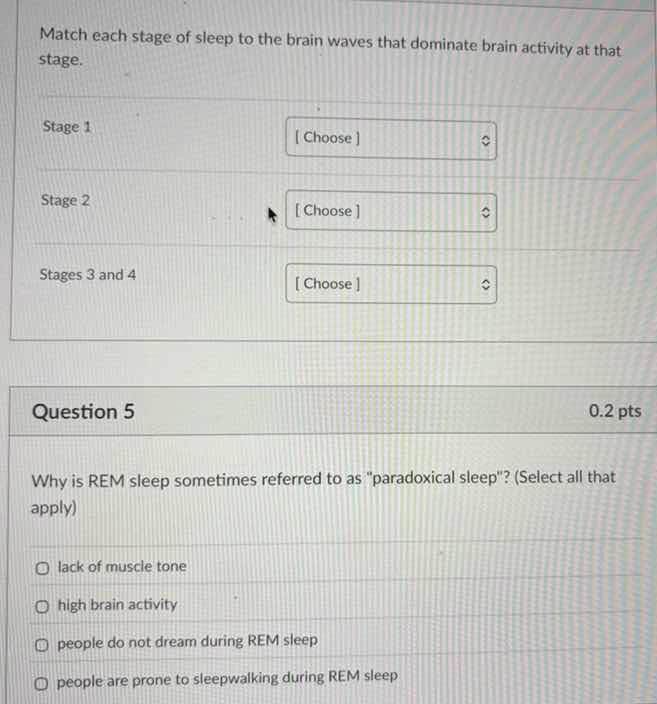
match each stage of sleep to the brain waves that dominate brain activity at that stage.
stage 1
choose
stage 2
choose
stages 3 and 4
choose
question 5
0.2 pts
why is rem sleep sometimes referred to as \paradoxical sleep\? (select all that apply)
□ lack of muscle tone
□ high brain activity
□ people do not dream during rem sleep
□ people are prone to sleepwalking during rem sleep
Brief Explanations
For the sleep stage-brain wave matching:
- Stage 1 sleep, the lightest sleep stage, is dominated by theta waves, which are slower than waking alpha waves but faster than deeper sleep waves.
- Stage 2 sleep is marked by sleep spindles and K-complexes, with theta waves still dominant but interrupted by these specific brain wave patterns.
- Stages 3 and 4 (deep sleep) are dominated by slow, high-amplitude delta waves.
For the REM sleep question:
- REM sleep is called paradoxical because the brain shows high, wake-like activity, but the body has almost no muscle tone (atonia), creating a contradictory state of active brain and inactive body. Dreaming occurs during REM sleep, and sleepwalking happens in deep sleep (stages 3-4), not REM.

Snap & solve any problem in the app
Get step-by-step solutions on Sovi AI
Photo-based solutions with guided steps
Explore more problems and detailed explanations
Sleep Stage-Brain Wave Matching:
Stage 1: Theta waves
Stage 2: Theta waves (with sleep spindles/K-complexes)
Stages 3 and 4: Delta waves
Question 5:
- lack of muscle tone
- high brain activity