QUESTION IMAGE
Question
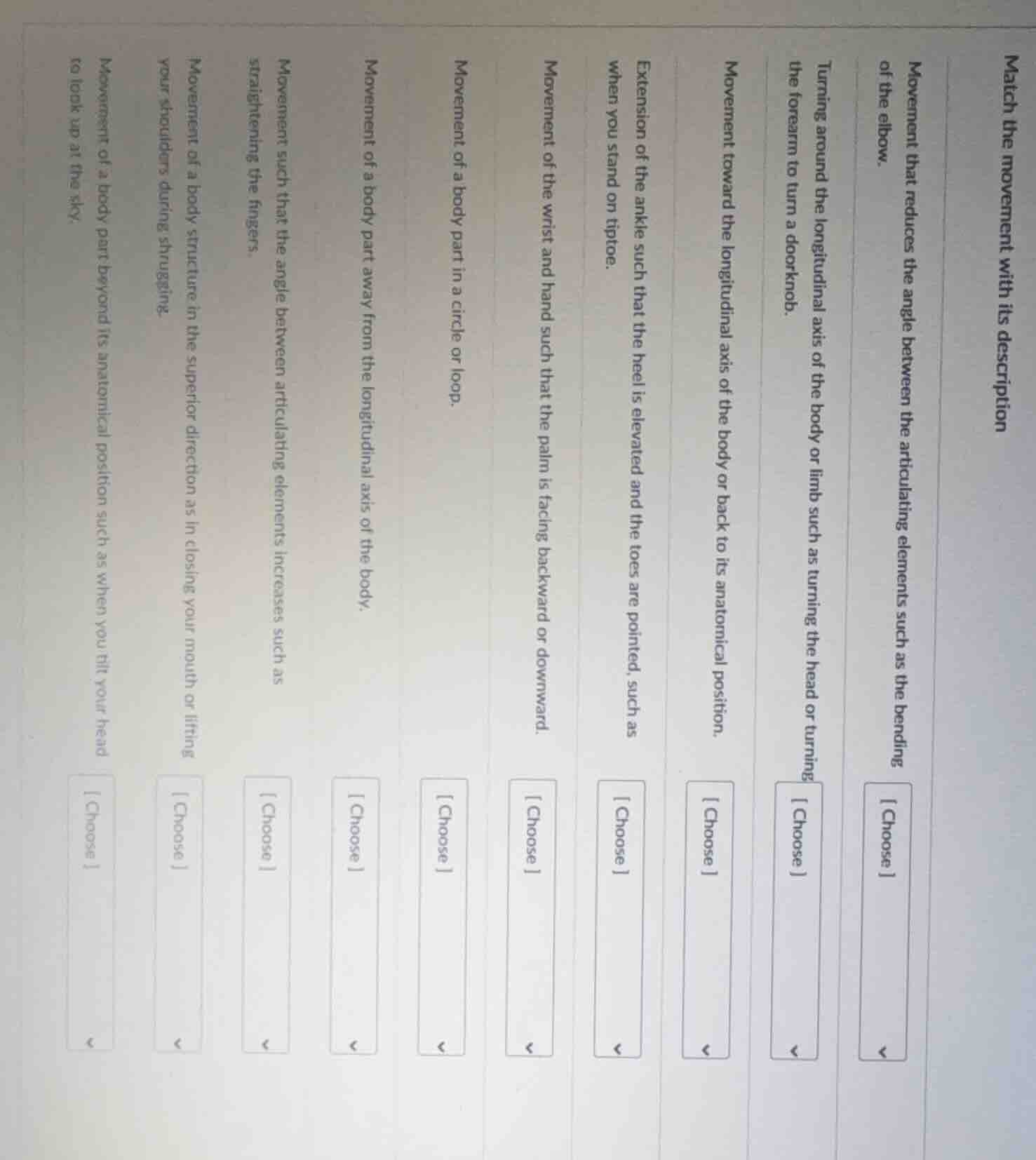
match the movement with its descriptionmovement that reduces the angle between the articulating elements such as the bending of the elbow. choose turning around the longitudinal axis of the body or limb such as turning the head or turning the forearm to turn a doorknob. choose movement toward the longitudinal axis of the body or back to its anatomical position. choose extension of the ankle such that the heel is elevated and the toes are pointed, such as when you stand on tiptoe. choose movement of the wrist and hand such that the palm is facing backward or downward. choose movement of a body part in a circle or loop. choose movement of a body part away from the longitudinal axis of the body. choose movement such that the angle between articulating elements increases such as straightening the fingers. choose movement of a body structure in the superior direction as in closing your mouth or lifting your shoulders during shrugging. choose movement of a body part beyond its anatomical position such as when you tilt your head to look up at the sky. choose
Each description is matched to the corresponding anatomical movement term based on standard musculoskeletal anatomy definitions:
- The movement reducing joint angle (elbow bending) is flexion.
- Rotation around a longitudinal axis (head/forearm turning) is rotation.
- Returning a body part to its standard position is reduction.
- Ankle extension lifting the heel (tiptoe) is plantar flexion.
- Wrist/hand movement turning palm backward/downward is pronation.
- Circular movement of a body part is circumduction.
- Moving a body part away from the body's longitudinal axis is abduction.
- Increasing the angle between articulating elements (straightening fingers) is extension.
- Superior movement of a body structure (shrugging shoulders) is elevation.
- Moving a body part beyond its normal anatomical position (head back to look up) is hyperextension.

Snap & solve any problem in the app
Get step-by-step solutions on Sovi AI
Photo-based solutions with guided steps
Explore more problems and detailed explanations
- Movement that reduces the angle between the articulating elements such as the bending of the elbow. → Flexion
- Turning around the longitudinal axis of the body or limb such as turning the head or turning the forearm to turn a doorknob. → Rotation
- Movement toward the longitudinal axis of the body or back to its anatomical position. → Reduction
- Extension of the ankle such that the heel is elevated and the toes are pointed, such as when you stand on tiptoe. → Plantar Flexion
- Movement of the wrist and hand such that the palm is facing backward or downward. → Pronation
- Movement of a body part in a circle or loop. → Circumduction
- Movement of a body part away from the longitudinal axis of the body. → Abduction
- Movement such that the angle between articulating elements increases such as straightening the fingers. → Extension
- Movement of a body structure in the superior direction as in closing your mouth or lifting your shoulders during shrugging. → Elevation
- Movement of a body part beyond its anatomical position such as when you tilt your head to look up at the sky. → Hyperextension