QUESTION IMAGE
Question
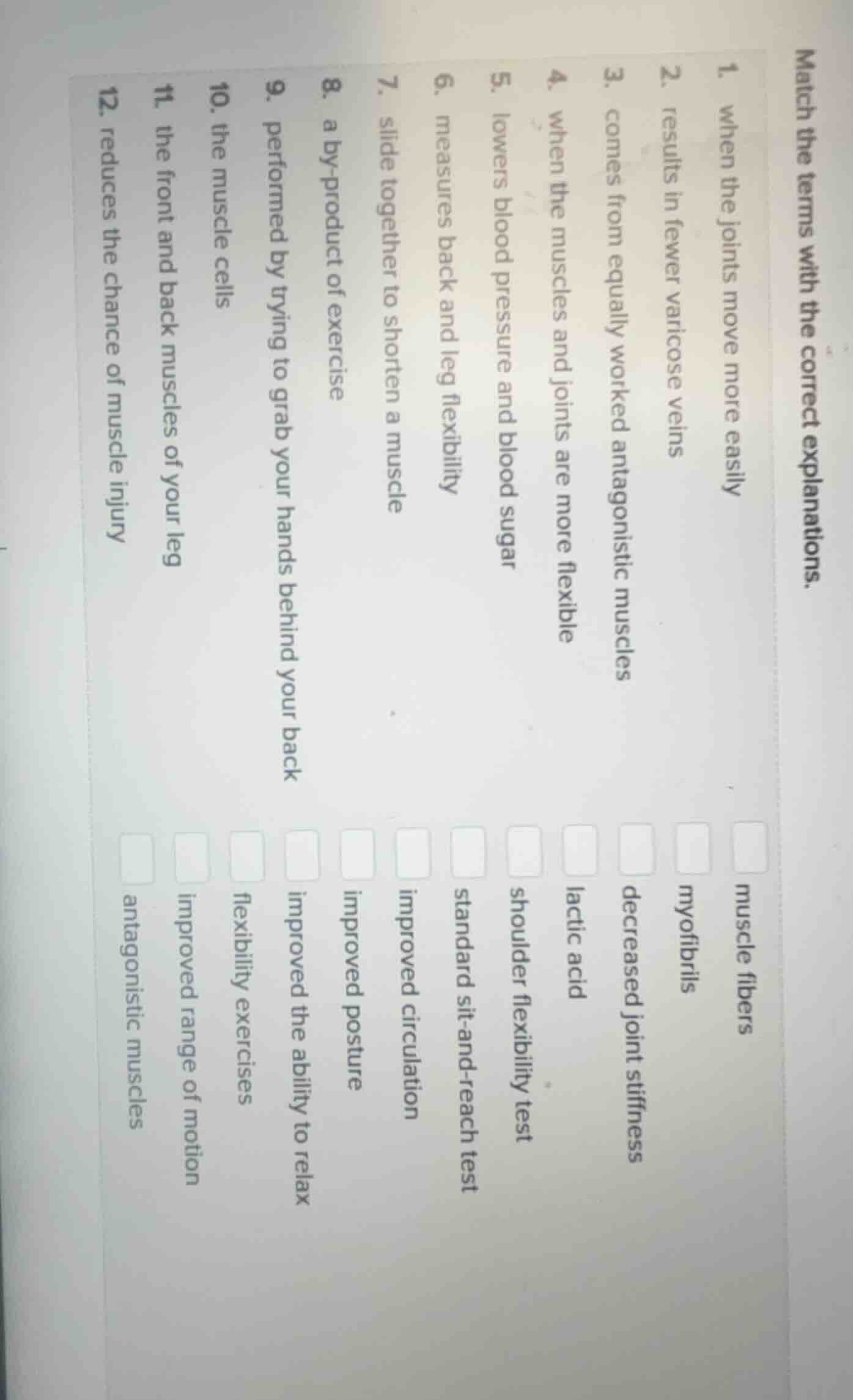
match the terms with the correct explanations.
- when the joints move more easily
- results in fewer varicose veins
- comes from equally worked antagonistic muscles
- when the muscles and joints are more flexible
- lowers blood pressure and blood sugar
- measures back and leg flexibility
- slide together to shorten a muscle
- a by - product of exercise
- performed by trying to grab your hands behind your back
- the muscle cells
- the front and back muscles of your leg
- reduces the chance of muscle injury
muscle fibers
myofibrils
decreased joint stiffness
lactic acid
shoulder flexibility test
standard sit - and - reach test
improved circulation
improved posture
improved the ability to relax
flexibility exercises
improved range of motion
antagonistic muscles
Brief Explanations
To solve this matching problem, we analyze each term and its corresponding explanation based on knowledge of muscle and joint physiology:
- When joints move more easily: This is due to "decreased joint stiffness" as less stiffness allows easier movement.
- Results in fewer varicose veins: Improved circulation (from exercise, etc.) helps prevent varicose veins, so "improved circulation".
- Comes from equally worked antagonistic muscles: "Antagonistic muscles" work in opposition, and equal work relates to their function.
- When muscles and joints are more flexible: More flexibility means an "improved range of motion" (how far joints/muscles can move).
- Lowers blood pressure and blood sugar: Exercise (which improves circulation, etc.) or healthy muscle function can do this, but "improved circulation" also supports, but actually, "flexibility exercises" (which promote overall health) or more accurately, the effect of exercise (but from the options, "improved circulation" is a by - product of exercise which helps, but maybe better: Wait, the option for 5: Wait, the options below: Let's re - check. The options below are: muscle fibers, myofibrils, decreased joint stiffness, lactic acid, shoulder flexibility test, standard sit - and - reach test, improved circulation, improved posture, improved the ability to relax, flexibility exercises, improved range of motion, antagonistic muscles.
Wait, let's do each one carefully:
- when the joints move more easily: Decreased joint stiffness (because if stiffness is decreased, movement is easier). So 1 - decreased joint stiffness.
- results in fewer varicose veins: Improved circulation (better blood flow reduces varicose veins). So 2 - improved circulation.
- comes from equally worked antagonistic muscles: Antagonistic muscles (they work in pairs, equal work leads to balance). So 3 - antagonistic muscles.
- when the muscles and joints are more flexible: Improved range of motion (flexibility allows a greater range of motion). So 4 - improved range of motion.
- lowers blood pressure and blood sugar: Flexibility exercises (regular exercise, including flexibility ones, can lower BP and blood sugar). Wait, or improved circulation? Wait, the option "flexibility exercises" is there. Let's check the other terms.
- measures back and leg flexibility: Standard sit - and - reach test (this test measures lower back and hamstring/leg flexibility). So 6 - standard sit - and - reach test.
- slide together to shorten a muscle: Myofibrils (within muscle fibers, myofibrils slide during muscle contraction to shorten the muscle). So 7 - myofibrils.
- a by - product of exercise: Lactic acid (is produced during anaerobic exercise as a by - product). So 8 - lactic acid.
- performed by trying to grab your hands behind your back: Shoulder flexibility test (this movement tests shoulder flexibility). So 9 - shoulder flexibility test.
- the muscle cells: Muscle fibers (muscle cells are also called muscle fibers). So 10 - muscle fibers.
- the front and back muscles of your leg: Flexibility exercises (exercising these muscles improves flexibility, but more accurately, the muscles' flexibility is related to flexibility exercises, or the term for the muscles? Wait, no, the option "flexibility exercises" is for actions, but "the front and back muscles of your leg" - maybe "flexibility exercises" target these, but actually, the term "flexibility exercises" is about the exercises, but maybe I made a mistake. Wait, the option "improved the ability to relax" - no. Wait, "flexibility exercises" are exercises…

Snap & solve any problem in the app
Get step-by-step solutions on Sovi AI
Photo-based solutions with guided steps
Explore more problems and detailed explanations
- 1 - decreased joint stiffness
- 2 - improved circulation
- 3 - antagonistic muscles
- 4 - improved range of motion
- 5 - flexibility exercises
- 6 - standard sit - and - reach test
- 7 - myofibrils
- 8 - lactic acid
- 9 - shoulder flexibility test
- 10 - muscle fibers
- 11 - flexibility exercises
- 12 - improved the ability to relax