QUESTION IMAGE
Question
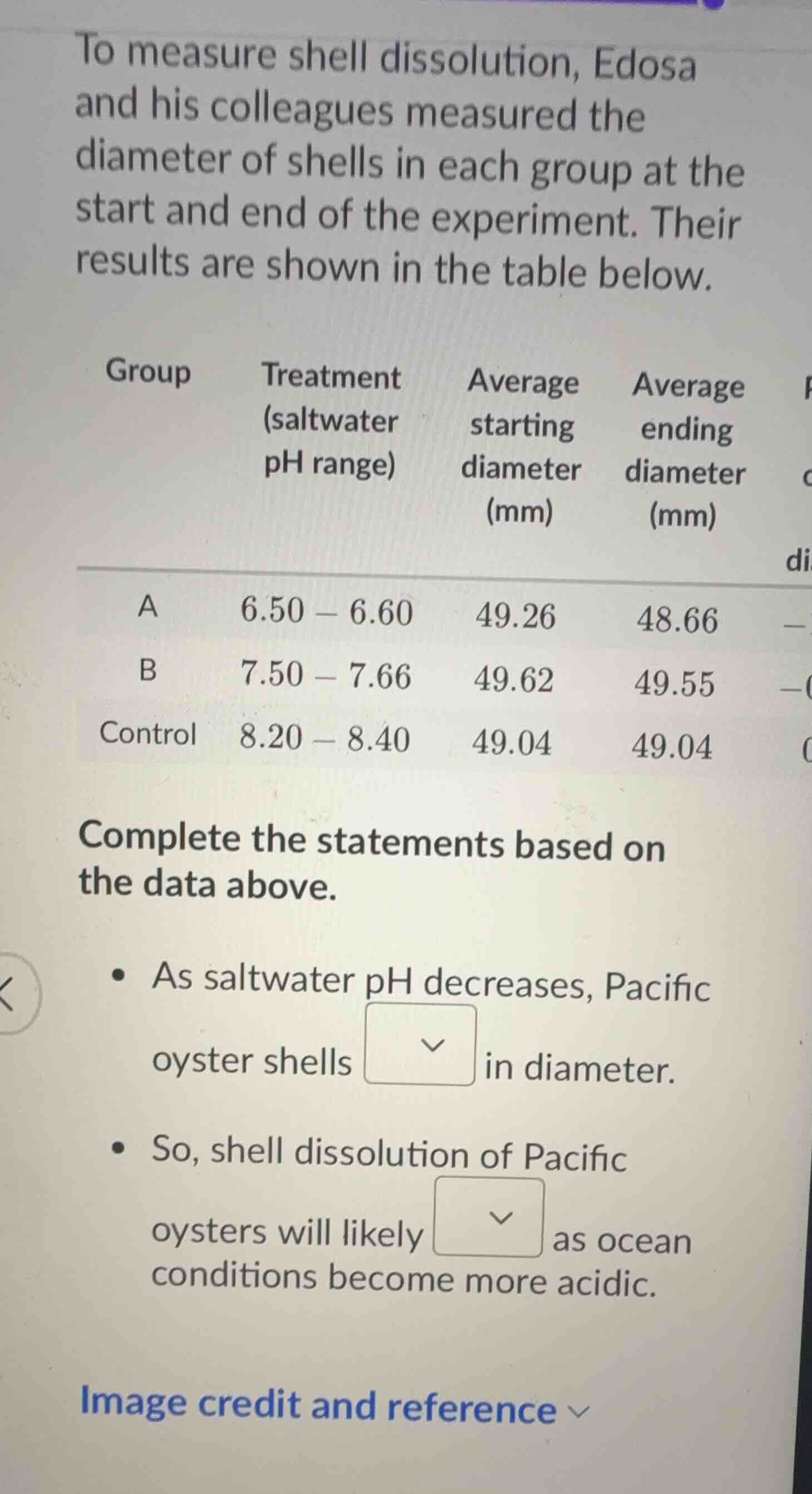
to measure shell dissolution, edosa and his colleagues measured the diameter of shells in each group at the start and end of the experiment. their results are shown in the table below.
group treatment (saltwater ph range) average starting diameter (mm) average ending diameter (mm)
a 6.50 – 6.60 49.26 48.66
b 7.50 – 7.66 49.62 49.55
control 8.20 – 8.40 49.04 49.04
complete the statements based on the data above.
- as saltwater ph decreases, pacific oyster shells dropdown in diameter.
- so, shell dissolution of pacific oysters will likely dropdown as ocean conditions become more acidic.
Brief Explanations
- For the first blank: Compare the average ending diameter with the average starting diameter for each group. Group A (lower pH: 6.50 - 6.60) has a decrease (49.26 to 48.66), Group B (pH 7.50 - 7.66) has a small decrease (49.62 to 49.55), and Control (higher pH: 8.20 - 8.40) has no change (49.04 to 49.04). As pH decreases, the diameter change (ending - starting) becomes more negative (more decrease). So shells decrease in diameter.
- For the second blank: Shell dissolution means the shell breaks down or loses mass/size. Since lower pH (more acidic) leads to decreased shell diameter, dissolution (the process of shell breakdown) should increase as acidity increases.

Snap & solve any problem in the app
Get step-by-step solutions on Sovi AI
Photo-based solutions with guided steps
Explore more problems and detailed explanations
- As saltwater pH decreases, Pacific oyster shells \(\boldsymbol{\text{decrease}}\) in diameter.
- So, shell dissolution of Pacific oysters will likely \(\boldsymbol{\text{increase}}\) as ocean conditions become more acidic.