QUESTION IMAGE
Question
meiosis introduction activity 2019
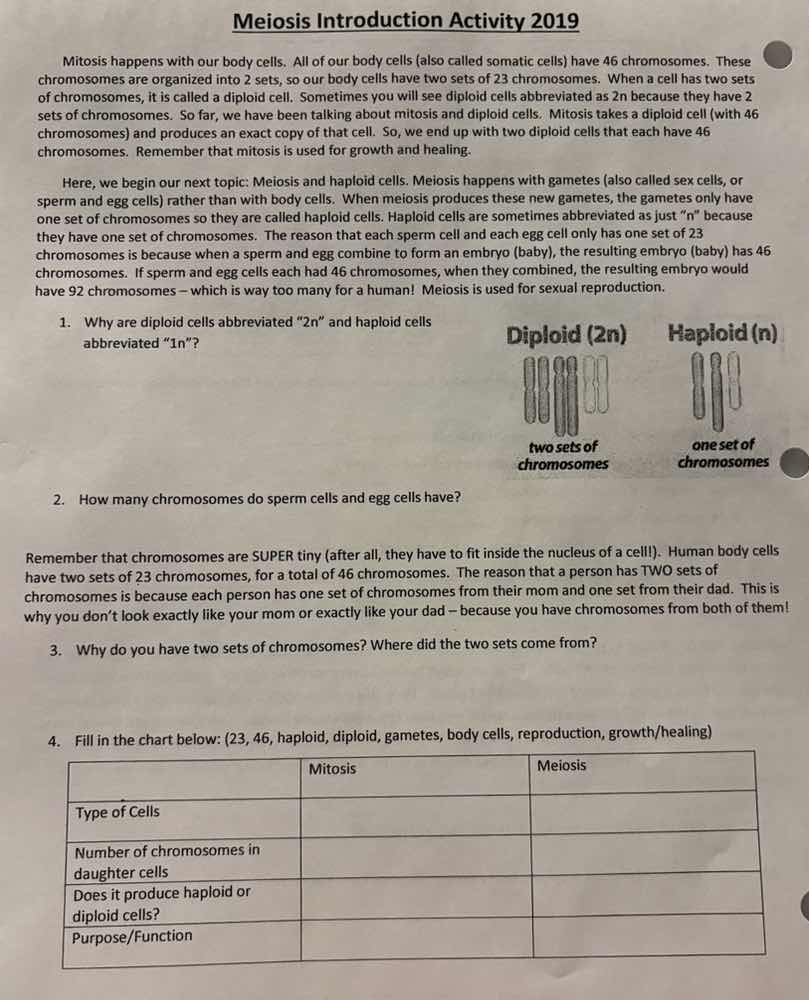
mitosis happens with our body cells. all of our body cells (also called somatic cells) have 46 chromosomes. these chromosomes are organized into 2 sets, so our body cells have two sets of 23 chromosomes. when a cell has two sets of chromosomes, it is called a diploid cell. sometimes you will see diploid cells abbreviated as 2n because they have 2 sets of chromosomes. so far, we have been talking about mitosis and diploid cells. mitosis takes a diploid cell (with 46 chromosomes) and produces an exact copy of that cell. so, we end up with two diploid cells that each have 46 chromosomes. remember that mitosis is used for growth and healing.
here, we begin our next topic: meiosis and haploid cells. meiosis happens with gametes (also called sex cells, or sperm and egg cells) rather than with body cells. when meiosis produces these new gametes, the gametes only have one set of chromosomes so they are called haploid cells. haploid cells are sometimes abbreviated as just “n” because they have one set of chromosomes. the reason that each sperm cell and each egg cell only has one set of 23 chromosomes is because when a sperm and egg combine to form an embryo (baby), the resulting embryo (baby) has 46 chromosomes. if sperm and egg cells each had 46 chromosomes, when they combined, the resulting embryo would have 92 chromosomes – which is way too many for a human! meiosis is used for sexual reproduction.
- why are diploid cells abbreviated “2n” and haploid cells abbreviated “1n”?
- how many chromosomes do sperm cells and egg cells have?
remember that chromosomes are super tiny (after all, they have to fit inside the nucleus of a cell!). human body cells have two sets of 23 chromosomes, for a total of 46 chromosomes. the reason that a person has two sets of chromosomes is because each person has one set of chromosomes from their mom and one set from their dad. this is why you don’t look exactly like your mom or exactly like your dad – because you have chromosomes from both of them!
- why do you have two sets of chromosomes? where did the two sets come from?
- fill in the chart below: (23, 46, haploid, diploid, gametes, body cells, reproduction, growth/healing)
| mitosis | meiosis | |
| type of cells | ||
| number of chromosomes in daughter cells | ||
| does it produce haploid or diploid cells? | ||
| purpose/function |
- The abbreviations correspond to the number of chromosome sets: diploid cells have 2 full sets, haploid cells have 1 set.
- Gametes (sperm/egg) are haploid, with half the chromosome count of body cells.
- Inheritance from both parents combines to form a full diploid set.
- Mitosis creates identical body cells for growth; meiosis makes gametes for sexual reproduction, with half the chromosomes.

Snap & solve any problem in the app
Get step-by-step solutions on Sovi AI
Photo-based solutions with guided steps
Explore more problems and detailed explanations
- Diploid cells have 2 full sets of chromosomes (abbreviated 2n), while haploid cells have only 1 set of chromosomes (abbreviated n).
- Sperm cells and egg cells have 23 chromosomes each.
- I have two sets of chromosomes to have a full, normal 46-chromosome count. One set comes from my biological mother, and the other set comes from my biological father.
4.
| Category | Mitosis | Meiosis |
|---|---|---|
| Number of chromosomes in daughter cells | 46 | 23 |
| Does it produce haploid or diploid cells? | diploid | haploid |
| Purpose/Function | growth/healing | reproduction |