QUESTION IMAGE
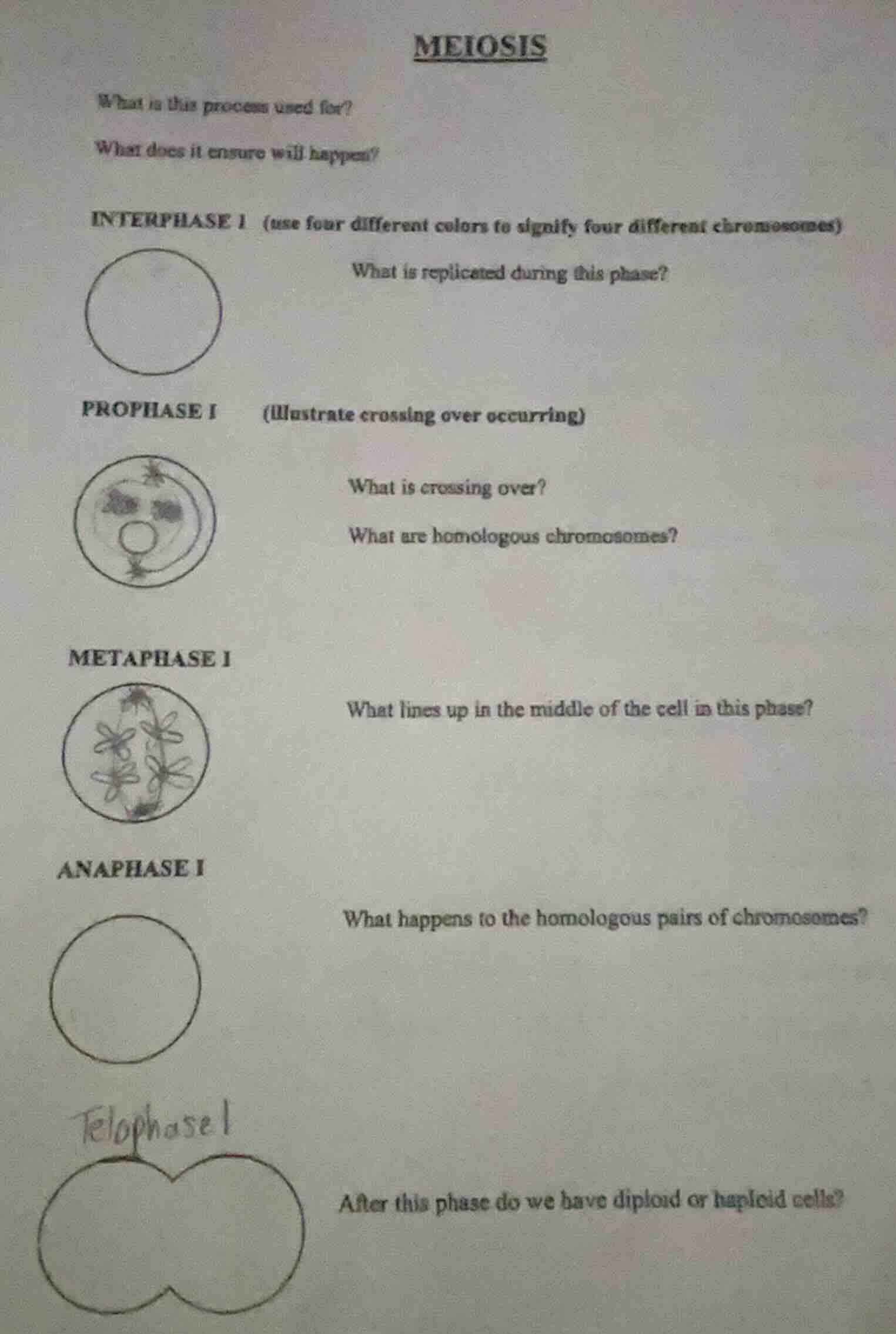
Question
meiosis
what is this process used for?
what does it ensure will happen?
interphase 1 (use four different colors to signify four different chromosomes)
what is replicated during this phase?
prophase i (illustrate crossing over occurring)
what is crossing over?
what are homologous chromosomes?
metaphase i
what lines up in the middle of the cell in this phase?
anaphase i
what happens to the homologous pairs of chromosomes?
telophase i
after this phase do we have diploid or haploid cells?
For "What is this process (meiosis) used for?"
Meiosis is a type of cell division. Its primary use is in the production of gametes (sperm and egg cells) in sexually reproducing organisms. It reduces the chromosome number by half, which is essential for sexual reproduction to maintain the correct chromosome number in offspring.
Meiosis ensures two main things. First, it ensures that the resulting gametes have half the number of chromosomes (haploid) of the parent cell (diploid), so that when fertilization occurs, the offspring will have the correct diploid chromosome number. Second, through processes like crossing over (in Prophase I) and independent assortment (in Metaphase I), it ensures genetic diversity in the offspring, which is important for evolution and adaptation.
During Interphase I of meiosis, the cell undergoes growth and prepares for division. The key component that is replicated is the DNA (deoxyribonucleic acid) within the chromosomes. Each chromosome is made up of DNA and proteins, and during Interphase I, the DNA is duplicated, resulting in each chromosome having two sister chromatids held together by a centromere. This replication is essential to ensure that each resulting cell after meiosis will have a complete set of genetic information (though with half the number of chromosomes compared to the parent cell).

Snap & solve any problem in the app
Get step-by-step solutions on Sovi AI
Photo-based solutions with guided steps
Explore more problems and detailed explanations
Meiosis is used for producing gametes (sperm and egg cells) in sexually reproducing organisms, and it also contributes to genetic diversity through processes like crossing over and independent assortment.