QUESTION IMAGE
Question
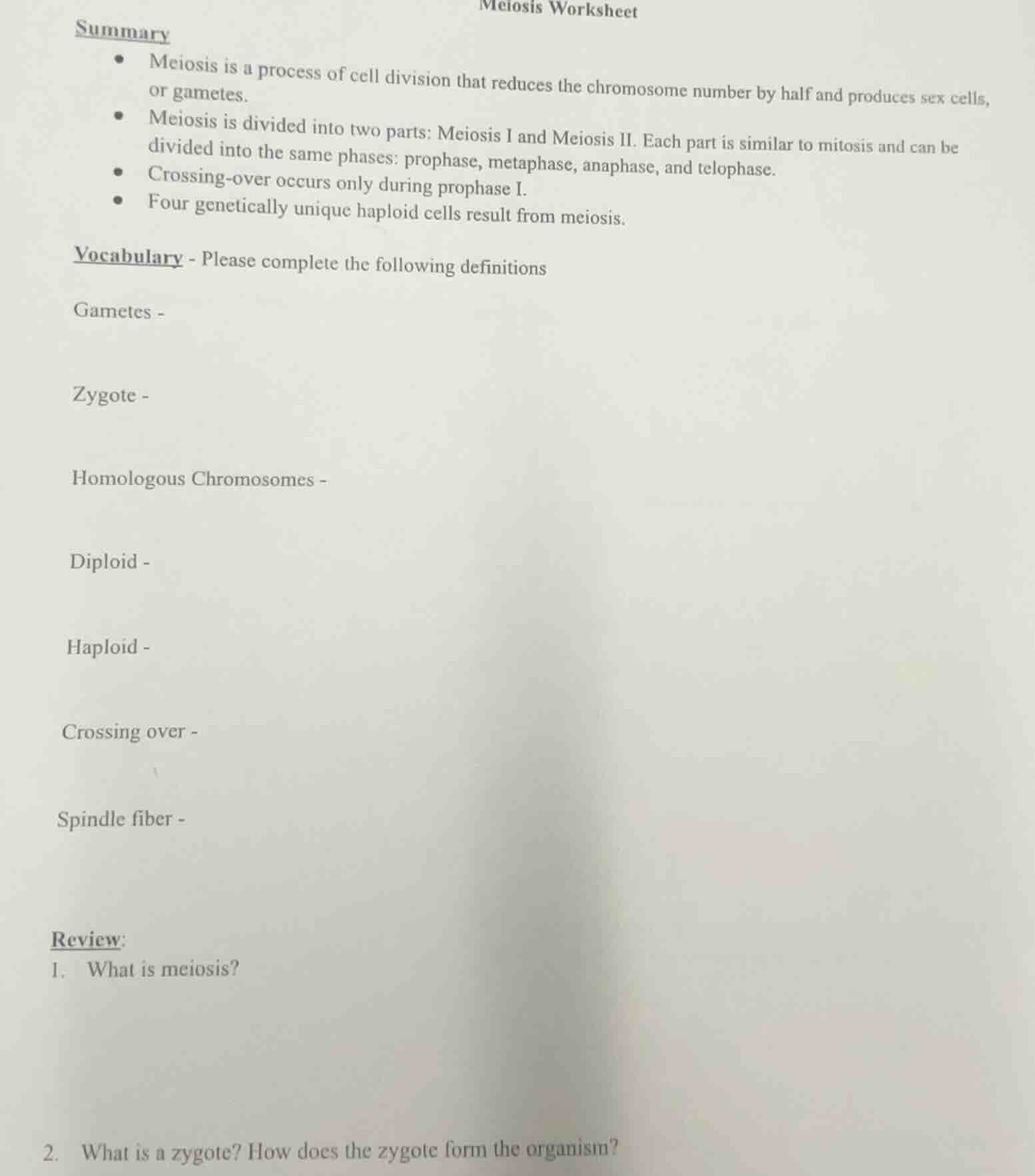
meiosis worksheetsummary• meiosis is a process of cell division that reduces the chromosome number by half and produces sex cells, or gametes.• meiosis is divided into two parts: meiosis i and meiosis ii. each part is similar to mitosis and can be divided into the same phases: prophase, metaphase, anaphase, and telophase.• crossing-over occurs only during prophase i.• four genetically unique haploid cells result from meiosis.vocabulary - please complete the following definitionsgametes -zygote -homologous chromosomes -diploid -haploid -crossing over -spindle fiber -review:1. what is meiosis?2. what is a zygote? how does the zygote form the organism?
Definitions are based on core biological concepts related to meiosis and sexual reproduction. Review answers align with the provided summary and standard cell biology knowledge.

Snap & solve any problem in the app
Get step-by-step solutions on Sovi AI
Photo-based solutions with guided steps
Explore more problems and detailed explanations
Vocabulary Definitions:
- Gametes - Haploid sex cells (sperm/egg) that fuse in fertilization.
- Zygote - Diploid cell formed by fusion of two gametes.
- Homologous Chromosomes - Chromosome pairs (1 from each parent) with same genes.
- Diploid - Cell with two full sets of chromosomes (2n).
- Haploid - Cell with one set of chromosomes (n).
- Crossing over - Exchange of DNA between homologous chromosomes in prophase I of meiosis, creating genetic variation.
- Spindle fiber - Microtubule structure that moves chromosomes during cell division.
Review Questions:
- What is meiosis?
A type of cell division that reduces chromosome number by half, producing genetically unique haploid gametes, divided into Meiosis I and Meiosis II.
- What is a zygote? How does the zygote form the organism?
A zygote is a diploid cell formed when two gametes (sperm and egg) fuse during fertilization. It develops into an organism through repeated mitotic cell divisions, which produce more cells, followed by cell differentiation to form specialized tissues and organs.