QUESTION IMAGE
Question
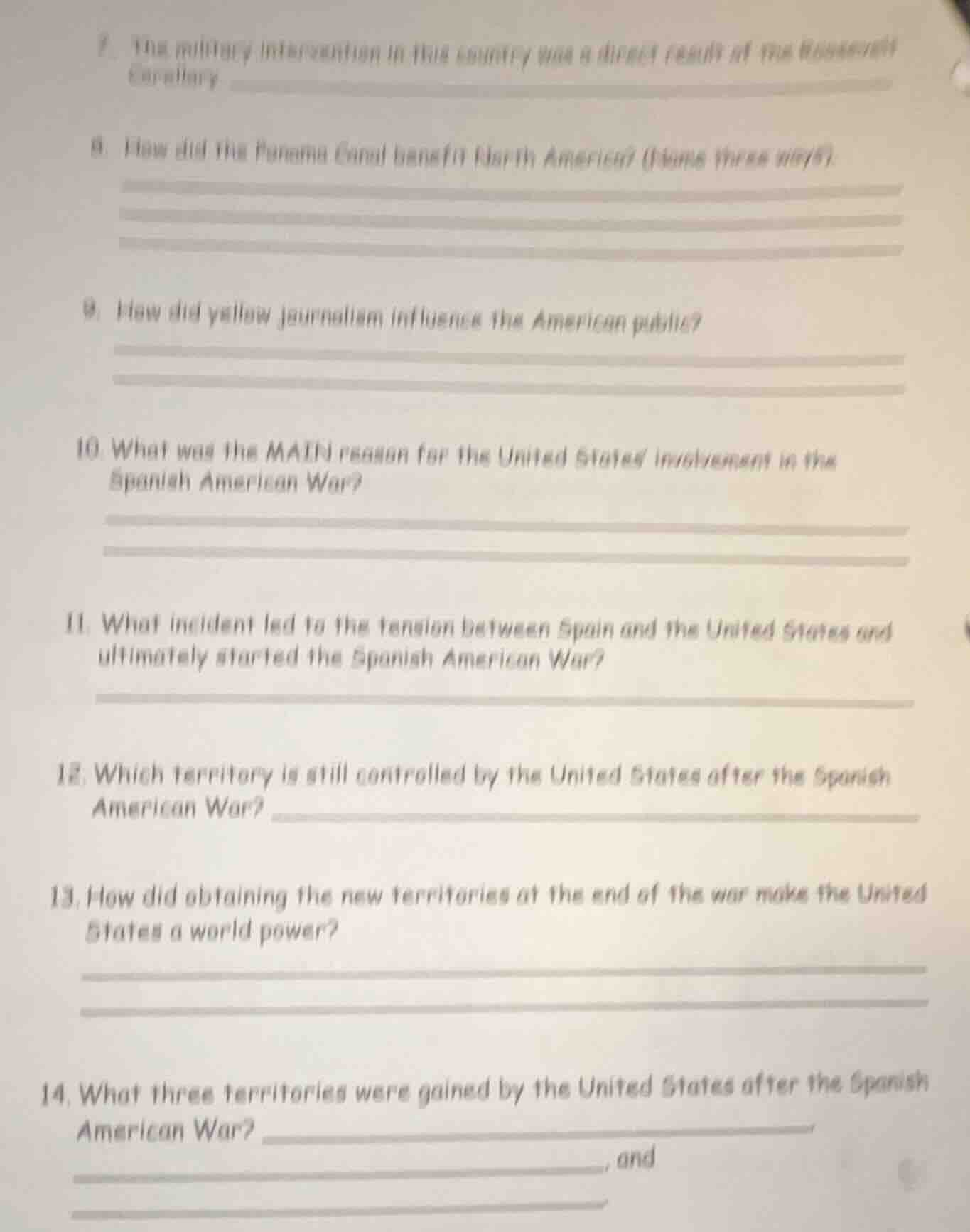
- the military intervention in this country was a direct result of the uss maine explosion
- how did the panama canal benefit north america? (name three ways).
- how did yellow journalism influence the american public?
- what was the main reason for the united states involvement in the spanish american war?
- what incident led to the tension between spain and the united states and ultimately started the spanish american war?
- which territory is still controlled by the united states after the spanish american war?
- how did obtaining the new territories at the end of the war make the united states a world power?
- what three territories were gained by the united states after the spanish american war? , and
Response
Question 8: How did the Panama Canal benefit North America? (Name three ways)
Brief Explanations
- Trade Efficiency: The Panama Canal significantly reduced the distance ships had to travel between the Atlantic and Pacific Oceans. For North American countries, this meant faster and cheaper transportation of goods. For example, goods from the West Coast of the United States to the East Coast no longer had to go around the southern tip of South America (Cape Horn), saving thousands of miles and weeks of travel time. This boosted domestic and international trade, as businesses could move products more quickly, reducing costs and increasing profits.
- Military Advantage: The canal provided a strategic shortcut for the U.S. Navy (and other North American military forces, though the U.S. was the primary military user in the region). It allowed for quicker deployment of naval vessels between the two oceans, enhancing North America's military presence and defense capabilities. In times of conflict or tension, the ability to move ships rapidly between the Atlantic and Pacific was crucial for protecting North American interests and projecting power globally.
- Economic Growth and Development: The construction and operation of the canal created jobs in North America, both during the building phase (with North American workers and companies involved) and in the ongoing management and maintenance. Additionally, the increased trade and shipping activity spurred economic growth in port cities and industries related to shipping (like shipbuilding, logistics, and warehousing) across North America. It also facilitated the growth of industries that relied on imported raw materials or exported finished goods, as the canal made these supply chains more efficient.
Brief Explanations
Yellow journalism, characterized by sensationalized news, exaggerated stories, and often inaccurate reporting, had several impacts on the American public:
- Shaping Public Opinion: It used dramatic headlines, vivid (and sometimes fabricated) descriptions, and emotional appeals to capture the public's attention. For example, during the lead - up to the Spanish - American War, yellow journalists like William Randolph Hearst and Joseph Pulitzer published stories about the supposed atrocities of the Spanish in Cuba. These stories, which often exaggerated or invented details, whipped up public outrage against Spain, influencing many Americans to support a war against Spain.
- Increasing Public Interest in News: The sensational nature of yellow journalism made the news more entertaining, which led to a significant increase in newspaper circulation. More Americans became regular newspaper readers as they were drawn to the exciting (even if not entirely true) stories. This also helped to spread information (both true and false) more widely, making the public more aware of international and domestic events, although the information was often distorted.
- Eroding Trust in Media (Over Time): While it initially attracted readers, the blatant sensationalism and inaccuracies of yellow journalism eventually led some members of the public to become more skeptical of the news media. However, in the short term, during the height of its popularity, it was very effective at manipulating public sentiment, especially in cases like the build - up to the Spanish - American War where it played a major role in pushing the country towards conflict.
Brief Explanations
The main reason for the United States' involvement in the Spanish - American War was a combination of factors, with the desire for economic expansion, national pride, and the influence of yellow journalism, but the most significant overarching factor was the desire to expand American influence and power, both economically and geopolitically.
- Economic Interests: The United States had economic interests in Cuba and other Spanish colonies. American businesses had invested in Cuban sugar plantations and other industries. The instability in Cuba (due to its struggle for independence from Spain) threatened these investments. Also, the United States wanted to expand its markets and access to resources. A war with Spain presented an opportunity to gain control of territories (like Cuba, Puerto Rico, Guam, and the Philippines) that could serve as new markets for American goods and sources of raw materials.
- National Pride and Geopolitical Ambitions: The United States was emerging as a world power, and there was a sense of national pride and a desire to assert itself on the global stage. Defeating a European power (Spain) would demonstrate American strength. Additionally, the idea of "Manifest Destiny" had evolved to include overseas expansion. The war was seen as a way to expand American influence beyond the North American continent.
- Influence of Yellow Journalism: As mentioned earlier, yellow journalism played a role in shaping public opinion. The sensational stories about Spanish atrocities in Cuba created a public outcry that put pressure on the government to act. While yellow journalism was more of a catalyst that mobilized public support, the underlying economic and geopolitical interests were the main drivers.

Snap & solve any problem in the app
Get step-by-step solutions on Sovi AI
Photo-based solutions with guided steps
Explore more problems and detailed explanations
- Trade Efficiency: Reduced shipping distance between Atlantic and Pacific, lowering costs and speeding up goods transport.
- Military Advantage: Enabled quicker naval deployment between oceans, enhancing defense and power projection.
- Economic Growth: Created jobs and boosted port cities/related industries through increased trade activity.