QUESTION IMAGE
Question
of mitosis.
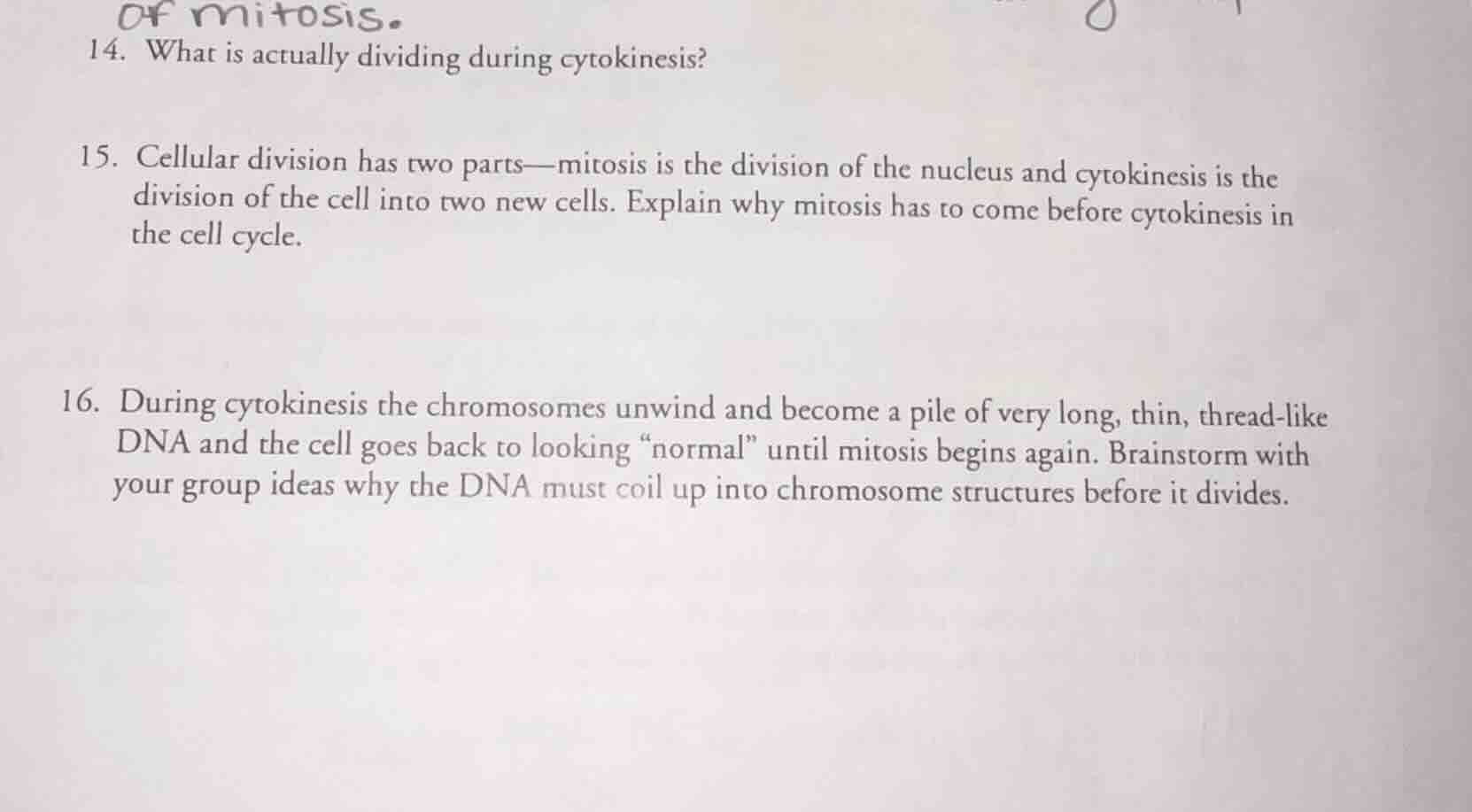
- what is actually dividing during cytokinesis?
- cellular division has two parts—mitosis is the division of the nucleus and cytokinesis is the
division of the cell into two new cells. explain why mitosis has to come before cytokinesis in
the cell cycle.
- during cytokinesis the chromosomes unwind and become a pile of very long, thin, thread - like
dna and the cell goes back to looking
ormal\ until mitosis begins again. brainstorm with
your group ideas why the dna must coil up into chromosome structures before it divides.
Brief Explanations
- For question 14: Cytokinesis is the final stage of cell division, focused on splitting the components outside the nucleus to form two independent cells.
- For question 15: Mitosis ensures the duplicated genetic material is evenly sorted into two identical sets within the nucleus. If cytokinesis happened first, the undivided nucleus would be trapped in one cell, leading to unequal or missing genetic material in the new cells.
- For question 16: Coiling DNA into chromosomes condenses the long, fragile DNA strands into compact structures. This prevents tangling and breakage during the physical separation process of cell division, and ensures each new cell receives an exact, complete copy of the genetic material.

Snap & solve any problem in the app
Get step-by-step solutions on Sovi AI
Photo-based solutions with guided steps
Explore more problems and detailed explanations
- The cytoplasm (and the cell itself, including its organelles and cell membrane) is actually dividing during cytokinesis.
- Mitosis must come before cytokinesis to ensure the duplicated genetic material in the nucleus is evenly divided into two identical sets first, so each new cell formed during cytokinesis receives a full, complete copy of the cell's DNA.
- DNA coils into chromosomes before division to:
- Prevent the long, thin DNA strands from tangling or breaking during the separation process
- Enable the precise, equal sorting of genetic material into the two new daughter cells, ensuring each gets a full, unbroken set of DNA