QUESTION IMAGE
Question
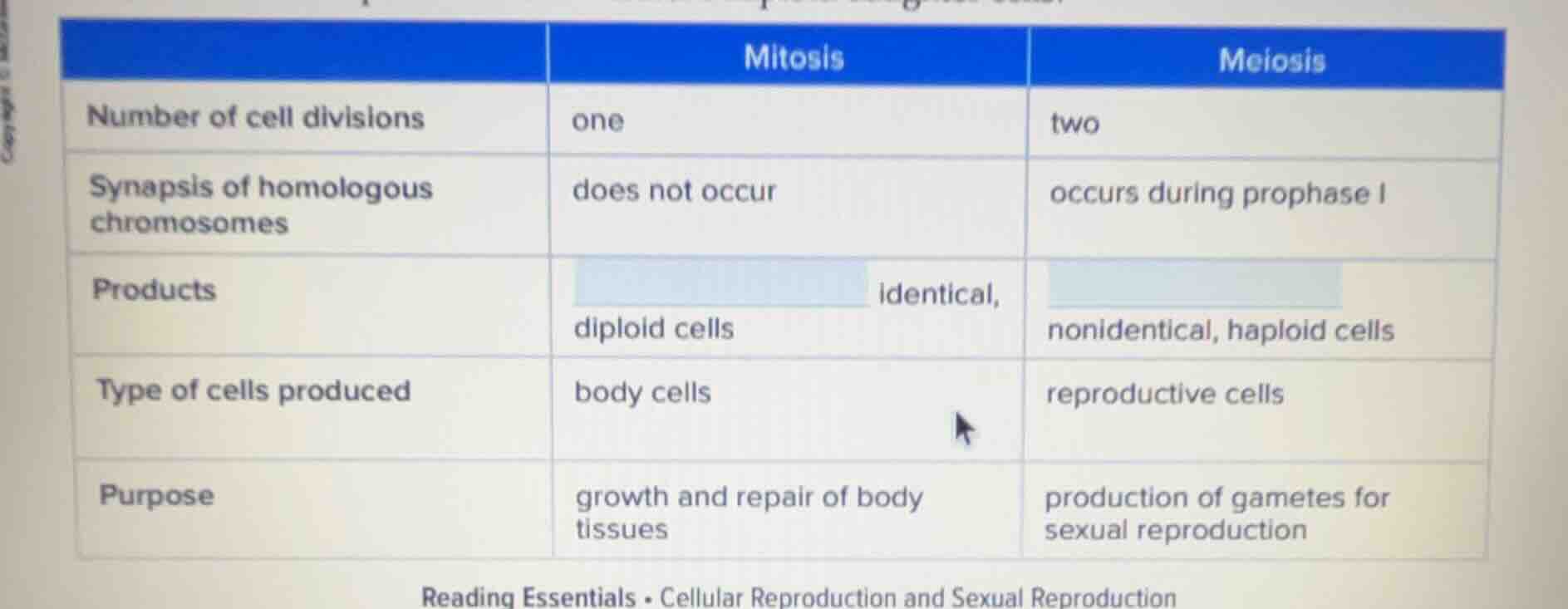
| mitosis | meiosis | |
| number of cell divisions | one | two |
| synapsis of homologous chromosomes | does not occur | occurs during prophase i |
| products | identical, diploid cells | nonidentical, haploid cells |
| type of cells produced | body cells | reproductive cells |
| purpose | growth and repair of body tissues | production of gametes for sexual reproduction |
reading essentials • cellular reproduction and sexual reproduction
Assuming the question is to fill in the missing part of the "Products" row for Mitosis and Meiosis:
For Mitosis (Products):
Step1: Recall Mitosis product properties
Mitosis produces two daughter cells that are genetically identical to the parent cell. So the number of cells is two (since one division of a diploid cell gives two diploid cells, and they are identical).
Step2: Fill the blank
The blank before "identical" should be "two" (as mitosis produces two daughter cells from one parent cell, and they are identical diploid cells).
For Meiosis (Products):
Step1: Recall Meiosis product properties
Meiosis has two divisions. The first division of a diploid cell (with synapsis etc.) and the second division. The end result is four haploid cells (since 2 divisions: 1 parent cell → 2 cells after first division, each → 2 cells after second division, total 4; and they are non - identical due to crossing over and independent assortment).
Step2: Fill the blank
The blank for Meiosis products should be "four" (as meiosis produces four non - identical haploid cells).
Final Answers for the Blanks:
- Mitosis Products blank: two
- Meiosis Products blank: four

Snap & solve any problem in the app
Get step-by-step solutions on Sovi AI
Photo-based solutions with guided steps
Explore more problems and detailed explanations
Step1: Recall Meiosis product properties
Meiosis has two divisions. The first division of a diploid cell (with synapsis etc.) and the second division. The end result is four haploid cells (since 2 divisions: 1 parent cell → 2 cells after first division, each → 2 cells after second division, total 4; and they are non - identical due to crossing over and independent assortment).
Step2: Fill the blank
The blank for Meiosis products should be "four" (as meiosis produces four non - identical haploid cells).
Final Answers for the Blanks:
- Mitosis Products blank: two
- Meiosis Products blank: four