QUESTION IMAGE
Question
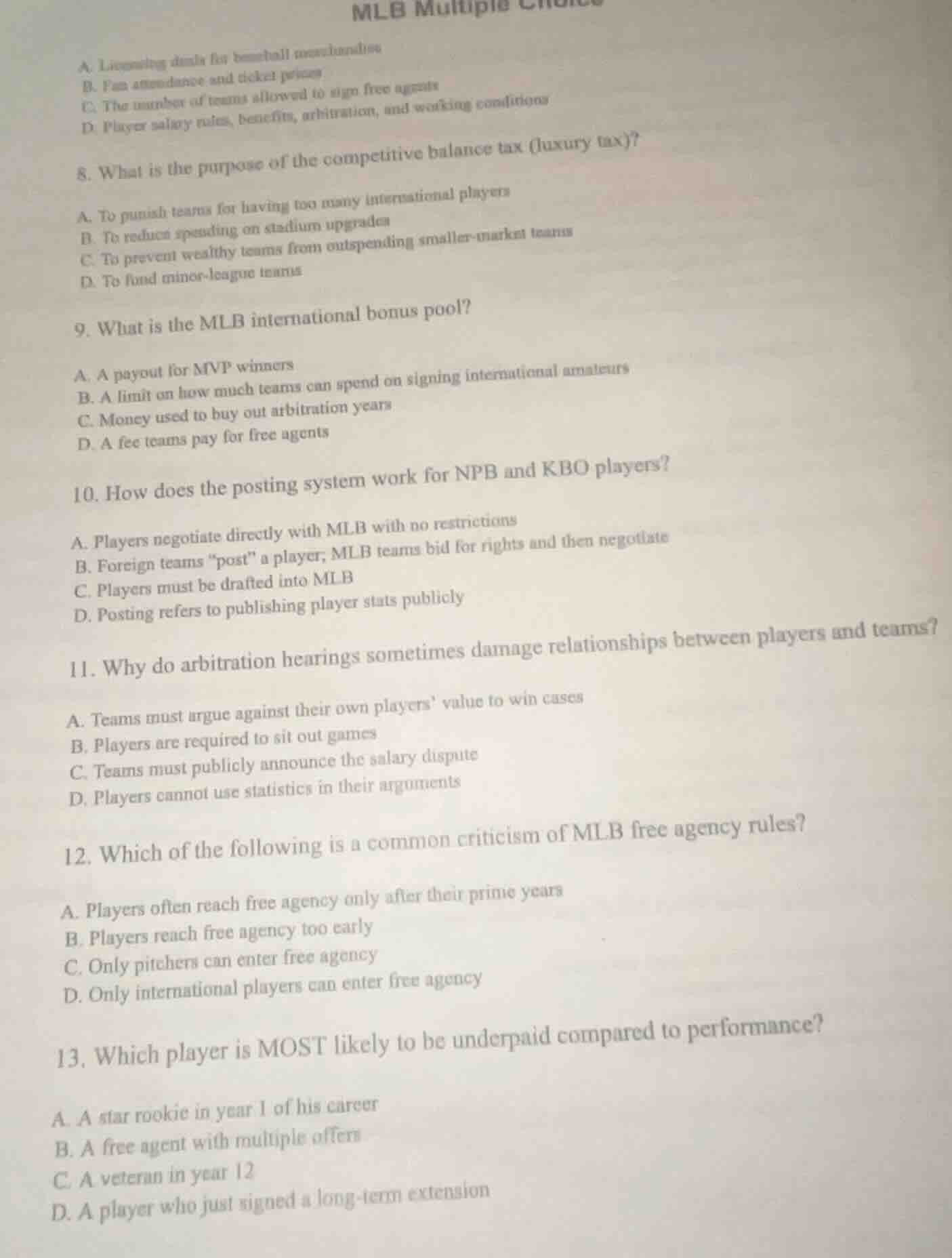
mlb multiple choice
a. licensing deals for baseball merchandise
b. fan attendance and ticket prices
c. the number of teams allowed to sign free agents
d. player salary rates, benefits, arbitration, and working conditions
- what is the purpose of the competitive balance tax (luxury tax)?
a. to punish teams for having too many international players
b. to reduce spending on stadium upgrades
c. to prevent wealthy teams from outspending smaller - market teams
d. to fund minor - league teams
- what is the mlb international bonus pool?
a. a payout for mvp winners
b. a limit on how much teams can spend on signing international amateurs
c. money used to buy out arbitration years
d. a fee teams pay for free agents
- how does the posting system work for npb and kbo players?
a. players negotiate directly with mlb with no restrictions
b. foreign teams “post” a player; mlb teams bid for rights and then negotiate
c. players must be drafted into mlb
d. posting refers to publishing player stats publicly
- why do arbitration hearings sometimes damage relationships between players and teams?
a. teams must argue against their own players’ value to win cases
b. players are required to sit out games
c. teams must publicly announce the salary dispute
d. players cannot use statistics in their arguments
- which of the following is a common criticism of mlb free agency rules?
a. players often reach free agency only after their prime years
b. players reach free agency too early
c. only pitchers can enter free agency
d. only international players can enter free agency
- which player is most likely to be underpaid compared to performance?
a. a star rookie in year 1 of his career
b. a free agent with multiple offers
c. a veteran in year 12
d. a player who just signed a long - term extension
- The luxury tax in MLB is designed to create parity by limiting large-market teams' spending advantages over smaller-market ones.
- The international bonus pool sets a cap on each team's spending for signing international amateur players.
- The posting system for NPB/KBO players has foreign teams make players available, MLB teams bid for negotiation rights, then negotiate with the player.
- In arbitration, teams argue that their player is worth less than the player claims, which creates tension.
- MLB free agency rules require players to accrue 6 years of service time, meaning many enter free agency after their peak performance years.
- Star rookies are under MLB's pre-arbitration system, where salaries are not tied to their on-field performance, making them likely underpaid.

Snap & solve any problem in the app
Get step-by-step solutions on Sovi AI
Photo-based solutions with guided steps
Explore more problems and detailed explanations
- C. To prevent wealthy teams from outspending smaller-market teams
- B. A limit on how much teams can spend on signing international amateurs
- B. Foreign teams "post" a player; MLB teams bid for rights and then negotiate
- A. Teams must argue against their own players' value to win cases
- A. Players often reach free agency only after their prime years
- A. A star rookie in year 1 of his career