QUESTION IMAGE
Question
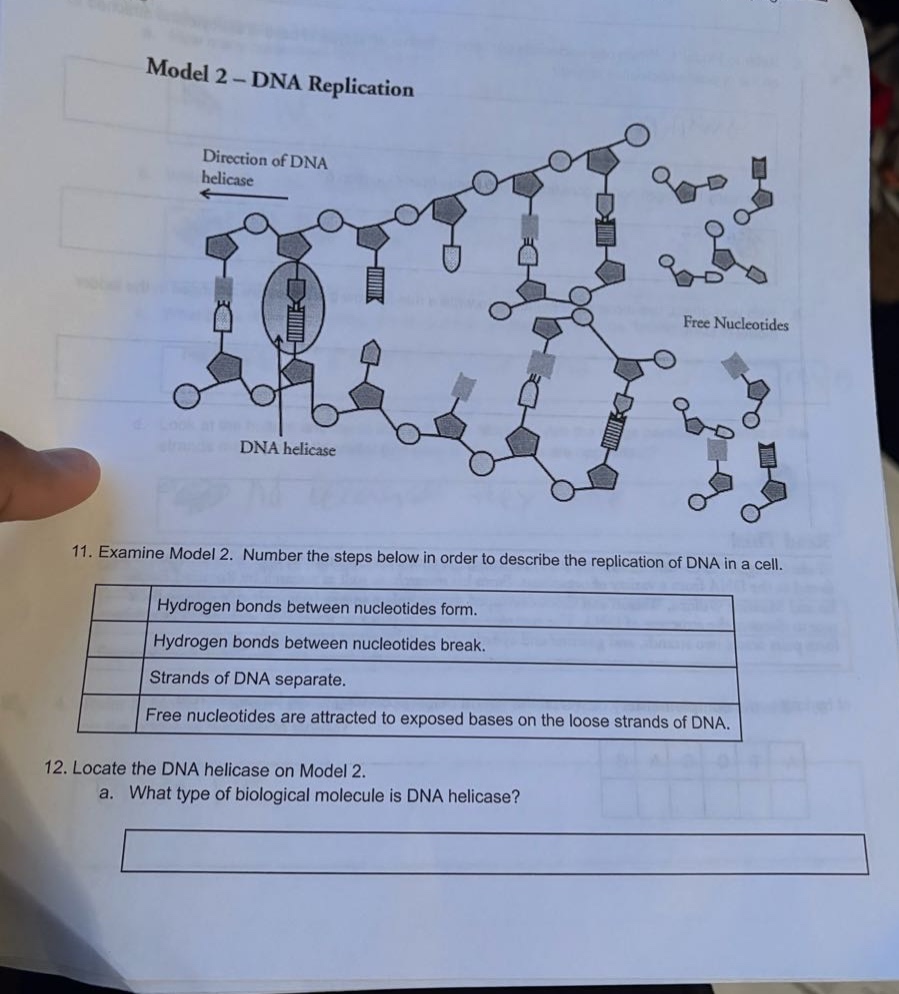
model 2 – dna replication
direction of dna
helicase
free nucleotides
dna helicase
- examine model 2. number the steps below in order to describe the replication of dna in a cell.
hydrogen bonds between nucleotides form.
hydrogen bonds between nucleotides break.
strands of dna separate.
free nucleotides are attracted to exposed bases on the loose strands of dna.
- locate the dna helicase on model 2.
a. what type of biological molecule is dna helicase?
Question 11
Step1: Identify the first step
The first step in DNA replication is the breaking of hydrogen bonds between nucleotides. This is because DNA helicase breaks the hydrogen bonds between the complementary base pairs, which is the initial event to start replication. So "Hydrogen bonds between nucleotides break" is step 1.
Step2: Identify the second step
After the hydrogen bonds break, the two strands of DNA separate. So "Strands of DNA separate" is step 2.
Step3: Identify the third step
Once the strands are separated, free nucleotides are attracted to the exposed bases on the loose strands. So "Free nucleotides are attracted to exposed bases on the loose strands of DNA" is step 3.
Step4: Identify the fourth step
Finally, hydrogen bonds form between the newly added nucleotides and the template strand. So "Hydrogen bonds between nucleotides form" is step 4.
DNA helicase is an enzyme, and enzymes are proteins. Proteins are biological molecules made of amino acids, and enzymes (like DNA helicase) have catalytic functions in biological processes (here, unwinding DNA during replication).

Snap & solve any problem in the app
Get step-by-step solutions on Sovi AI
Photo-based solutions with guided steps
Explore more problems and detailed explanations
- Hydrogen bonds between nucleotides break.
- Strands of DNA separate.
- Free nucleotides are attracted to exposed bases on the loose strands of DNA.
- Hydrogen bonds between nucleotides form.