QUESTION IMAGE
Question
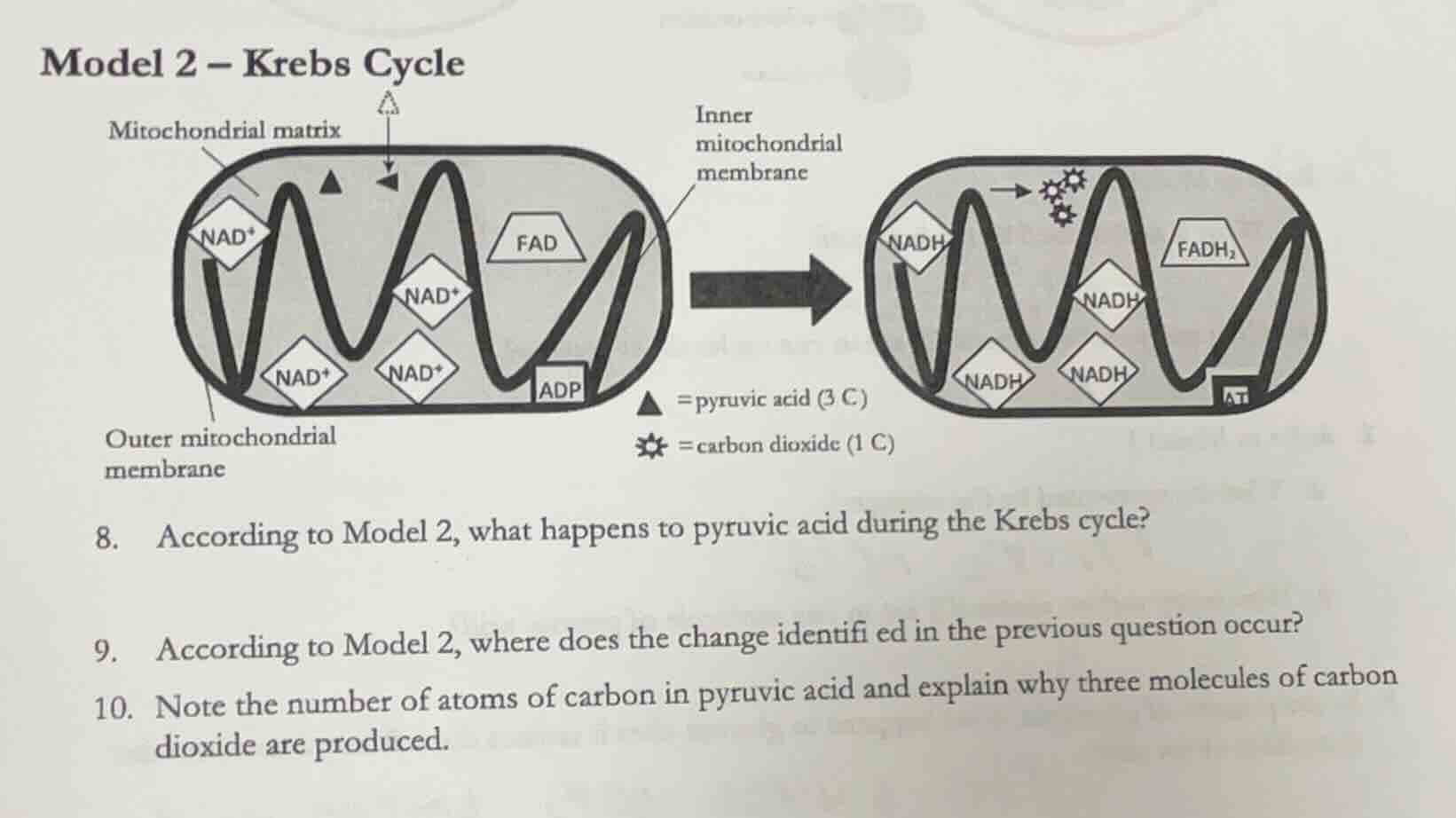
model 2 – krebs cycle
mitochondrial matrix
outer mitochondrial membrane
inner mitochondrial membrane
▲ = pyruvic acid (3 c)
❋ = carbon dioxide (1 c)
- according to model 2, what happens to pyruvic acid during the krebs cycle?
- according to model 2, where does the change identified in the previous question occur?
- note the number of atoms of carbon in pyruvic acid and explain why three molecules of carbon dioxide are produced.
For question 8:
The model shows pyruvic acid (3-carbon) entering the Krebs cycle, and carbon dioxide (1-carbon) is released as a product. The pyruvic acid is broken down, with its carbon atoms released as CO₂, while the remaining energy is used to generate NADH, FADH₂, and ATP.
For question 9:
The diagram labels the location of the Krebs cycle components (NAD⁺, FAD, ADP) as the mitochondrial matrix, which is the space inside the inner mitochondrial membrane.
For question 10:
Pyruvic acid has 3 carbon atoms. During the Krebs cycle, each pyruvic acid molecule is fully oxidized, with each of its 3 carbon atoms being released individually as a 1-carbon carbon dioxide molecule, resulting in 3 total CO₂ molecules per pyruvic acid.

Snap & solve any problem in the app
Get step-by-step solutions on Sovi AI
Photo-based solutions with guided steps
Explore more problems and detailed explanations
- Pyruvic acid (3-carbon) is broken down, and its carbon atoms are released as three molecules of carbon dioxide (1-carbon each), while the energy from the breakdown is used to produce NADH, FADH₂, and ATP.
- The changes to pyruvic acid occur in the mitochondrial matrix.
- Pyruvic acid contains 3 carbon atoms. During the Krebs cycle, each of these 3 carbon atoms is removed one at a time and released as a single-carbon carbon dioxide molecule, so three carbon dioxide molecules are produced to account for all the carbon in the original pyruvic acid.