QUESTION IMAGE
Question
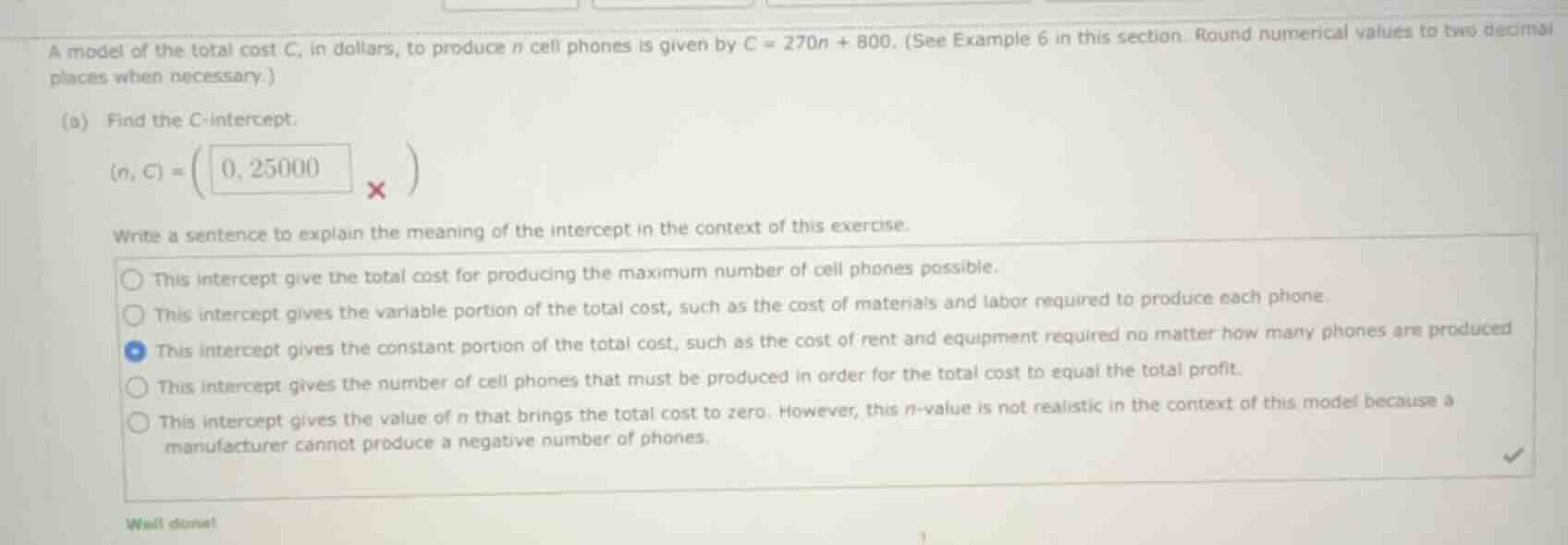
a model of the total cost ( c ), in dollars, to produce ( n ) cell phones is given by ( c = 270n + 800 ). (see example 6 in this section. round numerical values to two decimal places when necessary.)
(a) find the ( c )-intercept.
( (n, c) = left( 0, 25000 quad \boldsymbol{\times}
ight) )
write a sentence to explain the meaning of the intercept in the context of this exercise.
\\( \bigcirc ) this intercept give the total cost for producing the maximum number of cell phones possible.
\\( \bigcirc ) this intercept gives the variable portion of the total cost, such as the cost of materials and labor required to produce each phone.
\\( \bigcirc ) this intercept gives the constant portion of the total cost, such as the cost of rent and equipment required no matter how many phones are produced
\\( \bigcirc ) this intercept gives the number of cell phones that must be produced in order for the total cost to equal the total profit.
\\( \bigcirc ) this intercept gives the value of ( n ) that brings the total cost to zero. however, this ( n )-value is not realistic in the context of this model because a manufacturer cannot produce a negative number of phones.
Step1: Identify C-intercept condition
The C-intercept occurs when \(n=0\) (no cell phones produced).
Step2: Calculate C at n=0
Substitute \(n=0\) into \(C=270n + 800\):
\(C = 270(0) + 800 = 800\)

Snap & solve any problem in the app
Get step-by-step solutions on Sovi AI
Photo-based solutions with guided steps
Explore more problems and detailed explanations
(a)
The C-intercept is \((n, C)=(0, 800)\)
Meaning of the intercept:
This intercept gives the constant portion of the total cost, such as the cost of rent and equipment required no matter how many phones are produced