QUESTION IMAGE
Question
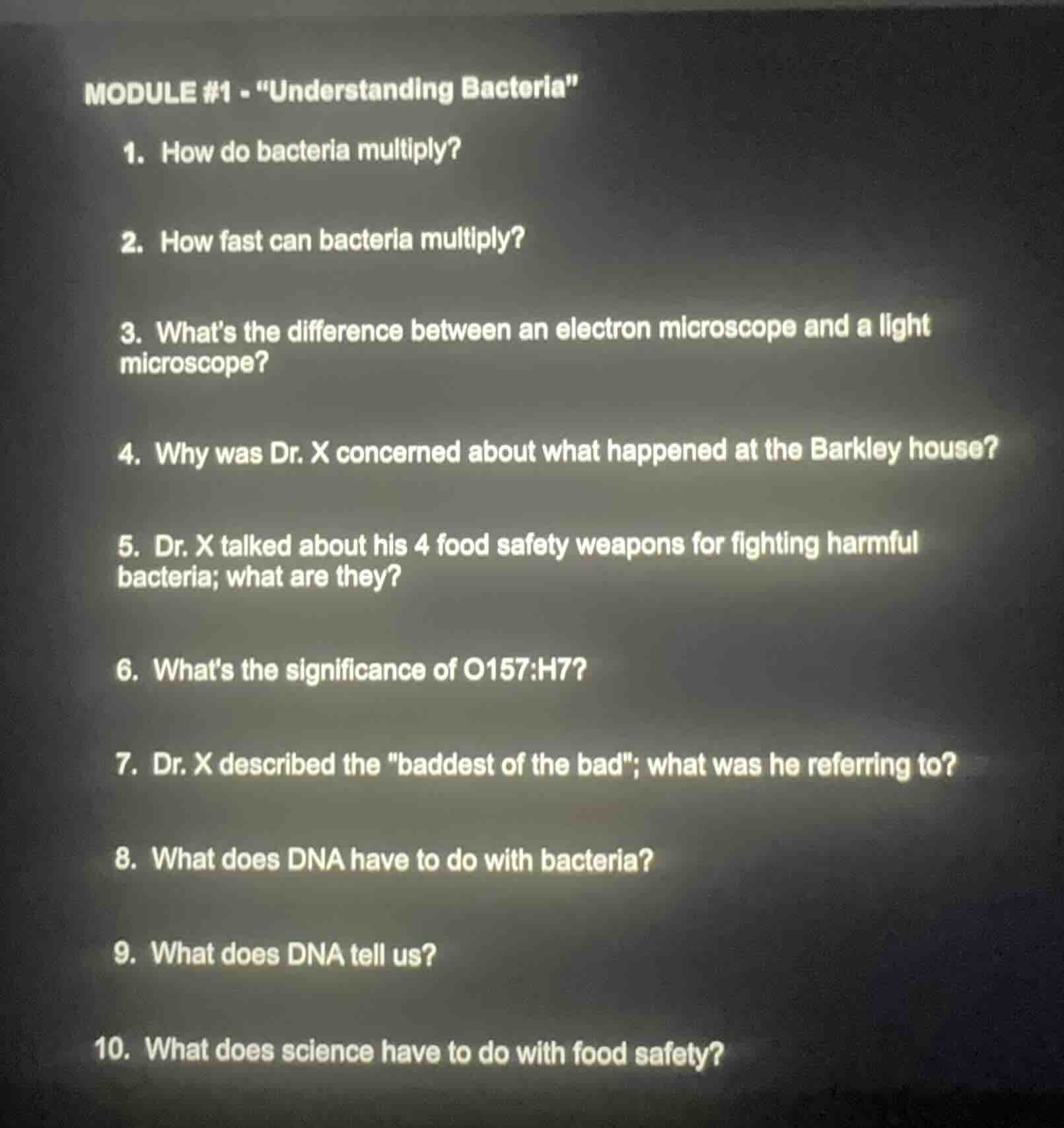
module #1 - \understanding bacteria\
- how do bacteria multiply?
- how fast can bacteria multiply?
- whats the difference between an electron microscope and a light microscope?
- why was dr. x concerned about what happened at the barkley house?
- dr. x talked about his 4 food safety weapons for fighting harmful bacteria; what are they?
- whats the significance of o157:h7?
- dr. x described the \baddest of the bad\; what was he referring to?
- what does dna have to do with bacteria?
- what does dna tell us?
- what does science have to do with food safety?
Brief Explanations
- Bacteria multiply via binary fission, asexual division of one cell into two identical daughter cells.
- Under ideal conditions (warmth, moisture, nutrients), some bacteria can multiply every 20 minutes, leading to exponential growth.
- Light microscopes use visible light and glass lenses, have lower magnification/resolution, and can view live samples; electron microscopes use electron beams and electromagnetic lenses, have far higher magnification/resolution, and require non-live, prepared samples.
- (Context-specific: Typically, the Barkley house incident involved a harmful bacterial contamination (like E. coli O157:H7) that sickened people, creating a risk of wider spread.)
- The four food safety weapons are: cook food to proper temperatures, separate raw and ready-to-eat foods, keep food cold (refrigerate promptly), and wash hands and surfaces often.
- O157:H7 is a strain of E. coli that produces potent toxins, causing severe foodborne illness (including bloody diarrhea, kidney failure) in humans; it is a major food safety concern linked to undercooked meat, produce, and contaminated water.
- Dr. X was referring to harmful, toxin-producing bacteria like E. coli O157:H7, which cause severe, sometimes life-threatening, illness.
- Bacteria have a single circular DNA chromosome (plus optional plasmids) that contains all their genetic instructions for growth, reproduction, and producing proteins/toxins; this DNA controls all bacterial cellular functions.
- Bacterial DNA tells us the species, strain, virulence factors (like toxin production), antibiotic resistance, and evolutionary relationships of the bacteria; it is used to identify and track bacterial outbreaks.
- Science provides the evidence-based methods to identify harmful bacteria, understand their growth conditions, develop testing protocols, and create guidelines for safe food handling, processing, and storage to prevent foodborne illness.

Snap & solve any problem in the app
Get step-by-step solutions on Sovi AI
Photo-based solutions with guided steps
Explore more problems and detailed explanations
- Bacteria multiply through binary fission, an asexual process where one parent cell divides into two genetically identical daughter cells.
- Some bacteria can multiply every 20 minutes under optimal environmental conditions (warmth, moisture, nutrient availability), leading to exponential population growth.
- Light microscopes use visible light and glass lenses, have ~1000x max magnification, can view live samples, and lower resolution; electron microscopes use electron beams and electromagnetic lenses, have ~10,000,000x max magnification, require fixed/non-live samples, and far higher resolution.
- (Context-dependent standard answer) The Barkley house had an outbreak of a dangerous foodborne bacteria (like E. coli O157:H7) that sickened individuals, and Dr. X was concerned about the risk of the bacteria spreading to cause more illnesses.
- Cook, Separate, Chill, and Clean (cook to safe temps, separate raw/ready foods, refrigerate promptly, wash hands/surfaces).
- O157:H7 is a highly virulent strain of E. coli that produces Shiga toxins, causing severe foodborne illness (including hemolytic uremic syndrome, a life-threatening kidney condition) and is a key food safety hazard.
- Dr. X was referring to dangerous, toxin-producing pathogenic bacteria such as E. coli O157:H7 that cause severe, potentially fatal foodborne illnesses.
- Bacteria have circular chromosomal DNA (and plasmids) that carries all their genetic information, directing their growth, reproduction, protein production, and ability to cause disease.
- Bacterial DNA identifies the specific species/strain, reveals if it carries genes for toxins or antibiotic resistance, helps track outbreak sources, and informs treatment and prevention strategies.
- Science underpins food safety by enabling identification of harmful pathogens, understanding their growth requirements, developing detection tests, and creating evidence-based guidelines for safe food handling, processing, and storage to prevent illness.