QUESTION IMAGE
Question
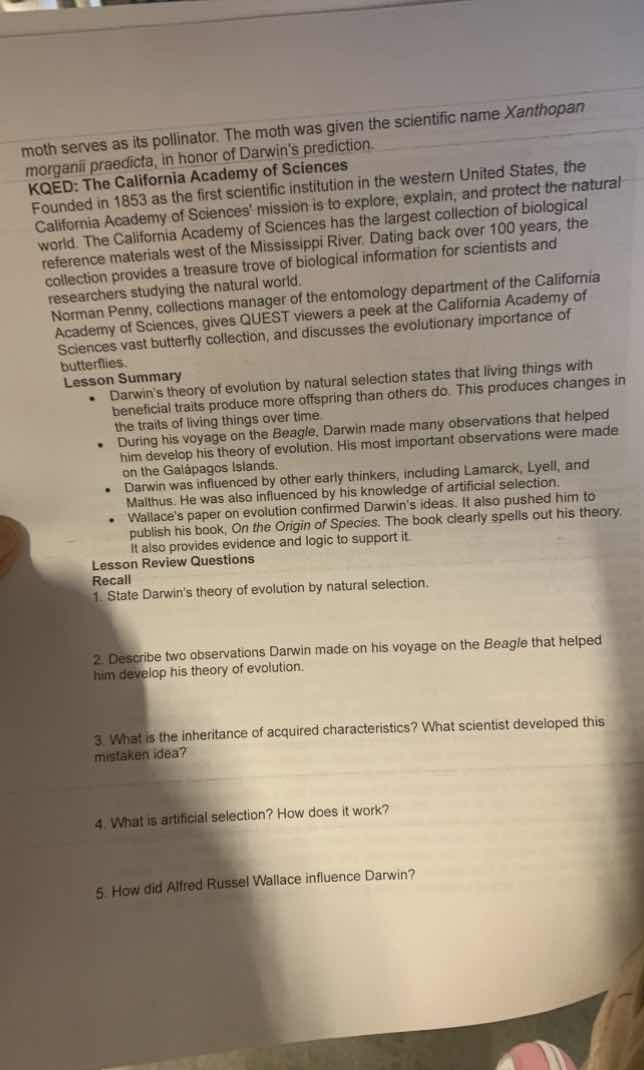
moth serves as its pollinator. the moth was given the scientific name xanthopan morganii praedicta, in honor of darwins prediction.kqed: the california academy of sciencesfounded in 1853 as the first scientific institution in the western united states, the california academy of sciences mission is to explore, explain, and protect the natural world. the california academy of sciences has the largest collection of biological reference materials west of the mississippi river. dating back over 100 years, the collection provides a treasure trove of biological information for scientists and researchers studying the natural world.norman penny, collections manager of the entomology department of the california academy of sciences, gives quest viewers a peek at the california academy of sciences vast butterfly collection, and discusses the evolutionary importance of butterflies.lesson summary- darwins theory of evolution by natural selection states that living things with beneficial traits produce more offspring than others do. this produces changes in the traits of living things over time.- during his voyage on the beagle, darwin made many observations that helped him develop his theory of evolution. his most important observations were made on the galápagos islands.- darwin was influenced by other early thinkers, including lamarck, lyell, and malthus. he was also influenced by his knowledge of artificial selection.- wallaces paper on evolution confirmed darwins ideas. it also pushed him to publish his book, on the origin of species. the book clearly spells out his theory. it also provides evidence and logic to support it.lesson review questionsrecall1. state darwins theory of evolution by natural selection.2. describe two observations darwin made on his voyage on the beagle that helped him develop his theory of evolution.3. what is the inheritance of acquired characteristics? what scientist developed this mistaken idea?4. what is artificial selection? how does it work?5. how did alfred russel wallace influence darwin?
- Darwin's theory of evolution by natural selection centers on heritable beneficial traits, differential survival/reproduction, and cumulative population change over time.
- Darwin's key Beagle observations included unique, island-specific Galápagos finch beak shapes adapted to local food sources, and distinct, geographically isolated Galápagos tortoise shell variations across different islands.
- The inheritance of acquired characteristics is the incorrect idea that traits an organism develops during its lifetime (e.g., a blacksmith's strong arms) can be passed to offspring, developed by Jean-Baptiste Lamarck.
- Artificial selection is the process where humans intentionally select and breed organisms with desired heritable traits, leading to trait concentration in successive generations (e.g., domestic dog breeds, crop varieties).
- Alfred Russel Wallace independently developed a nearly identical theory of evolution by natural selection; his manuscript forced Darwin to expedite the publication of his own work, On the Origin of Species.

Snap & solve any problem in the app
Get step-by-step solutions on Sovi AI
Photo-based solutions with guided steps
Explore more problems and detailed explanations
- Darwin's theory of evolution by natural selection states that organisms with heritable traits beneficial to their environment are more likely to survive and reproduce, passing these traits to their offspring. Over generations, these advantageous traits become more common in the population, leading to gradual evolutionary change in the species.
- - Observation 1: Darwin noticed that finches on different Galápagos Islands had distinct beak shapes, each adapted to the specific food sources available on their respective islands.
- Observation 2: He observed unique tortoise shell shapes on different Galápagos Islands, which correlated with the environmental conditions and vegetation of each island.
- The inheritance of acquired characteristics is the mistaken concept that physical traits an organism acquires during its lifetime (from use, disuse, or environmental exposure) can be passed down to its offspring. This idea was developed by Jean-Baptiste Lamarck.
- Artificial selection is a process where humans intentionally select individual organisms with desirable heritable traits and breed them to produce offspring with those traits. It works by humans, not the natural environment, determining which organisms reproduce, leading to the desired traits becoming more common in the population over successive generations.
- Alfred Russel Wallace sent Darwin a manuscript outlining his own, nearly identical theory of evolution by natural selection. This confirmed Darwin's ideas and motivated him to finally publish his groundbreaking work, On the Origin of Species, much sooner than he had planned.