QUESTION IMAGE
Question
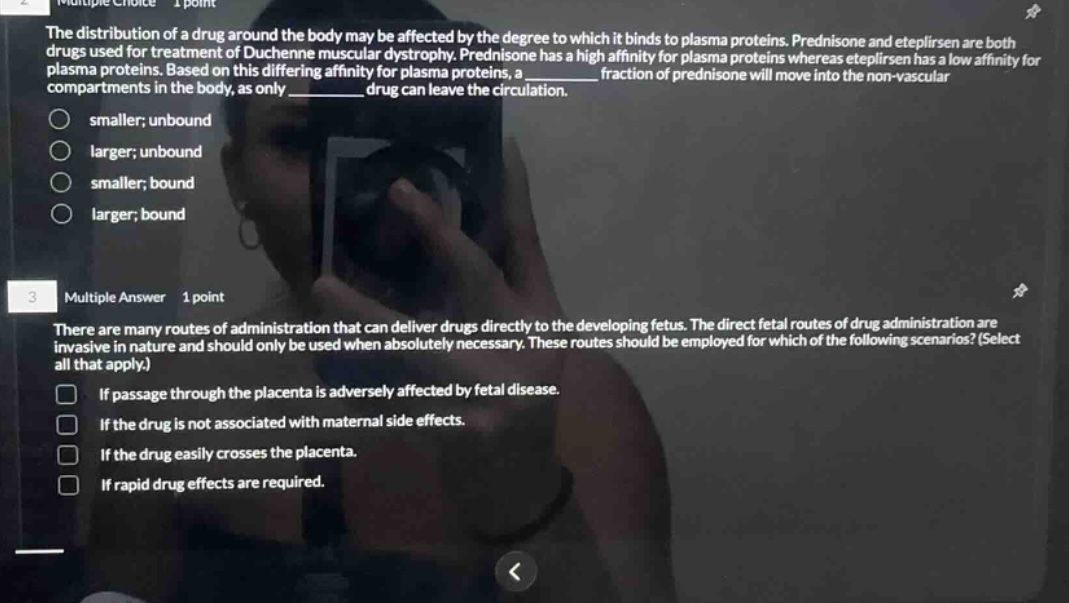
multiple choice 1 point the distribution of a drug around the body may be affected by the degree to which it binds to plasma proteins. prednisone and eteplirsen are both drugs used for treatment of duchenne muscular dystrophy. prednisone has a high affinity for plasma proteins whereas eteplirsen has a low affinity for plasma proteins. based on this differing affinity for plasma proteins, a ____ fraction of prednisone will move into the non - vascular compartments in the body, as only ____ drug can leave the circulation. smaller; unbound larger; unbound smaller; bound larger; bound multiple answer 1 point there are many routes of administration that can deliver drugs directly to the developing fetus. the direct fetal routes of drug administration are invasive in nature and should only be used when absolutely necessary. these routes should be employed for which of the following scenarios? (select all that apply.) if passage through the placenta is adversely affected by fetal disease. if the drug is not associated with maternal side effects. if the drug easily crosses the placenta. if rapid drug effects are required.
Question 2 (Multiple Choice)
- For drug distribution, drugs bound to plasma proteins are generally unable to leave the circulation, while unbound (free) drugs can.
- Prednisone has a high affinity for plasma proteins, meaning a smaller fraction of it is unbound. But wait, no—wait, the question is about moving into non - vascular compartments. Since only unbound drug can leave circulation, and prednisone has high affinity (so more bound, less unbound? Wait, no, let's re - think. If a drug has high affinity for plasma proteins, most of it is bound. But to move into non - vascular compartments, the drug needs to be unbound. Wait, no, the first blank: prednisone has high affinity for plasma proteins, so the fraction that can move into non - vascular compartments (where it's not in circulation) would be smaller? No, wait, no—wait, eteplirsen has low affinity, so more of it is unbound. But for prednisone: high affinity means most is bound, so the fraction that is unbound (and can leave circulation) is smaller? Wait, no, the question is "a ____ fraction of prednisone will move into the non - vascular compartments, as only ____ drug can leave the circulation."
Only unbound drug can leave circulation. Prednisone has high affinity for plasma proteins, so the amount of unbound prednisone is small. Therefore, the fraction of prednisone that moves into non - vascular compartments (since only unbound can move) is smaller? Wait, no, that doesn't make sense. Wait, maybe I got it backwards. Wait, if a drug has high affinity for plasma proteins, it's mostly bound. Bound drugs can't leave circulation. So the fraction of the drug that can move into non - vascular compartments (unbound) is small. And only unbound drug can leave circulation. So the first blank: smaller? No, wait, no—wait, let's take an example. Suppose Drug A (prednisone) has high affinity: 90% bound, 10% unbound. Drug B (eteplirsen) has low affinity: 10% bound, 90% unbound. To move into non - vascular compartments, the drug has to be unbound. So for prednisone, the fraction that moves into non - vascular compartments is the unbound fraction, which is small (10%), so a smaller fraction? But the second blank is unbound, because only unbound drug can leave circulation. Wait, but the options: "smaller; unbound" or "larger; unbound"? Wait, no, I think I made a mistake. Wait, the key is: drugs bound to plasma proteins are trapped in the vascular compartment (circulation). Only unbound drugs can diffuse out into non - vascular compartments. Prednisone has high affinity for plasma proteins, so most of it is bound. So the fraction of prednisone that is unbound (and can move into non - vascular compartments) is small. So the first blank is "smaller", the second is "unbound". Wait, but let's check the options. The options are:
- smaller; unbound
- larger; unbound
- smaller; bound
- larger; bound
Since only unbound drug can leave circulation, the second blank must be "unbound". Now, for the first blank: prednisone has high affinity, so the fraction that is unbound (and can move into non - vascular) is smaller than a drug with low affinity (like eteplirsen). So the correct option is "smaller; unbound"? Wait, no, wait, maybe I got it wrong. Wait, if a drug has high affinity for plasma proteins, it's mostly bound. So the amount of drug that can leave circulation (unbound) is small. So the fraction of prednisone that moves into non - vascular compartments is smaller, and only unbound drug can leave. So the correct option is "smaller; unbound"? Wait, no, wait, let's re - read the question: "Prednisone has a high affinity…
- Option 1: If passage through the placenta is adversely affected by fetal disease.
- If the placenta can't effectively transfer the drug due to fetal disease, direct fetal drug administration (invasive) may be necessary to get the drug to the fetus.
- Option 2: If the drug is not associated with maternal side effects.
- The invasiveness of direct fetal routes is a major concern, and maternal side effects (or lack thereof) do not justify using an invasive direct fetal route. The route is chosen based on fetal needs, not maternal side effects. So this is incorrect.
- Option 3: If the drug easily crosses the placenta.
- If the drug easily crosses the placenta, there is no need for an invasive direct fetal route, as the drug can reach the fetus via the placenta. So this is incorrect.
- Option 4: If rapid drug effects are required.
- Invasive direct fetal routes can deliver the drug directly to the fetus, which can result in rapid drug effects. This is a valid scenario for using these invasive routes.

Snap & solve any problem in the app
Get step-by-step solutions on Sovi AI
Photo-based solutions with guided steps
Explore more problems and detailed explanations
A. smaller; unbound